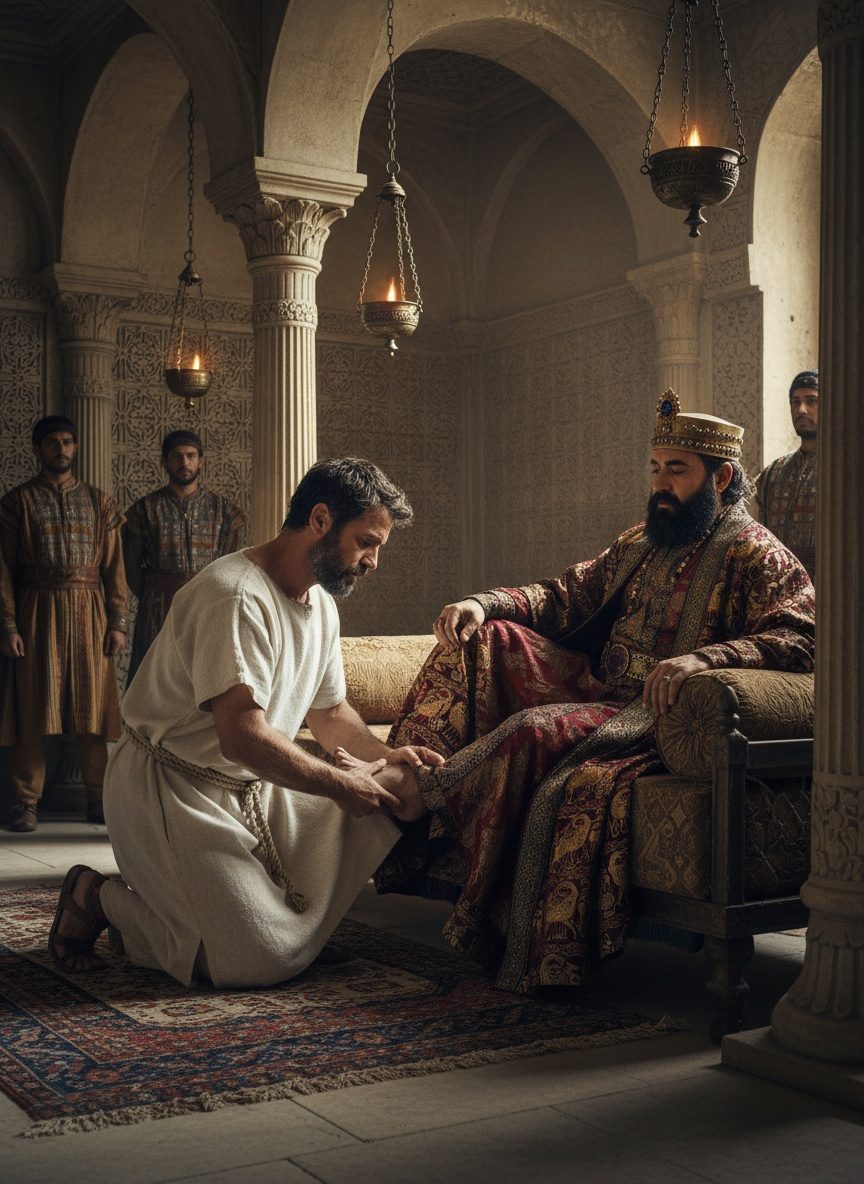
In the heart of the sprawling Persian Empire, amid gold-leafed palaces and bustling marketplaces, lay a shadowy dungeon. Inside, a Greek physician named Democedes sat, his fate tied to the whims of his captors. His brilliant mind was shackled by iron, yet it was to this very captive that history turned its eyes — the subject of an audacious tale of healing, diplomacy, and an unexpected bid for freedom.
The Fall of a King
The year was 522 BC, and the Persian Empire under King Darius the Great stretched from the rugged peaks of the Hindu Kush to the verdant valleys along the Nile. Darius, a ruler with an iron will and an unquenchable ambition, was as accustomed to victory as the swift rivers that cut through his lands. But a misstep changed everything. A fall from his horse left him with a grievous injury to his ankle, shrouded in agony and leaving him unable to stand.
The palace, a marvel of ancient engineering in what is today southwestern Iran, echoed with hushed whispers. The Persian court’s elite physicians, seasoned and skilled, huddled around their sovereign. Yet despite their expertise, the king's pain remained unyielding, as relentless as the Persian sun.
It was within these opulent halls that a beacon of hope emerged — a prisoner's name whispered through the corridors like a secret: Democedes of Croton.
A Greek in Chains
Democedes was no ordinary healer. Born in Croton, a Greek city in what is now southern Italy, his reputation as a physician of unmatched skill preceded him. But fate had cast him adrift. Captured and enslaved by the Persians, his life was an uncomfortable paradox — a lauded healer whose hands were bound by iron.
Yet, even amidst captivity, Democedes had managed to maintain his expertise, a fact known only to a few within the Persian elite. His talents had elevated him to the status of a prized possession, a rare jewel in Darius's vast empire. He lingered on the margins of power, his knowledge a silent ally of necessity.
When the king's suffering persisted, it became evident that conventional methods would not suffice. Desperation will often open doors that fortitude keeps shut. Democedes was called forth, a glimmer of salvation shimmering amid the desperation.
The Healing Touch
Dragged from his dark confinement into the light of the Persian court, Democedes faced an emperor in pain. Under the scrutinizing gaze of the assembled nobility and enslaved alike, he set to work. His command of medicine was as precise as it was unconventional, blending herbs, oils, and massages — a symphony of healing unmatched by the court's physicians. Within days, the severity of Darius's pain diminished, the swelling abated.
The gratitude of an emperor can alter destinies. Darius, a man known for his formidable presence both in heart and in wrath, recognized the delicate miracle achieved by Democedes. But Democedes was no supplicant — he was a man with a wish, a desire that transcended the opulence surrounding him.
The Audacious Request
“Send me home,” Democedes petitioned, his voice carrying the earnestness of a man who had sewn his dreams into the fabric of his request. His home, the very thought of returning to Croton, shimmered like a beacon in the dark.
The court, taken aback, recoiled at the audacity of such a plea from a mere slave. But Darius, perhaps swayed by his gratitude or the sharp intellect that knew the value of a debt well paid, considered the request. Yet, a direct release was impossible — the prestige of possessing such a healer was a testament to Persian supremacy.
Thus, in a negotiation both cunning and remarkable, Darius agreed to send Democedes, under guard, as part of an exploratory mission to Greece. In a moment that embodied the cunning diplomacy of ancient empires, the request was granted — not in the form Democedes had imagined but with a new horizon nonetheless.
The Uncharted Voyage
Democedes's journey back to the Greek world was both a personal odyssey and a geopolitical maneuver. Accompanied by Persian delegates, it served dual purposes: a reconnaissance mission under the guise of granting the healer his desires. Touching the coasts of the Aegean and navigating the labyrinth of Greek city-states, the entourage witnessed cultures both kindred and alien.
Yet, Democedes carried a cunning parallel to his skill — the determination to seize his freedom. Arriving at Tarentum, near his homeland, he eluded his escort, slipping into the embrace of freedom with the alacrity of a sailor borne upon a fair wind. Despite the King's emissaries earning wrath, Darius, perhaps admiring of the Greek's daring, made no further attempt to reclaim him.
In a twist of historical poignancy, Democedes vanished into the annals of obscurity, his tale surviving through the words of Herodotus and the echoes of those who marveled at his boldness. His legacy was not one of recorded deeds but of inspiring an age with the brilliant spark of intelligence intertwined with the hunger for liberty.
A Legacy of Freedom
Democedes's story, a confluence of fate, courage, and intellectual prowess, invites reflection beyond its ancient roots. It speaks to the timeless struggle for autonomy, the yearning that defines the human spirit. In a world where knowledge often lay in the hands of a privileged few, Democedes's quiet act of rebellion illuminates the power of intellect as a tool of emancipation.
As we examine the intricate tapestry of history, the tale of Democedes serves as a reminder: the past holds stories of quiet defiance, of voices rising from the shadows to alter destinies. In his hands, a singular act of healing transcended medicine, becoming a universal testament to the indomitable will to live free.