513 BC. The chill wind leapt over the waters of the Bosphorus, nipping at the edges of the tents pitched along the shoreline.
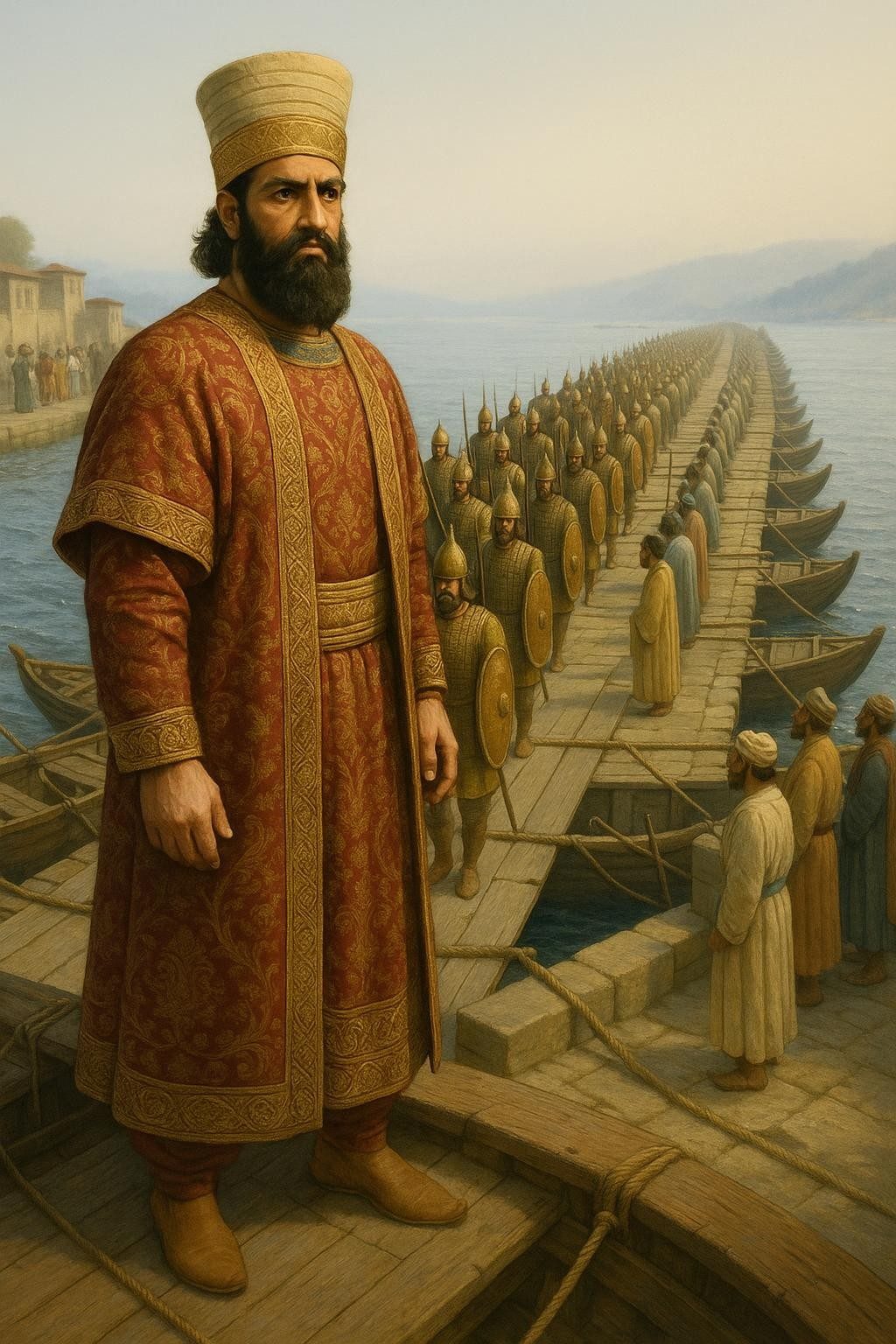
The Persian King Darius I stood poised at the edge of Europe, a land that seemed vast and unconquerable. Yet, what lay before him was not just another campaign. It was a testament to human ambition and ingenuity. A challenge presented itself: two continents separated by a stretch of treacherous waters. The crossing of the Bosphorus was more than a logistical obstacle; it was a daring feat that required not only military might but also the brilliance of Persian engineering. In the early dawn light, shimmering like a serpent, an extraordinary sight slowly came into view — a bridge of boats strung across the water’s expanse, an audacious creation by the hand of man.
The plan was as audacious as it was simple: lash together 700 ships, side by side, to form a passage over the ever-shifting waves. With rope, timber, and an unwavering will, they spanned the tumultuous strait that had long been nature’s boundary between Asia and Europe. The ships, pressed into service not as vessels but as floating piers, bobbed gently on the water, their decks aligned to allow the incessant parade of soldiers to trample across, creating a hum of footsteps over the murmurs of the undulating sea.
The Bosphorus, long seen as an insurmountable divide, stood conquered — not by brute force, but by the sheer brilliance of tactical planning. This bridge of boats was a masterpiece of ancient military engineering, a reflection of the perspicacity for which Darius himself was celebrated. The Persian Empire, under his rule, had transcended boundaries and limitations, both geographical and logistical. With the crossing, Darius was not simply venturing into new territories; he was stretching the very limits of what was possible for a king to achieve.
The scale of the operation was daunting. An army of hundreds of thousands waited, their fate tied to the success of the crossing. From the high ridges overlooking the water, the ranks of infantry and cavalry stretched as far back as the eye could see, a river of human determination and ambition. The sun rose higher, casting its golden light on the men of different tongues and origins brought together under the Persian banner. They bore witness to their king's boldness, and their resolve was steeled by the audacity of the task before them.
But what propelled Darius to undertake such an ambitious endeavor? A ruler blessed with a combination of foresight and absolute power, he envisaged not only a bridge across the water but an unyielding connection between worlds. His gaze was fixed on the vast lands beyond, ripe for conquest and unification under the vast Persian cloak. Darius understood that the physical crossing would be as symbolic as it was strategic, asserting Persian influence where the old boundaries once stood untouchable.
As the army began its crossing, the scene was a compelling mix of grandeur and precariousness. Spears glinted in the early morning light, their sharp points drawing faint lines across the sky. The horses, experienced and unyielding, followed the path of their human counterparts, their hooves clipping rhythmically on the wooden surfaces below. A tapestry of sounds enveloped the area, from the sharp commands of officers to the rhythmic dapple of water against wood and the creaking timbers adapting to the weight of thousands.
This crossing was more than a military maneuver; it was a unique conjunction of human intellect and nature's challenge, where the line between genius and folly was drawn taut. Ancient sources rarely agreed on the precise numbers or details, but they unanimously attested to the overwhelming sense of awe that accompanied this Herculean undertaking. It was a moment that melded fable with fact, the individualized stories of the thousands intertwining like the ropes that held their path aloft over the sea.
Yet, history teaches us that every audacious plan carries its inherent risks. The dangers lay not just in the waters below but in the human heart—the uncertainty sown by the sway of the boats, the vulnerability of being suspended between elements. When Darius’ soldiers set their feet upon Europe, they stood upon the very brink between security and vulnerability, an illustration that even the mightiest empire could broker its fate with the world’s chaos and nature’s caprice.
The tales of what followed this crossing are interspersed with both triumph and hardship. The campaign that pressed into Europe etched itself into the complex tapestry of history as a testament to bold expansionism. But the true victory lay in the idea — the palpable sense that such a task was within grasp. The venture was as much about the audacity to defy the natural order as it was about military conquest. Here, Darius had orchestrated a symphony where nature became the overture, and human resolve the crescendo.
In this passage over the Bosphorus, Darius immortalized the spirit of ambition that transcends ages, an echo of humankind's eternal quest to redefine the realms of possibility. His bridge of boats may have long since vanished into the depths of history's river, but its legacy lingers. The Bosphorus today still flows between the two vibrant currents of culture, economy, and life, bridging gaps that once seemed insurmountable, much like Darius’ ephemeral walkway of wooden vessels.
In remembering the man who crossed the silver strait over a bridge he dared to conjure, we glimpse the essence of an indomitable will and a vision that reaches beyond horizons. This story is not merely one of ships and soldiers; it is a mirror in which to see our own reflection, questioning what bold leaps we might take when confronted by the vast waters of the unknown. Darius I didn't just bridge two lands; he bridged the perpetual divide between a mere vision and the manifestation of greatness.