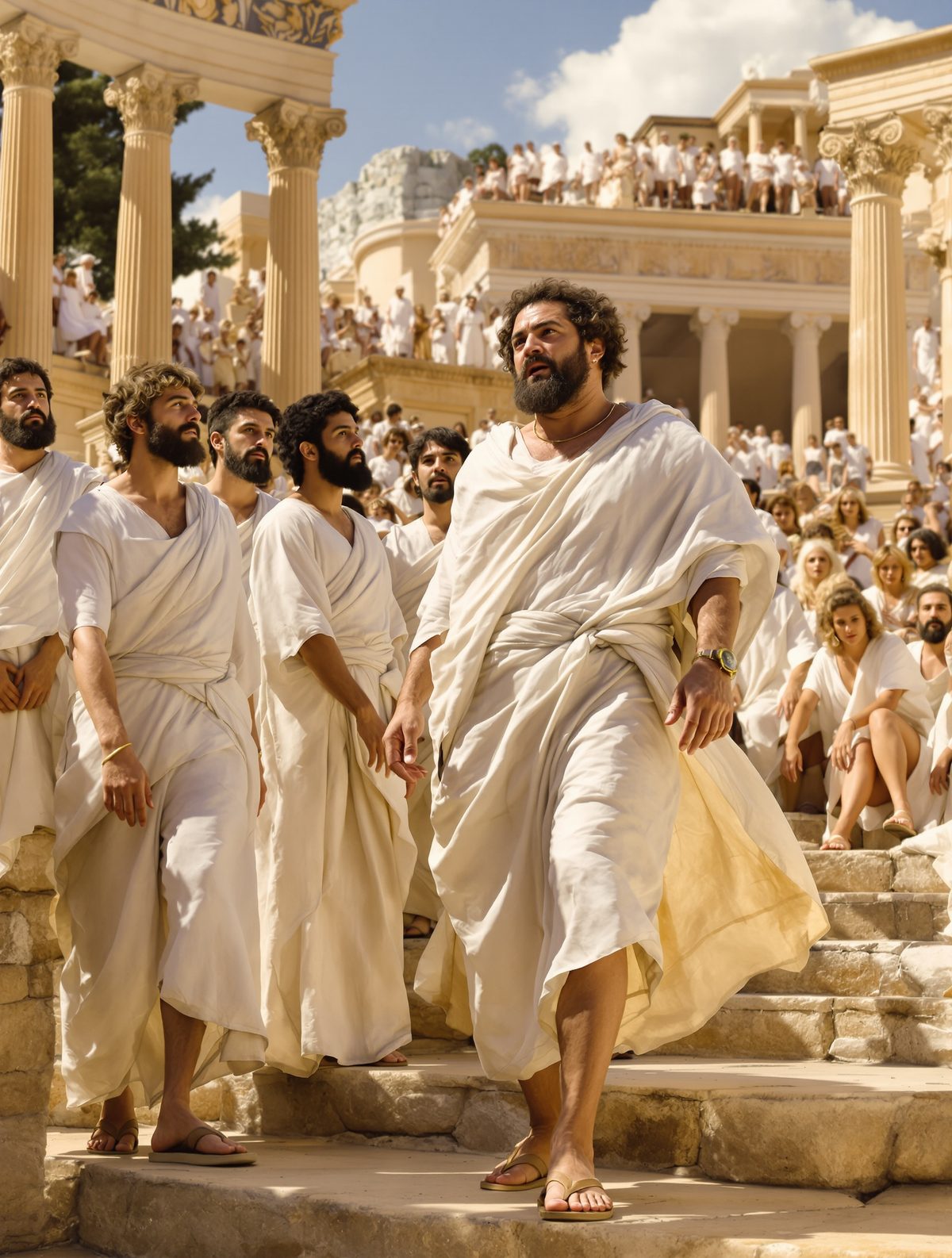
The messenger's hands trembled as he delivered Queen Tomyris's response to the most powerful man on Earth. Cyrus the Great, ruler of the vast Persian Empire, had just proposed marriage to the nomadic queen—not out of love, but as a transparent attempt to seize her lands without a fight. Her reply was swift and brutal: "Rule your own people, and try to bear the sight of me ruling mine... But of course you will not take this advice, since peace is the last thing you desire."
Then came the words that would seal the fate of history's greatest conqueror: "If you are so eager to try your strength against the Massagetae, abandon this laborious business of bridge-building. Withdraw your forces three days' march from the river, and I will do the same. Then we can fight on equal terms. Or if you prefer to meet us on your side of the water, do you withdraw." The message concluded with a chilling prophecy: "You will have your fill of blood."
It was 530 BC, and Cyrus the Great had never lost a battle in three decades of warfare. He had built the largest empire the world had ever seen, stretching from India to the Mediterranean. But somewhere in the windswept steppes of Central Asia, a nomadic queen was about to teach him that some opponents fight by different rules entirely.
The Conqueror Who Never Knew Defeat
By 530 BC, Cyrus II of Persia had achieved what no man before him had accomplished. His empire sprawled across 2 million square miles, governing roughly 44% of the world's population. He had toppled the mighty Lydian Empire, conquered Babylon without a siege, and liberated the Jewish exiles—earning him the unprecedented title of "messiah" in the Hebrew Bible. The Cyrus Cylinder, often called the first charter of human rights, proclaimed his philosophy of ruling through tolerance rather than terror.
But Cyrus was not content. At 70 years old, most kings would have been consolidating their gains and preparing succession plans. Instead, Cyrus looked northeast, toward the vast steppes beyond the Jaxartes River (modern-day Syr Darya), where nomadic tribes roamed freely across lands that had never bent the knee to any empire.
The target of his ambition was the Massagetae, a confederation of Saka nomads whose name literally meant "Great Getae." These weren't the settled, city-dwelling peoples Cyrus was accustomed to conquering. They were horse warriors who lived in felt tents, drank mare's milk, and could shoot arrows with deadly accuracy while riding at full gallop. To Cyrus, they seemed like easy prey—scattered tribes with no fortified cities, no organized army, and no apparent unity.
He could not have been more wrong.
The Queen Who Would Not Bow
Queen Tomyris ruled the Massagetae with an iron will that had been forged by a lifetime on the steppes. Her name, derived from the Scythian word for "brave," proved prophetic. Classical sources describe her as a ruler who commanded not through birthright but through respect earned in battle—a woman who could outride and outfight most of her warriors.
The Massagetae practiced customs that would have seemed alien to civilized Persians. They worshipped only the sun god and considered it the height of honor to die in battle. Their elderly, rather than dying of disease, would be killed and eaten by their families—a practice that horrified Greek historians but reflected their belief that a warrior's strength could be absorbed through consumption.
When Cyrus's marriage proposal arrived, Tomyris saw through it immediately. This wasn't diplomacy; it was conquest disguised as romance. Her rejection wasn't just personal—it was a declaration that the Massagetae would never submit to Persian rule, no matter how vast Cyrus's empire had become.
What happened next revealed the fundamental difference between these two rulers. Cyrus, accustomed to the chess-like maneuvers of civilized warfare, began constructing a massive bridge across the Jaxartes River. Tomyris, understanding that her people's survival depended on mobility and knowledge of the terrain, offered him a choice that was really an ultimatum: fight on equal ground, or face her people on their own territory.
The Trap in the Desert
Cyrus chose to cross the river, bringing his army deep into Massagetae territory. It was here that his military genius, honed through decades of conventional warfare, would prove inadequate against an enemy who fought like phantoms.
The Persian army that crossed into the steppes was a marvel of ancient military engineering. Herodotus estimated its size at 200,000 men, though modern historians suggest it was likely smaller—perhaps 50,000 to 80,000 troops. These included the elite Immortals, heavy cavalry, and siege engineers who had broken the walls of Babylon. They brought supplies for a quick campaign, expecting to face an enemy that would either flee or be crushed in a single decisive battle.
Cyrus's initial strategy seemed to work perfectly. Using wine as bait—a substance unknown to the Massagetae, who drank only water and milk—the Persians set a trap. They abandoned a camp filled with wine and food, then withdrew. A large force of Massagetae, led by Tomyris's son Spargapises, discovered the camp and feasted. Unused to alcohol, they quickly became drunk and helpless.
The Persians returned to find their enemies incapacitated. They captured Spargapises and thousands of his warriors in what seemed like a brilliant tactical victory. Cyrus sent word to Tomyris that he would release her son in exchange for her submission.
The queen's response was swift and terrible. In a message that has echoed through history, she wrote: "Bloodthirsty Cyrus, do not be uplifted by this thing that has happened—that with this fruit of the vine, whereof you fill yourselves and rage so that as the wine descends into your bodies, ill words rise up in you—with such a drug you have overcome my child by treachery and not by strength and fighting."
A Mother's Fury Unleashed
What happened next demonstrated why underestimating a grieving mother—especially one who commanded an army—was a fatal mistake. Spargapises, upon sobering up and realizing he had been captured through trickery rather than honorable defeat, begged Cyrus to remove his chains. The moment he was freed, the young prince took his own life rather than live with the shame of capture.
When news reached Tomyris, her grief transformed into something far more dangerous: calculated rage. She sent one final message to Cyrus: "Now choose. Withdraw from this land unharmed, content with your triumph over a third of the Massagetae, or stay, and I swear by the sun that for all your insatiable thirst, I will give you your fill of blood."
Cyrus, perhaps blinded by his previous easy victory, chose to stay and fight. It was the last decision he would ever make.
The final battle took place somewhere in the steppes of modern-day Kazakhstan, though its exact location remains lost to history. Unlike previous Persian victories against organized armies that fought in formation, this battle was chaos incarnate. The Massagetae struck like a whirlwind, their horse archers firing clouds of arrows before melting away into the grasslands, only to reappear from another direction.
Herodotus described it as "the fiercest battle between non-Greeks that has ever been fought." The Massagetae, fighting for their homeland and their murdered prince, showed no mercy. They had adapted their tactics specifically to counter Persian strengths, using their superior mobility to negate the advantage of heavy infantry and turning the vast steppes into a killing ground.
The Death of a Legend
When the dust settled, Cyrus the Great lay dead among his soldiers. The man who had never lost a battle had finally met his match in the form of an enemy he had dismissed as primitive nomads. According to Herodotus, Queen Tomyris found his body among the Persian dead and fulfilled her promise in the most literal way possible—she filled a wineskin with blood and thrust Cyrus's severed head into it, declaring: "As I threatened, I give you your fill of blood."
The psychological impact of this gesture cannot be overstated. In the ancient world, proper burial was essential for the afterlife. By desecrating Cyrus's remains, Tomyris was sending a message that would resonate across the known world: the Persians were not invincible, and their expansion had limits.
News of Cyrus's death sent shockwaves throughout the Persian Empire. The army that limped back across the Jaxartes was a fraction of the force that had crossed with such confidence. More importantly, the aura of Persian invincibility—the psychological weapon that had often secured victories before battles were even fought—was shattered.
The Legacy of a Final Stand
Tomyris's victory over Cyrus represents more than just a military triumph; it was a collision between two entirely different ways of understanding power and civilization. Cyrus had built his empire on the principle that superior organization, technology, and numbers would always defeat what he saw as primitive tribal societies. Tomyris proved that intimate knowledge of terrain, adaptive tactics, and unbreakable will could overcome even the mightiest empire.
The defeat had immediate consequences for Persian expansion. Future Persian rulers would be far more cautious about campaigns against steppe nomads, recognizing that these societies possessed military capabilities that conventional armies struggled to counter. The pattern would repeat throughout history: from the Huns who terrorized Rome to the Mongols who conquered much of the known world, nomadic societies repeatedly proved that mobility and adaptability could triumph over seemingly superior forces.
Perhaps most remarkably, Tomyris achieved something that would resonate through the ages—she demonstrated that resistance to imperial expansion was possible, even against overwhelming odds. Her victory inspired countless other peoples to resist Persian rule, contributing to the eventual decline of Achaemenid power.
Today, in an era where technological and economic superiority are often seen as guarantees of success, the story of Cyrus and Tomyris offers a sobering reminder. Underestimating opponents, dismissing different ways of life as primitive, and assuming that past victories guarantee future success can lead to catastrophic miscalculations. Sometimes the greatest empires fall not to equals, but to those they never bothered to understand.