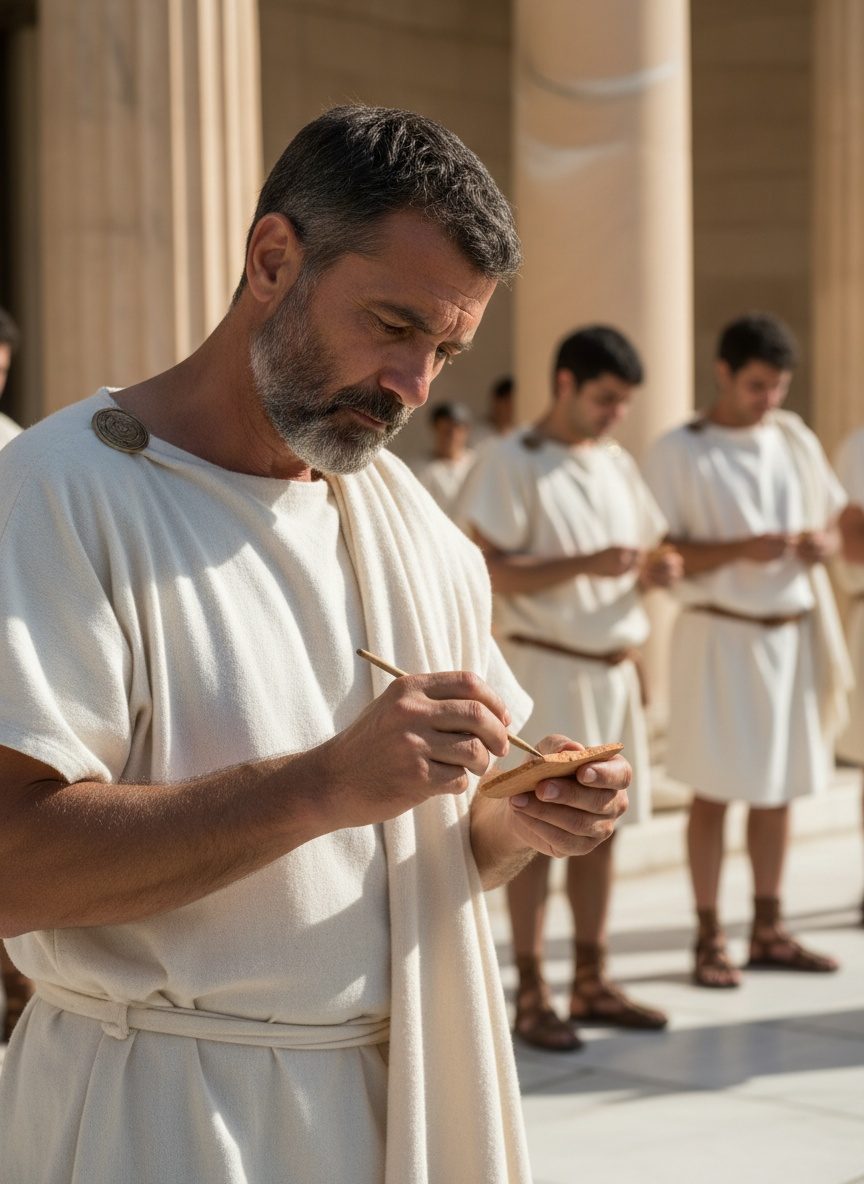
482 BCE. The sun hung low over the dusty streets of Athens as citizens bustled towards the Agora, their sandals kicking up fine clouds of ochre dust. A city known for its wisdom and bravery stood at the crossroads of justice and power.
The Ostracism: A Shield Against Tyranny
The ostracism. It was a curious, barbaric ritual by modern standards, yet a sophisticated safeguard against tyranny in ancient Athens. Introduced in the early years of democracy, it allowed citizens to cast their votes in the form of scratched names on broken shards of pottery, known as ostraka. Those whose names rose to infamy risked a ten-year exile — a banishment that aimed not to punish but to preserve liberty.
In practice, ostracism was an annual democratic safety valve, a means to defuse political tensions without bloodshed. Each year, Athenians gathered to decide who might become a threat to the city’s fragile political balance. It was not enough to appeal to popularity or public service records; it was the looming shadow of potential power that drew names on clay.
Aristides: Justice Incarnated
Among the eminent men of Athens, Aristides was unlike any other. Known as "The Just," his life was a testament to integrity. His reputation was built not on flamboyant speeches or outlandish bravado, but on decisions steeped in fairness and actions devoid of self-interest. His title was no mere embellishment; it was a reflection of his very nature.
Yet in 482 BCE, Aristides found himself at the mercy of the very system he served so dutifully. As the political landscape shifted, Athens found itself embroiled in a debate over naval expansion. Themistocles, his political rival, argued passionately for a larger fleet to counter the looming Persian threat. Aristides, cautious as ever, counselled against magnifying military might at the expense of civic virtue. Two visions for Athens clashed, and Aristides became a target.
A Stranger in the Crowd
On that fateful day, the Athenian Agora buzzed with the murmurs of deliberation. Citizens clutched their pottery shards, their voices a symphony of apprehension and resolve. Aristides, amidst the throng, embodied serenity. Anonymity was impossible for a man of his stature, yet he walked as unobtrusively as he could through the crowd, contemplating the whims of fate.
It was then that a stranger, unfamiliar and perhaps dispassionate, approached him. With a gesture, he extended his shard to Aristides, requesting assistance. The Athenian spoke a name — "Aristides" — not realizing he addressed the man himself. There was no visible sign of dismay or indignation on Aristides’ face; instead, he simply took the shard, etched his own name upon it, and returned it. In this moment, his commitment to the democratic process outweighed personal pride or affront.
The Quiet Resolve of a Statesman
As the shards accumulated into mounds at the center of the Agora, they represented both the will and wariness of the people. The echoes of scratching pottery mingled with the rustle of tunics and the occasional call of a vendor still hopeful to make a sale. Aristides’ name emerged, an ominous chorus that confirmed the inevitable: banishment.
Aristides received the news without protest or rancor. For him, justice was a principle to be upheld with dignity. His acceptance of exile was less an act of defeat than a reaffirmation of his belief in the greater good. He removed himself from the complex interplay of power dynamics that threatened to consume Athenian democracy.
A Legacy Etched in Clay
The tale of Aristides serves as a profound reminder that the mechanisms of democracy, while imperfect, demand a critical balance between individual virtues and collective action. In this story of ostracism, one sees the inevitable clash between principle and politics, where even the most righteous can be swept aside by the tide of fear and ambition.
Today, as societies grapple with the tension between personal freedoms and societal well-being, the story of Aristides resonates. It asks whether justice should be subject to the fickle tides of public opinion or remain an unwavering beacon. His silent acquiescence and unwavering commitment to democratic ideals invite reflection on the very nature of justice in our own tumultuous times.