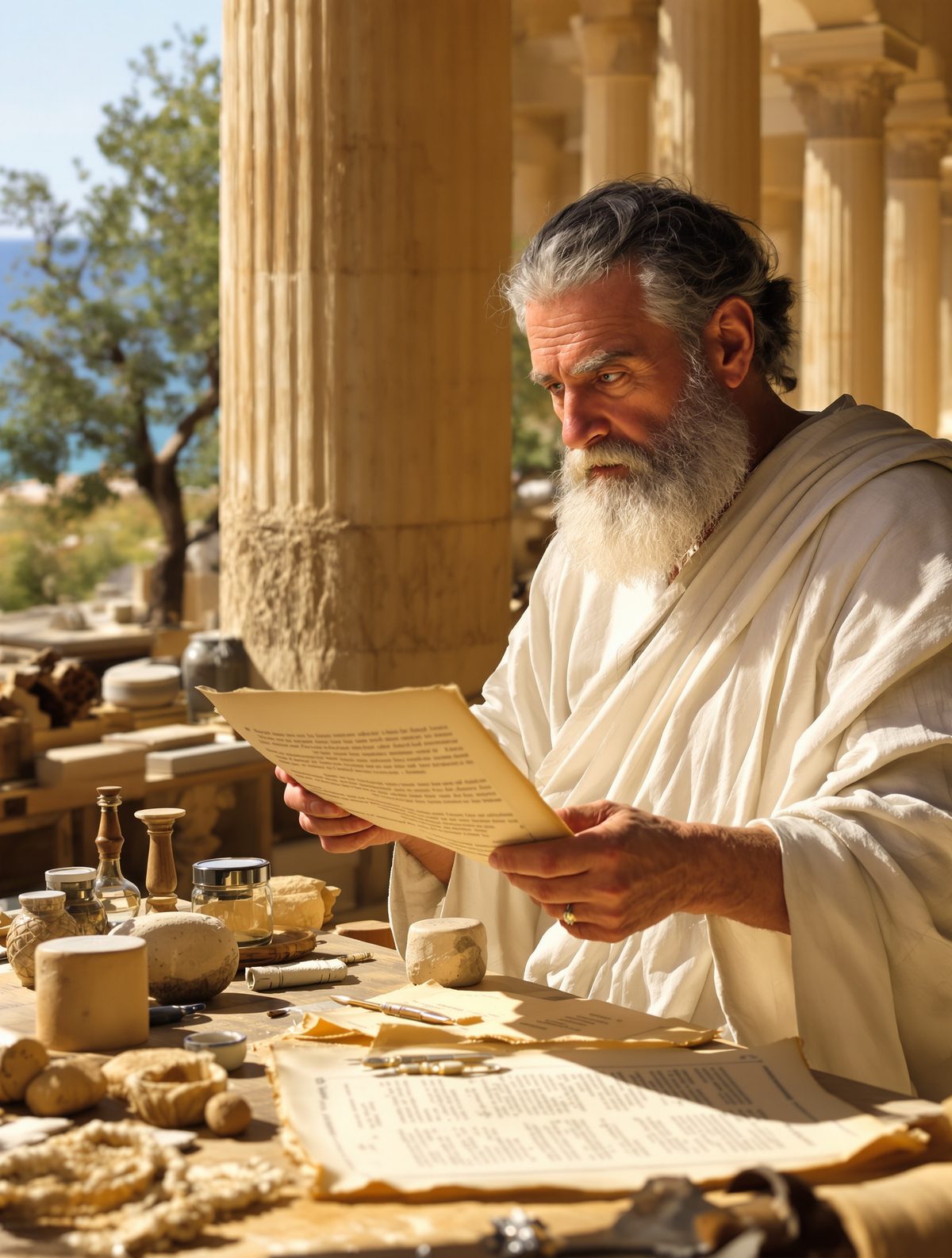
Picture this: A 60-year-old mathematician slides into his bronze bathtub in ancient Syracuse, Sicily. The warm water sloshes over the rim, pooling on the mosaic floor below. Most people would curse the mess. But Archimedes of Syracuse—one of history's greatest minds—sees something extraordinary in those simple ripples. In an instant, the solution to a problem that has plagued him for weeks crystallizes in his mind. What happens next becomes one of history's most famous moments: a naked genius sprinting through the streets of a Greek city-state, shouting at the top of his lungs.
The year was approximately 246 BC, and that moment of bathtub brilliance wouldn't just solve a royal mystery—it would lay the foundation for modern physics, engineering, and scientific method itself.
The Golden Crown Mystery That Started It All
Our story begins not with mathematics, but with politics, paranoia, and precious metal. King Hiero II of Syracuse, Archimedes' close friend and possibly his cousin, had commissioned a magnificent golden crown from a local craftsman. The king provided pure gold for the project, but when the finished crown arrived, something felt wrong.
The crown weighed exactly the same as the gold originally provided—but Hiero suspected the craftsman had pocketed some of the pure gold and mixed in cheaper silver to make up the weight. It was the perfect crime, if true. How could anyone prove theft when the weight remained identical?
In an age before precise chemical analysis, this seemed impossible to determine without melting down the crown—which would destroy the very object in question. Hiero turned to the smartest person he knew: his court mathematician, Archimedes. "Find out if I've been cheated," the king commanded, "but don't damage the crown."
For weeks, Archimedes wrestled with the problem. He knew that silver was less dense than gold, meaning that if the crown contained silver, it would need to be slightly larger than a pure gold crown of the same weight. But measuring the volume of an irregularly shaped crown seemed impossible with the crude measuring tools of the 3rd century BC.
The Bath That Changed Science Forever
On that fateful day in 246 BC, Archimedes headed to the public baths—a daily ritual in Greek society. These weren't the marble palaces of Roman bathhouses that would come centuries later, but they were still impressive structures with bronze tubs and sophisticated heating systems.
As Archimedes lowered himself into the tub, he noticed something every bather had seen countless times before: the water level rose. But unlike everyone else, Archimedes' mathematical mind made a connection that would echo through history. The volume of water displaced must equal exactly the volume of his submerged body.
In that instant, the solution hit him like a thunderbolt. He could measure the volume of the irregularly shaped crown by submerging it in water and measuring the displacement! If the crown displaced more water than an equal weight of pure gold, it contained cheaper, less dense metals.
What happened next shocked even the bath attendants who had seen plenty of eccentric behavior from Syracuse's intellectual elite. According to the Roman architect Vitruvius, who recorded this story decades later, Archimedes leaped from the tub without bothering to grab his clothes and ran naked through the streets shouting "Eureka! Eureka!"—Greek for "I have found it!"
A Naked Sprint Into Scientific History
Imagine the scene: a distinguished 60-year-old mathematician, dripping wet and completely nude, racing through the narrow stone streets of Syracuse. Citizens diving out of the way, vendors dropping their wares, children pointing and laughing. The sight of a naked philosopher wasn't entirely shocking in Greek culture—gymnasiums and athletic competitions celebrated the human form—but this was different. This was a man possessed by an idea.
Archimedes' route likely took him from the public baths near the harbor, up through the residential quarter where wealthy Greeks lived in houses decorated with elaborate frescoes, past the bustling agora where merchants sold everything from Egyptian papyrus to Spanish silver, and finally to either his own workshop or the royal palace where King Hiero waited.
The Greek word "eureka" that Archimedes shouted has become perhaps the most famous scientific exclamation in history. But here's something they didn't teach you in school: this might never have actually happened. The only source for the naked run is Vitruvius, writing nearly 200 years later, and ancient historians weren't always sticklers for literal truth. They often embellished stories to make moral or philosophical points.
Whether Archimedes actually streaked through Syracuse or not, the discovery was real—and revolutionary.
The Genius Behind the Bathtub Revelation
To understand why this moment was so significant, you need to know who Archimedes really was. Born around 287 BC in Syracuse, he wasn't just a mathematician—he was the closest thing the ancient world had to a universal genius. He invented the Archimedes screw (still used for irrigation today), calculated pi more accurately than anyone before him, and created war machines so effective that Roman soldiers would flee at the sight of a rope emerging from Syracuse's walls, thinking it was another of Archimedes' contraptions.
But Archimedes considered himself a pure mathematician first. According to Plutarch, he was so absorbed in mathematical problems that he would forget to eat and had to be dragged to the baths by servants. He drew geometric figures in the ashes of the fire, traced them on his oiled skin, and was known to work on proofs while walking through the city.
The bathtub discovery—whether it involved public nudity or not—demonstrated Archimedes' greatest skill: seeing universal principles in everyday phenomena. What became known as Archimedes' Principle states that any object submerged in fluid experiences an upward buoyant force equal to the weight of the displaced fluid. This insight would later help engineers design ships, submarines, and countless other floating vessels.
The Crown's Verdict and Scientific Method
When Archimedes tested the crown using his displacement method, the results were damning. The crown displaced more water than an equal weight of pure gold, proving that the craftsman had indeed mixed in cheaper metals. King Hiero had been cheated, and the dishonest goldsmith faced the severe penalties that ancient rulers imposed on those who dared to steal from them.
But the real treasure wasn't catching a thief—it was the scientific method Archimedes had stumbled upon. He had moved from observation (water displacement) to hypothesis (volume measurement) to experimentation (testing the crown) to conclusion (proof of fraud). This systematic approach to solving problems would become the foundation of modern scientific inquiry.
What's remarkable is that Archimedes didn't just solve one problem—he created a tool for solving countless others. The principle of displacement would later help scientists understand everything from the density of planets to the behavior of gases under pressure.
Why a 2,200-Year-Old Bath Still Matters
Today, as we grapple with problems that would have seemed like magic to Archimedes—climate change, artificial intelligence, genetic engineering—his bathtub moment offers a timeless lesson. The greatest discoveries often come not from expensive laboratories or sophisticated equipment, but from a prepared mind observing the ordinary world with extraordinary attention.
Every time you see a ship floating on water, watch ice cubes bob in your drink, or marvel at a hot air balloon rising into the sky, you're witnessing Archimedes' principle in action. The same insight that struck a naked mathematician in ancient Syracuse still governs how we design everything from aircraft carriers to space stations.
Perhaps most importantly, Archimedes showed us that the boundary between practical problems and pure science is often artificial. He started with a political question—was the king being cheated?—and ended up discovering a fundamental law of physics. In our age of specialization, when we often separate theoretical research from applied engineering, Archimedes reminds us that the most profound insights often emerge when we blur those lines.
So the next time you slip into a bath and watch the water level rise, remember: you're witnessing the same phenomenon that launched a naked genius into the streets of Syracuse and changed the course of human knowledge forever. Sometimes the most ordinary moments contain extraordinary revelations—if we're prepared to see them.