December 1811. The jagged coastline of Lyme Regis braced against the crashing waves of the English Channel, framed by the steeply towering cliffs that held whispers of ancient secrets.
Unearthing the Unexpected
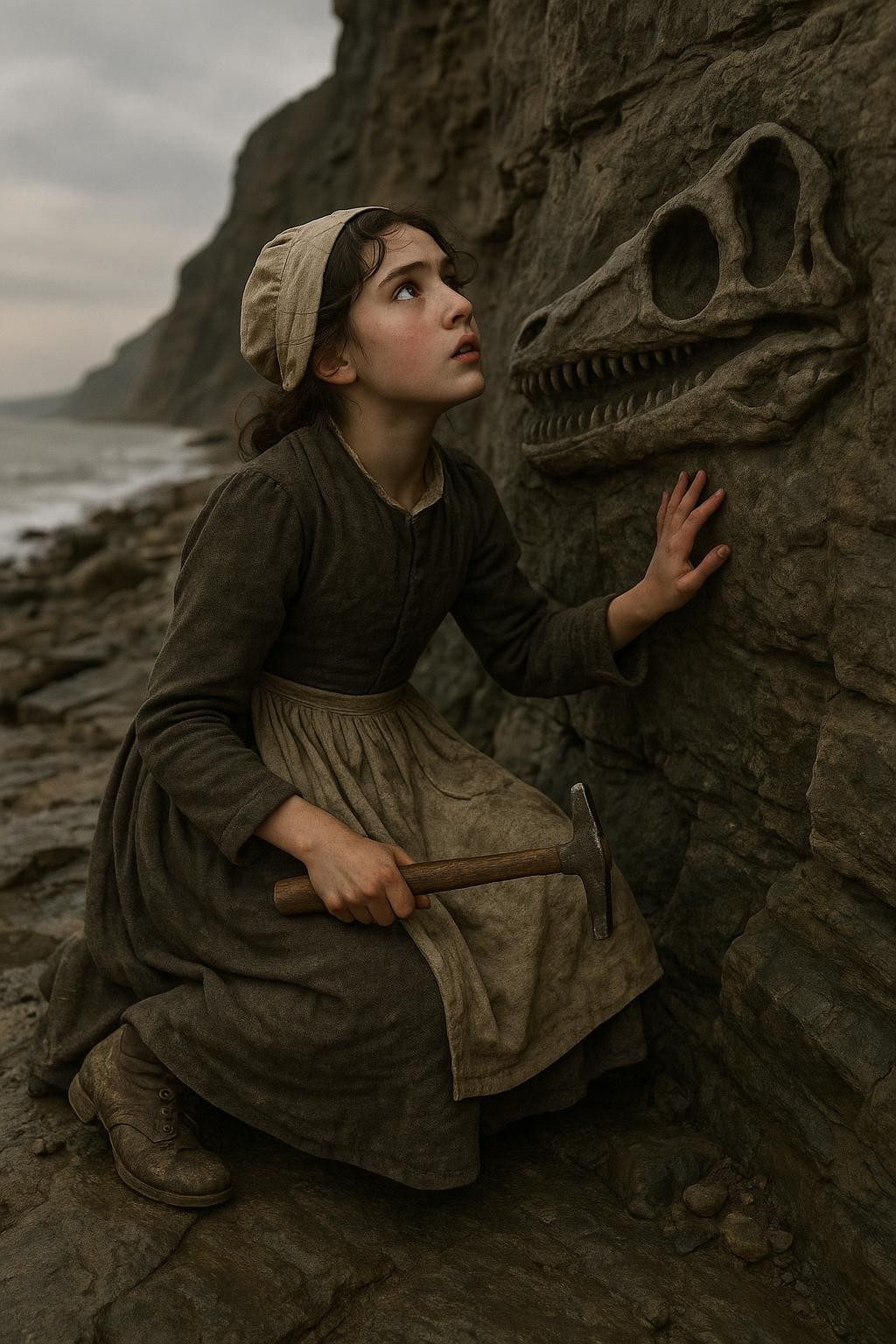
On that brisk winter day, a twelve-year-old girl named Mary Anning stood poised with her hammer in hand, her eyes scanning the friable cliff face. The air was cool and salty, a constant companion as she chipped away at the rock. It was a landscape she knew intimately; the rugged cliffs of Dorset were as familiar to her as the lines of her own hands. With every calculated strike, she edged closer to history.
Mary Anning's family had long relied on "curiosities" for their income, selling fossils to tourists in their small coastal town. While the locals referred to them as "Devil's Fingers" or "Snake Stones," the fossils were far more ancient than superstition could explain. Anning was particularly adept at her diligent work, and her keen eye for the unusual had already set her apart.
Then, on that day in December, her hammer struck something more resilient than the surrounding rock. Mary uncovered a large, reptilian skull with jaws that had lined teeth resembling those of a predatory fish—a discovery that would mark the start of something profound. Her young heart would have quickened with the thrill of discovery, yet she likely had no inkling of the enormity of what she had found. Holding the future in her trembling hands, Mary had made one of the first major finds of a new field of study that would become known as paleontology.
The Monster with No Name
The creature Mary had unearthed would soon be recognized as an ichthyosaur—a name combining the Greek words for fish (“ichthys”) and lizard (“sauros”). Yet, at the time of its discovery, no one could even classify it as a relic from an era millions of years old. The ancient world Mary had crashed into was still largely unknown to the scientific community and inconceivable to the general populace.
At over five feet long, the complete skeleton Mary extracted over many months was unprecedented. It was testament to her skill and patience, an extraordinary feat for anyone—let alone a child. Word of the find spread slowly at first, trickling across the minds of local scholars intrigued by such an oddity. But it would not be long before those outside Dorset took notice.
The scientific community of early 19th-century Britain was dominated by men, and its gates were not easily opened to a young girl from a working-class family. Yet, against a backdrop of societal limitations, her discovery eventually drew the attention of a burgeoning network of naturalists and geologists. They flocked to Lyme Regis, drawn by whispers of a remarkable beast that defied understanding.
While Mary’s find galvanized scientific discussion, it did not immediately secure her the recognition she deserved. Instead, gentlemen of science often claimed ownership of the knowledge her labor had unearthed. This was an age when science took the discoveries of outsiders, like Mary, as their foundation but rarely offered due credit.
A Reluctant Acknowledgment
It took time before Mary's contribution began to seep into academic discussions. The slow trickle of scientific acceptance eventually turned into a flood as more evidence piled up: these fossils weren't curiosities but rather vestiges of a long-lost world. The discovery of the ichthyosaur set the groundwork for challenging prevailing views about the Earth's past, paving the way for groundbreaking theories like Charles Darwin's subsequent work on evolution.
As for Mary, her reputation among fossil hunters and geologists continued to grow over the years. She was self-taught and yet astoundingly knowledgeable, frequently consulted by prominent figures seeking her insight on their fossil finds. Despite her lack of formal education, Anning demonstrated an innate understanding that rivaled any scholar.
In a world where her gender and social standing worked against her, Mary Anning's prowess became a quiet force in reshaping scientific thought. While she never saw her name enshrined in scientific papers during her lifetime, the impression she left on those who waded into the field of paleontology was indelible. Her farm began turning into a destination for those seeking not just fossils but enlightenment, even if she remained financially and publicly underappreciated for much of her life.
A Legacy in Stone
Mary Anning's childhood discovery has echoed across the annals of history, illustrating that wonder and scientific imagination can spring from the most unexpected places. Her story reminds us of the vast unknown, waiting patient beneath the earth's surface, awaiting the hands of a determined explorer. From her quarry of Jurassic stone, Mary extracted not just bones but the keys to a past that would redefine the history of life.
As modern scientists delve into the fossilized remains and explore the lost ecosystems of the Jurassic, Mary Anning remains a symbolic figurehead—an impassioned seeker of knowledge who eroded the bedrock of scientific convention with nothing more than grit, ingenuity, and a simple hammer. Her legacy challenges us to ponder the depth of potential within each curious mind, inspiring a new generation to probe the layers of time written in the rocks.