Roald Amundsen slept with his window open. Most of us would find that uncomfortable, but for Amundsen, discomfort was preparation.
Pioneering Principles: Preparation Meets Precision
At the dawn of the 20th century, the race to explore the poles captivated the imagination of explorers around the globe. And Roald Amundsen, a Norwegian with an undeterred spirit, was no different. Yet, Amundsen’s approach to this high-stakes pursuit was anything but ordinary. Unlike many of his contemporaries, he harbored an obsession with meticulous preparation and rigorous training.
Amundsen spent considerable time among the Inuit, learning the secrets of survival in extreme conditions. Here, he gained invaluable insights into clothing, navigation, and, most importantly, the use of sled dogs. While others might take such observations lightly, Amundsen regarded them as cornerstone lessons for his polar ambitions. He didn't merely borrow techniques; he dissected them, understanding how they could be adapted, improved, and weaponized in his quest for the South Pole.
His choice to sleep with his window open, even in the severest Norwegian winters, exemplified his dedication to conditioning his body for brutal cold. It wasn't just a quirky habit; it was a deliberate strategy designed to acclimatize himself for the chilling embrace of Antarctica. To Amundsen, every drafty night was a step closer to his dream.
The Edge of the World: A Calculated Endeavor
The journey to the South Pole was not one to be undertaken lightly. Here, Amundsen set himself apart from his peers through a scientific devotion to logistics and calculation. Each detail of the expedition was planned with exhausting precision. From the number of boots each man would have to the precise caloric requirement of every meal, nothing was left to chance.
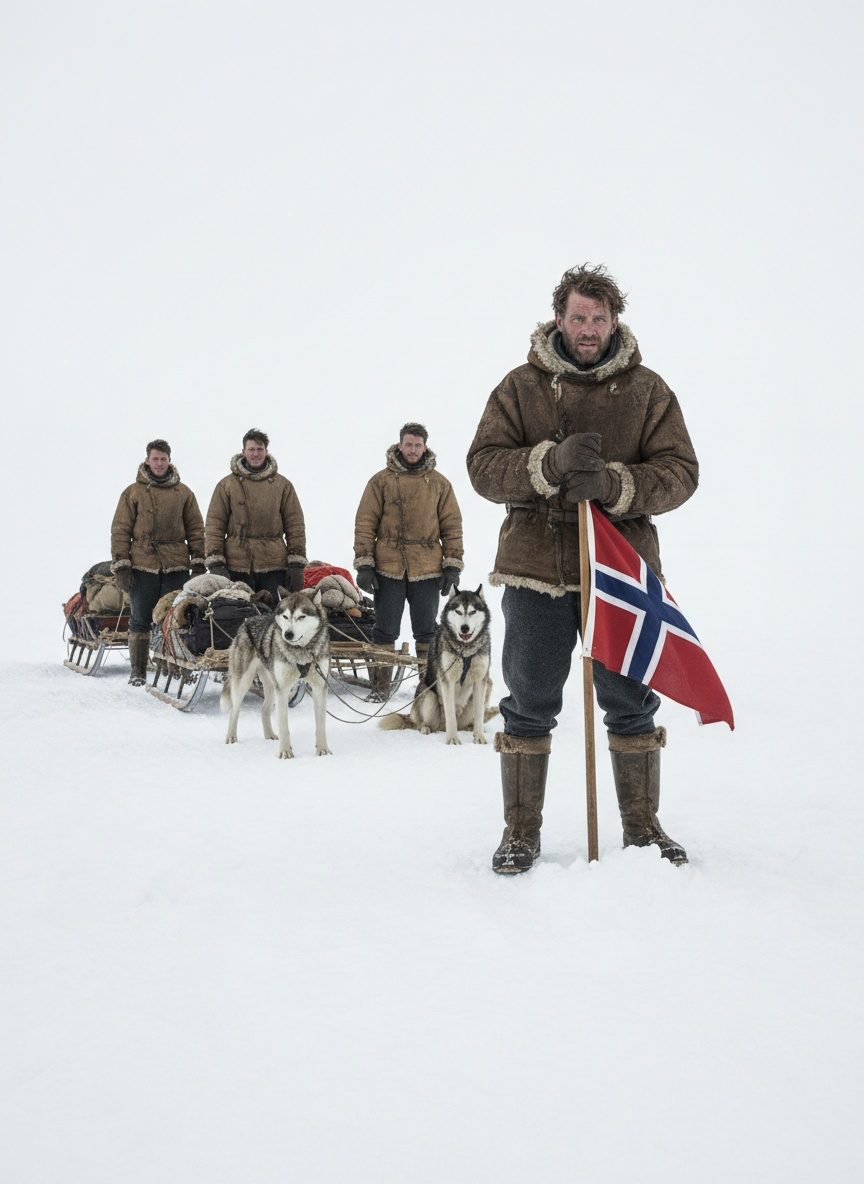
One of his greatest assets was his team of 97 sled dogs, each individually selected for their endurance and skill. Amundsen understood that the dogs were not just companions but the lifeline of the expedition. He orchestrated a strategy that involved the use of these animals to the fullest potential, setting up a series of food depots meticulously calculated along the route in advance. This methodical approach was unheard of at the time and a testament to Amundsen’s thoroughness.
When Amundsen and his team set foot on the treacherous Antarctic ice, they embarked on a mission of unprecedented pace and precision. Their progress was a testament to their preparation, allowing them to focus on execution rather than improvisation. On December 14, 1911, Amundsen’s little troupe proudly planted the Norwegian flag at the South Pole, securing their place in history.
The Other Side of Glory: Tragedy and Triumph
Roald Amundsen’s achievement was a beacon of success, but not the final word in the story of polar exploration. Just over a month after Amundsen’s triumph, the British explorer Robert Scott reached the South Pole, only to find that all the glory was claimed by another. Exhaustion, despair, and poor planning led Scott and his team to a doomed fate, sealing the harsh, unforgiving reality of the explorer's world.
While Scott was hampered by poor preparation and heavy reliance on untested motor sledges, Amundsen’s meticulous strategy and adaptation of Indigenous knowledge tilted the scales in his favor. Sadly, when Scott's party arrived at the Pole on January 17, 1912, they did not survive the return journey. It was a stark contrast to Amundsen's expedition, where all team members returned safely, even after conquering the world's most hostile climate.
In this epic narrative of ambition and loss, the deeds of Amundsen and Scott stand as divergent pathways, showcasing the vital importance of tenacity intertwined with meticulous preparation.
The Legacy Left Behind: An Undying Lesson
Roald Amundsen’s legacy goes beyond being first to the South Pole; it is a masterclass in the power of preparation and respect for the environment. The explorer's story is not solely one of triumph over adversity but an inspiration to value meticulous foresight and strategic wisdom.
From the icy grip of his open window to the endless white drifts of Antarctica, Amundsen’s tale encourages us to honor those who came before us and adapt their wisdom for our purposes. His success reminds us that achieving the extraordinary requires farsightedness as much as bravery.
In a time when human endeavor stretched the limits of known geography, Amundsen left us a blueprint of preparation and precision that resonates beyond the realm of exploration. His odyssey to the South Pole remains a vivid reminder of the boundless possibilities when planning meets perseverance, and it cautions us of the steep price of neglecting either.