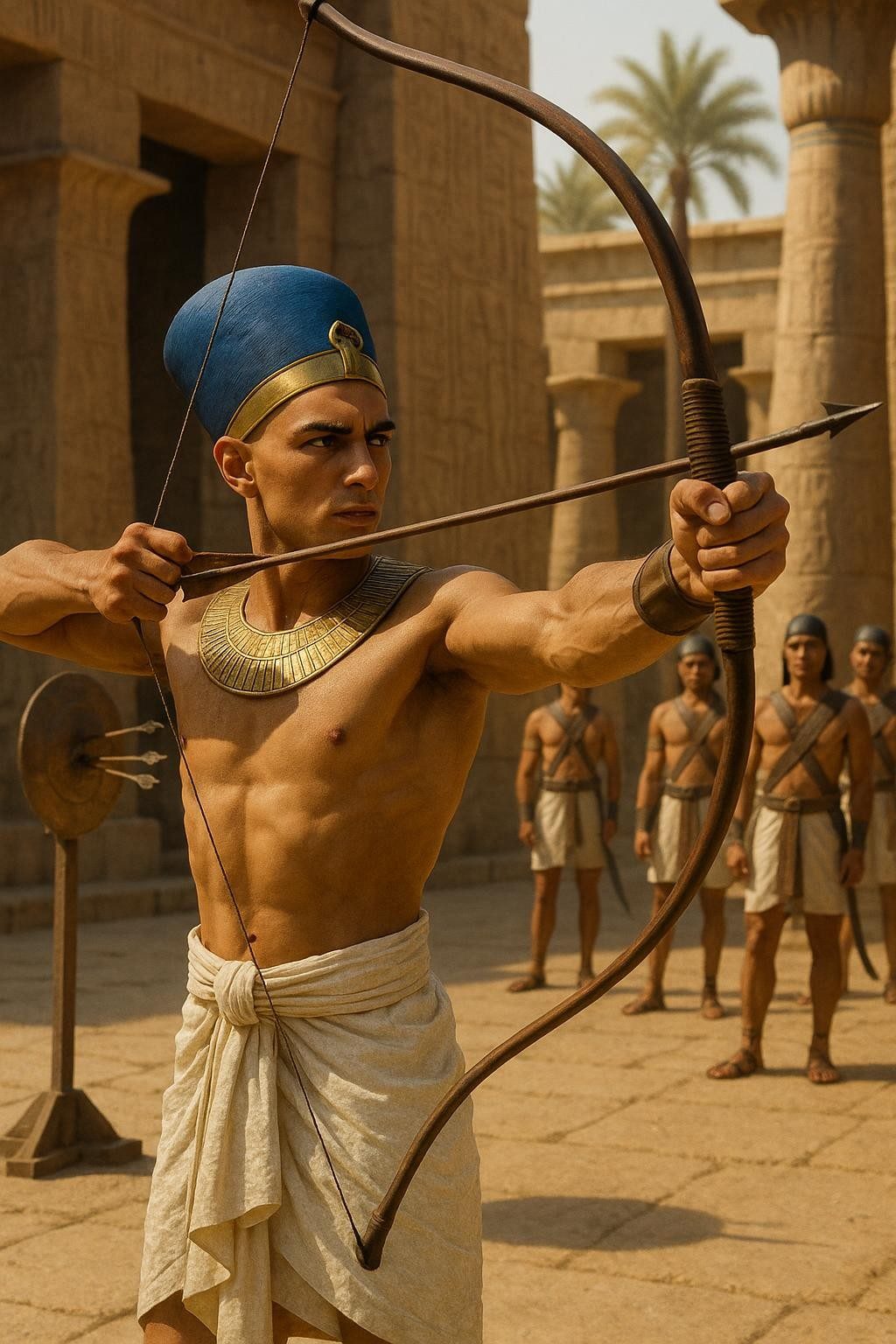
The challenge was set. The sun blazed overhead, casting long shadows across the embalmed sands of Egypt. A figure stood before a copper target glistening atop its post. The sound of taut sinew whispered through the morning air as the bow creaked under immense pressure. In an instant, the arrow whistled through the sky, its tip puncturing the metal with an effortless precision that seemed almost divine. It was Amenhotep II, not yet twenty, whose muscles rippled from years of dedicated training, demonstrating a mastery that was unparalleled in the land of the Nile.
The Boy Who Trained Like a Warrior
Long before the copper target stood as a testament to his prowess, Amenhotep II was already setting the stage for his legendary reign. As the favored son of Pharaoh Thutmose III, expectations were monumental, yet his upbringing was anything but ordinary. While most royal heirs enjoyed a cushioned life filled with luxuries befitting their status, Amenhotep immersed himself in the world of military training, a stark departure from the princely norms. He spent grueling hours under Egypt’s relentless sun, his hands molded by the oars of swift ships and the reigns of powerful chariots. This was not the life of a pampered prince, but that of a dedicated soldier in the making.
Amenhotep's determination was relentless. His arms grew strong from drawing the bow with force that could rival any man in his father’s army. While other young nobles studied etiquette and history, Amenhotep was mastering the arts of agility and endurance. His body became a weapon, sharp and lethal, honed by the rigorous demands he placed upon himself, refusing to accept anything less than perfection.
The Test of Strength and Skill
The day of his trial of skill was as much an affair of state as it was personal triumph. By the time he faced the copper target, Amenhotep’s athletic feats were already whisperings on the breeze from Nubia to the northern delta. It was said that his physical prowess was unmatched, each demonstration of his skill another stone in the foundation of his growing legacy. The chosen weapon this day was the bow, an instrument that did not yield easily to human strength or skill.
None other dared to attempt stringing his bow. Amongst the gathered soldiers, whispers of its impossibility made the rounds. Crafted to harness incredible force, it now became symbolic of Amenhotep’s strength and his right to rule. One by one, arrows flew true and went clean through the meticulously placed copper. With each shot, the gasps from the onlookers grew louder. The feat was carved into stone, to be remembered by those present and those yet to come, a message of power aimed at both friend and foe of Egypt.
The Symbolism of Power
Beyond mere spectacle, these demonstrations were rich in symbolic power. Amenhotep II was not just cementing his position as Pharaoh; he was declaring a message to the world. His showmanship wasn’t merely about personal glory—every arrow was a declaration of Egypt’s might and a signal to all who might dare to question his leadership. It served as a visual narrative of strength, a cleverly crafted segment of the larger narrative that would define the 18th Dynasty.
In an era where power must be visibly demonstrated, Amenhotep's feat was a strategic maneuver. His physical prowess exemplified a dual narrative: one of inherited divinity and God-given right to rule and another of meted-out worldly punishment and reward. It was a portrayal of fearless leadership and invulnerability set in the realm of human achievement, positioning Egypt as an impenetrable fortress under his reign.
A Legacy Cast in Stone and Legend
Amenhotep II, much like the arrow that started it all, was unstoppable in his vision and ambition. His rule would continue to employ the calculated display of strength to project stability and control. While his dynastic efforts would solidify Egypt’s territorial and political power, it was his personal undertakings that captured the imagination of his subjects and adversaries alike.
This young king’s life reminds us that foundations of power are often laid far from the thrones of gold and splendor. They are built in the perseverance of training fields and the determination manifest in acts that innovate the legend. The bow that no other could string becomes a haunting reminder that history remembers those who dare to define their own path.
In moments where the strength of character faced tangible trials, Amenhotep II’s story becomes not just a tale of ancient power but a timeless reminder of the capabilities inherent within determined leadership. It is a narrative of how perceived impossibilities yield to the hands that wield them relentlessly, and through such indomitable spirit, even the mightiest challenges are pierced through like a copper target in the glaring Egyptian sun.