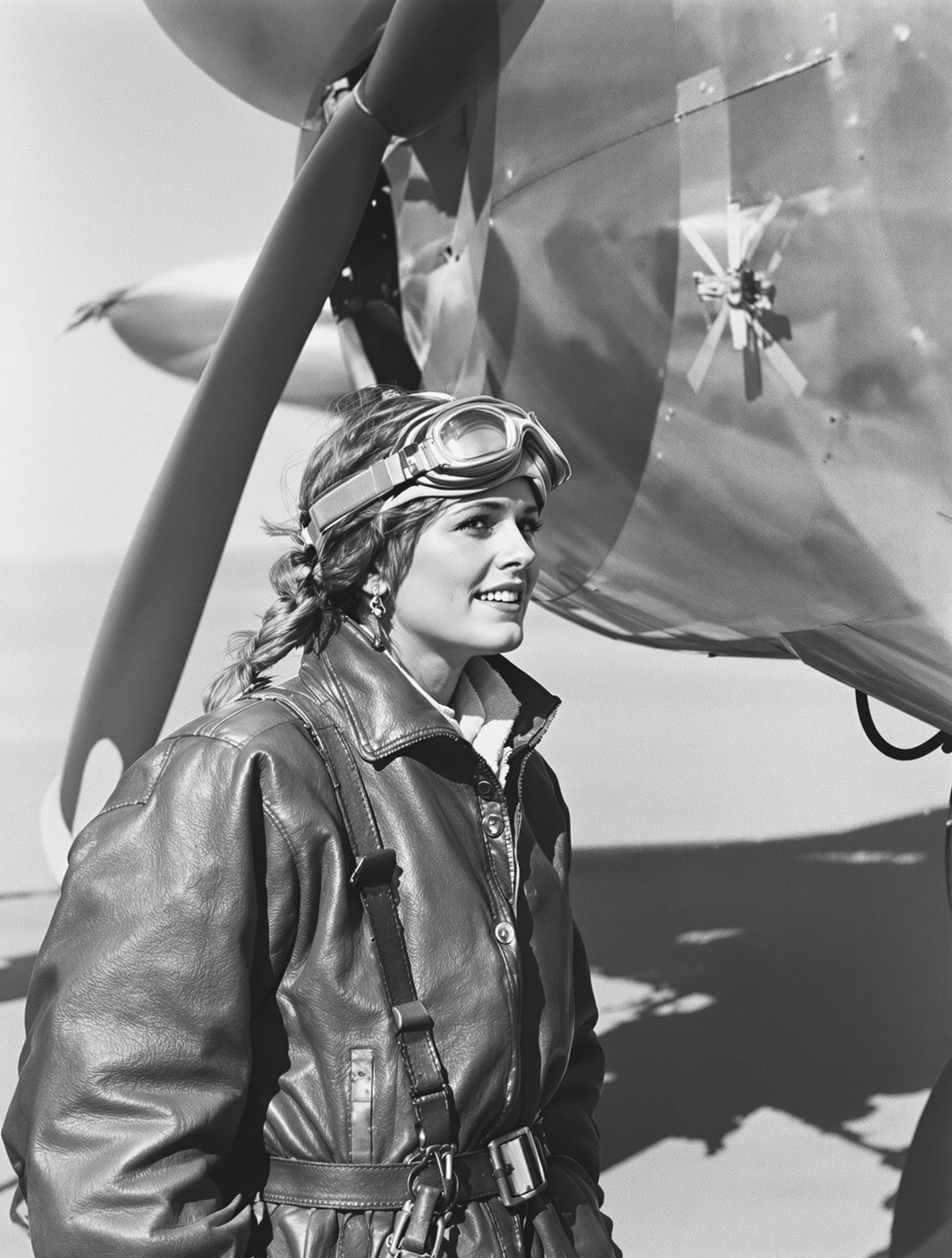
At 8:43 AM on July 2, 1937, a crackling radio transmission cut through the static over the vast Pacific Ocean. "We are running north and south but do not see the island. Gas is running low. Been unable to reach you by radio." The voice belonged to Amelia Earhart, the world's most famous female aviator, speaking from the cockpit of her twin-engine Lockheed Electra somewhere above 64,000 square miles of empty ocean. Twenty minutes later, she transmitted her final words: "We are on the line 157-337, running on line north and south." Then, silence. Neither Earhart nor her navigator Fred Noonan would ever be heard from again.
What happened in those final moments has captivated the world for over eight decades, spawning countless theories, expeditions, and investigations. But the story of Amelia Earhart's disappearance is more than just an unsolved mystery—it's a tale of ambition, courage, and the dangerous pursuit of dreams in an age when crossing oceans by air was still a death-defying act of faith.
The Aviator Who Refused to Stay Grounded
By 1937, Amelia Mary Earhart had already cemented her place in aviation history. She was the first woman to fly solo across the Atlantic Ocean, the first person to fly solo from Hawaii to California, and held numerous altitude and speed records. But for Earhart, these achievements were stepping stones to something grander: becoming the first woman to circumnavigate the globe by air.
The idea wasn't born from ego—it was calculated ambition. At 39, Earhart knew her reflexes were slowing, and younger aviators were breaking her records. This flight would be her masterpiece, a 29,000-mile journey that would take her around the world's widest point, near the equator. It was a route no one had attempted before, far more challenging than previous circumnavigations that followed shorter northern routes.
What many don't realize is that Earhart's first attempt at the world flight had already ended in disaster. On March 20, 1937, during takeoff from Hawaii, her Lockheed Electra ground-looped on the runway, causing significant damage. The crash cost her $50,000 in repairs—equivalent to nearly a million dollars today—and forced her to postpone the flight for months while the aircraft was rebuilt.
The Million-Dollar Gamble
The financial pressure behind Earhart's final flight reveals a lesser-known desperation driving her mission. The expedition was hemorrhaging money, funded by a combination of her own savings, her husband George Putnam's publishing fortune, and corporate sponsorships. Purdue University had purchased the $80,000 Lockheed Electra (worth $1.5 million today) as a "flying laboratory," but the costs kept mounting.
Earhart's navigator, Fred Noonan, was a former Pan American Airways navigator with unparalleled experience flying over water. He had mapped many of Pan Am's Pacific routes and was considered one of the best in the business. However, he had a well-known drinking problem that had cost him his Pan Am job. Some historians suggest this may have played a role in their navigation difficulties, though no evidence supports claims he was intoxicated during the final flight.
The modified Lockheed Electra was a marvel of 1930s technology, stripped of passenger amenities and packed with extra fuel tanks that could hold 1,200 gallons—enough for 20-24 hours of flight. The aircraft also carried cutting-edge radio equipment, including a 50-watt transmitter and a radio direction finder that should have guided them to their destination.
The Needle in the Pacific Haystack
Howland Island, their intended destination, was barely a speck in the vast Pacific—a flat coral atoll just 1.6 miles long and 0.5 miles wide. To put this in perspective, finding Howland Island from the air in 1937 was like hitting a target the size of a city block from 100 miles away, while traveling at 150 miles per hour, with 1930s navigation equipment.
The U.S. government had spent months preparing for Earhart's arrival, constructing a 5,000-foot runway and establishing a radio beacon. The Coast Guard cutter Itasca was positioned offshore, ready to guide her in with radio signals. Everything that could be planned had been planned—except for the communication breakdown that would prove fatal.
What's particularly tragic is how close they came to success. Radio operators on the Itasca could hear Earhart's transmissions clearly, but she couldn't hear their responses. The reasons remain debated: different radio frequencies, antenna problems, or operator error. At 7:42 AM, she reported flying at 1,000 feet and said she was "running north and south" looking for the island. She was probably within 50 miles of safety.
The Search That Never Ended
The immediate search for Earhart and Noonan was the most extensive and expensive in aviation history up to that time. The U.S. Navy and Coast Guard deployed nine ships and 66 aircraft, scouring 250,000 square miles of ocean over 17 days. The operation cost $4 million—roughly $75 million in today's currency—but found nothing.
George Putnam refused to give up, funding private searches for years. He received hundreds of reports of radio signals that might have been distress calls from Earhart, but none led to her discovery. The official search was called off on July 19, 1937, and Earhart and Noonan were declared legally dead on January 5, 1939.
However, the mystery has never truly died. Over the decades, researchers have proposed three main theories: that they crashed into the Pacific and sank (the official conclusion), that they survived on uninhabited Gardner Island (now Nikumaroro) for days or weeks before dying, or that they were captured by the Japanese on the Marshall Islands and died in custody.
The Gardner Island theory gained traction in the 1990s when researchers found artifacts that might have belonged to Earhart: a piece of aircraft aluminum, a woman's compact, and even bones that were lost before they could be properly analyzed. In 2018, a new analysis of a photograph taken on the Marshall Islands three months after Earhart's disappearance claimed to show two figures that could be the missing aviators, though experts remain divided on its authenticity.
Echoes Across Time
Perhaps the most haunting aspect of Earhart's story is how tantalizingly close we've come to solving it, only to have answers slip away like morning mist. Modern technology has brought us closer than ever—deep-sea sonar, satellite imagery, and forensic analysis have all been employed in the search. Yet the Pacific keeps its secrets.
The enduring fascination with Amelia Earhart's fate reflects something deeper than mere curiosity about a historical mystery. In an age when we can track a smartphone anywhere on Earth and monitor flights in real-time, the idea that someone can simply vanish seems almost impossible. Her story reminds us that despite our technological mastery, the world still holds mysteries beyond our reach.
More importantly, Earhart's disappearance shouldn't overshadow her achievements. She didn't just break barriers for women in aviation—she challenged the very notion of what humans could accomplish. At a time when many women couldn't even vote in all states, she was pushing the boundaries of human exploration. Her final transmission, calm and professional even as fuel ran low over an endless ocean, reveals the character that made her a legend: unflinching courage in the face of the unknown.
Today, as we stand on the brink of space tourism and dream of missions to Mars, Amelia Earhart's story serves as both inspiration and warning. The frontier calls to those brave enough to answer, but it demands everything in return—sometimes even the chance to tell your own story.