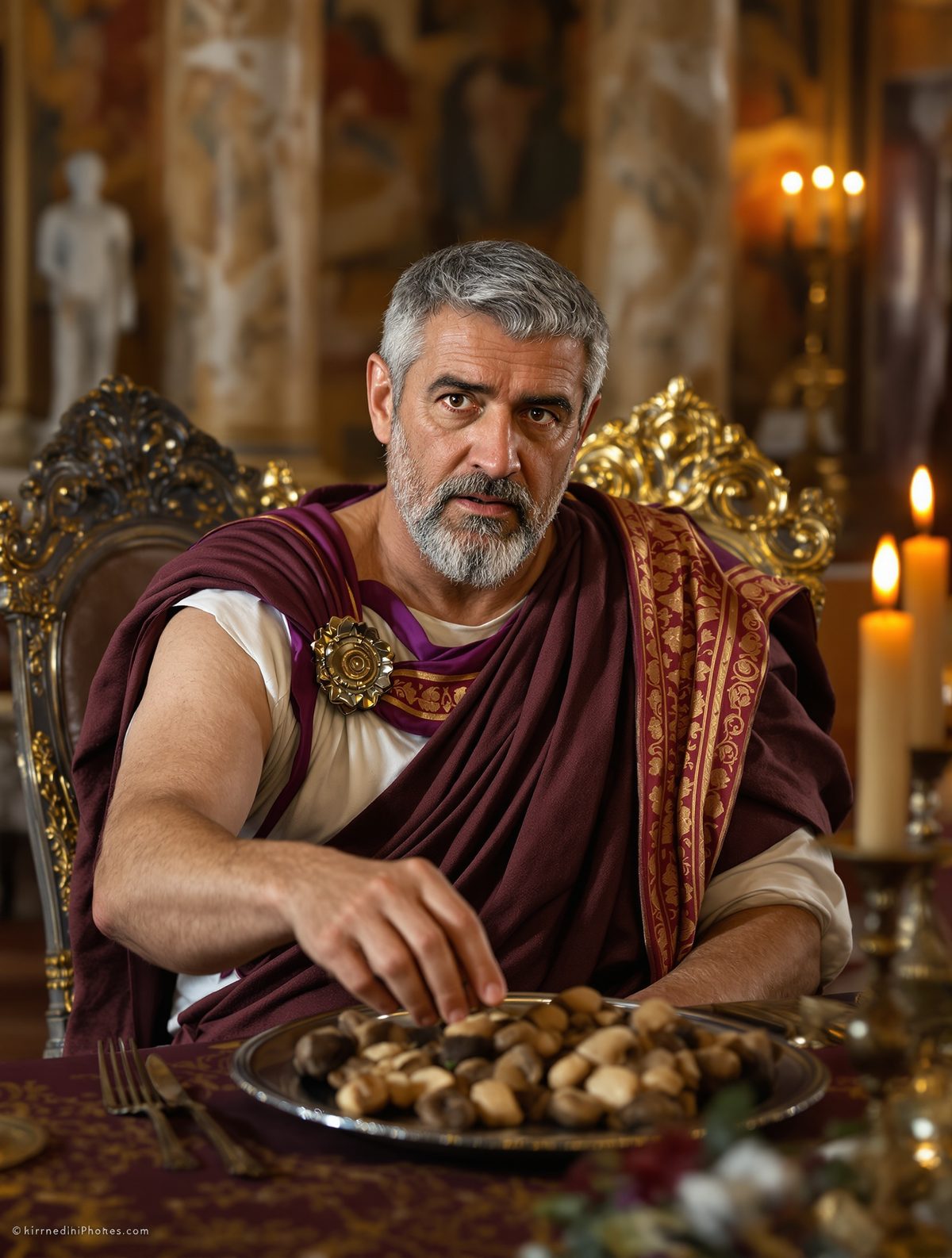
Picture this: Rome's richest man, worth more than entire kingdoms, lies dying in the Syrian desert. His seven legions—42,000 of Rome's finest soldiers—have been slaughtered or captured. And now, his captors are about to give him exactly what they believe he's always wanted: all the gold he can drink. Literally.
In 53 BC, Marcus Licinius Crassus met one of history's most fitting and brutal ends. The man who had turned greed into an art form would die with molten gold coursing down his throat, a final, terrible gift from enemies who understood his reputation all too well.
The Man Who Made Misery Profitable
To understand why Crassus died as he did, you need to understand how he lived. This wasn't just another rich Roman—this was a man who had weaponized human suffering into a business model that would make modern hedge fund managers blush.
Crassus didn't inherit his wealth; he harvested it from Rome's chaos. During the brutal civil wars of the 80s BC, when Sulla's death squads roamed the streets, Crassus saw opportunity where others saw terror. He bought the confiscated properties of executed enemies at rock-bottom prices, often while their previous owners' blood was still fresh on the Senate steps. By some estimates, his real estate portfolio eventually included over 7,000 properties across Rome.
But his most ingenious—and morally bankrupt—scheme involved fire. Rome was a tinderbox of wooden buildings and narrow streets, and fires were constant. Crassus assembled the world's first private fire brigade of 500 trained slaves. Here's the twist: when your house caught fire, Crassus would arrive and offer to buy it from you at a fraction of its value. Refuse, and he'd stand there watching it burn. Accept, and his firefighters would spring into action, saving what was now his property.
The numbers were staggering. Modern economists estimate Crassus's wealth at roughly 200 million sestertii—equivalent to about $2 billion today. He owned silver mines in Spain, vast estates across the empire, and so many slaves that he could field a private army. He once boasted that a man couldn't call himself rich unless he could maintain a legion from his personal fortune.
The Hunger for Glory That Money Couldn't Buy
By 60 BC, Crassus had everything money could buy, but money couldn't buy the one thing he craved most: military glory. Rome's aristocracy measured greatness in triumphs, not bank accounts, and Crassus was painfully aware that his peers saw him as nothing more than a glorified moneylender.
His partners in the secret political alliance known as the First Triumvirate had what he lacked. Julius Caesar was conquering Gaul, adding territory the size of France to Rome's empire. Pompey the Great had earned his surname by conquering pirates, kings, and entire regions. Their names were chanted by crowds; their victories were carved in stone.
Crassus's greatest military achievement was crushing Spartacus's slave rebellion in 71 BC—hardly the stuff of epic poetry. Worse, Pompey had arrived at the last moment and stolen much of the credit. The humiliation burned. For a man accustomed to buying whatever he wanted, being unable to purchase respect must have been unbearable.
So when the opportunity came to govern Syria in 54 BC, Crassus saw his chance. Syria bordered the Parthian Empire, Rome's greatest rival in the east. The Parthians controlled the lucrative Silk Road trade routes and sat atop legendary Persian treasures. One successful campaign could make Crassus rich beyond even his dreams while covering him in the military glory he desperately craved.
March to Disaster: The Campaign That Doomed an Empire's Dreams
In 54 BC, Crassus began assembling what should have been an unstoppable force. Seven full legions—approximately 42,000 men—plus auxiliary troops and cavalry. It was one of the largest armies Rome had ever sent eastward, equipped with the finest weapons and armor Roman engineering could provide.
The signs were ominous from the start. As Crassus's army marched through the streets of Rome, a tribune named Ateius performed ancient curses, calling down the wrath of the gods on the expedition. The Roman people, who usually celebrated military departures, watched in sullen silence. Even Crassus's own son Publius, a promising young officer fresh from service under Caesar in Gaul, seemed to sense doom approaching.
But Crassus was beyond reason. Ancient sources describe him as obsessed, talking constantly of the riches that awaited in Parthian cities like Babylon and even distant China. He reportedly dreamed of extending Roman rule all the way to the Pacific Ocean, making Caesar's Gallic conquests look like mere border skirmishes.
The march across Syria and into Mesopotamia began well enough, but Crassus made a fatal error in listening to Arab guides who promised to lead him by the shortest route to victory. What they actually led him to was a carefully prepared trap in the desert near the town of Carrhae.
Carrhae: When Roman Steel Met Parthian Fire
On a scorching day in May 53 BC, Crassus found himself facing an enemy unlike any Rome had ever encountered. The Parthian general Surena had assembled a force that seemed almost supernatural to Roman eyes—10,000 mounted archers whose composite bows could punch through Roman armor at 200 yards, and 1,000 heavily armored cataphract cavalry whose horses and riders were encased in steel from head to toe.
What followed wasn't really a battle; it was a systematic execution. The Romans formed their traditional squares, shields locked together, waiting for the enemy charge that never came. Instead, the Parthian horse archers circled them like wolves, raining arrows from every direction. When the Romans tried to charge, the Parthians simply rode away, their horses fresher and faster. When the Romans stood still, they died slowly under the constant arrow storm.
The psychological warfare was as devastating as the physical. The Parthians had brought drums and brass instruments that created a thunderous, otherworldly noise that unnerved the Roman soldiers. The sound, according to survivors, was "like the roaring of wild beasts mixed with sounds resembling thunder."
Hours passed. Roman casualties mounted. When young Publius Crassus finally led a desperate cavalry charge to break the deadlock, he and his 1,000 Gallic horsemen were cut off and annihilated. The Parthians returned carrying his head on a spear.
Seeing his son's severed head broke something fundamental in Crassus. Ancient historians describe him standing motionless, staring at the gruesome trophy while his army disintegrated around him. By nightfall, perhaps 20,000 Romans lay dead in the desert sand, with another 10,000 captured. Only about 10,000 escaped—one of the most catastrophic defeats in Roman military history.
The Golden Death: A Mockery Fit for History's Greatest Miser
What happened next depends on which ancient source you trust, but the core story remains chillingly consistent. Crassus, wounded and demoralized, was captured during a botched attempt at negotiation under a flag of truce. Some sources suggest treachery; others blame miscommunication. What matters is that Rome's richest man found himself a prisoner of people who knew exactly who he was and what he represented.
General Surena and the Parthian court had heard the stories. They knew about the fire brigades, the war profiteering, the vast wealth built on others' misery. To them, Crassus represented everything corrupt about Roman ambition—the reduction of human life to mere accounting entries.
According to the historian Dio Cassius, they decided his death should match his life's obsession. They melted down gold—possibly looted from Roman supplies, possibly from their own treasuries—and forced it down his throat while he still lived. "Since you have shown such a great thirst for gold," they reportedly told him, "now drink your fill."
Other versions of the story suggest they poured the molten gold into his mouth after death, then sent his head to the Parthian king as a trophy. Either way, the symbolism was unmistakable: the man who had spent his life consuming others had been consumed by his own greed.
The head of Crassus arrived at the Parthian court just as the king was watching a performance of Euripides' tragedy "The Bacchae." The actor playing King Pentheus grabbed Crassus's head and used it as a prop, reciting the lines: "We bring from the mountain a tendril fresh-cut to the palace, a wonderful prey." The audience erupted in applause, not knowing they were cheering over the remains of one of Rome's most powerful men.
Legacy of Gold: Why Crassus's Death Still Matters
The death of Marcus Licinius Crassus sent shockwaves through the ancient world that are still reverberating today. His defeat at Carrhae shattered Roman confidence and marked the beginning of the end for the Republic he had helped to undermine.
Without Crassus to balance the triumvirate, Caesar and Pompey turned on each other, leading directly to the civil wars that would destroy the Roman Republic and birth the Roman Empire. In a very real sense, Crassus's greed-driven invasion of Parthia helped kill the Roman system of government that had conquered the Mediterranean.
But perhaps more importantly, the story of Crassus serves as an eternal warning about the corrupting power of extreme wealth and the danger of confusing material success with human worth. Here was a man who could buy anything except the respect of his peers and the satisfaction of his own soul. His desperate quest for military glory—not out of patriotism or duty, but out of wounded ego—led 42,000 men to their deaths in a foreign desert.
In our modern age of billionaires and wealth inequality, when the richest individuals control resources greater than entire nations, the fate of Crassus feels remarkably relevant. His story reminds us that no amount of money can purchase immunity from the consequences of our choices, and that the pursuit of wealth without wisdom or virtue ultimately consumes those who practice it.
The Parthians who poured gold down Crassus's throat understood something that we often forget: there is such a thing as too much of what we think we want. Sometimes, the most fitting punishment is to give someone exactly what they've spent their life pursuing—and let them choke on it.