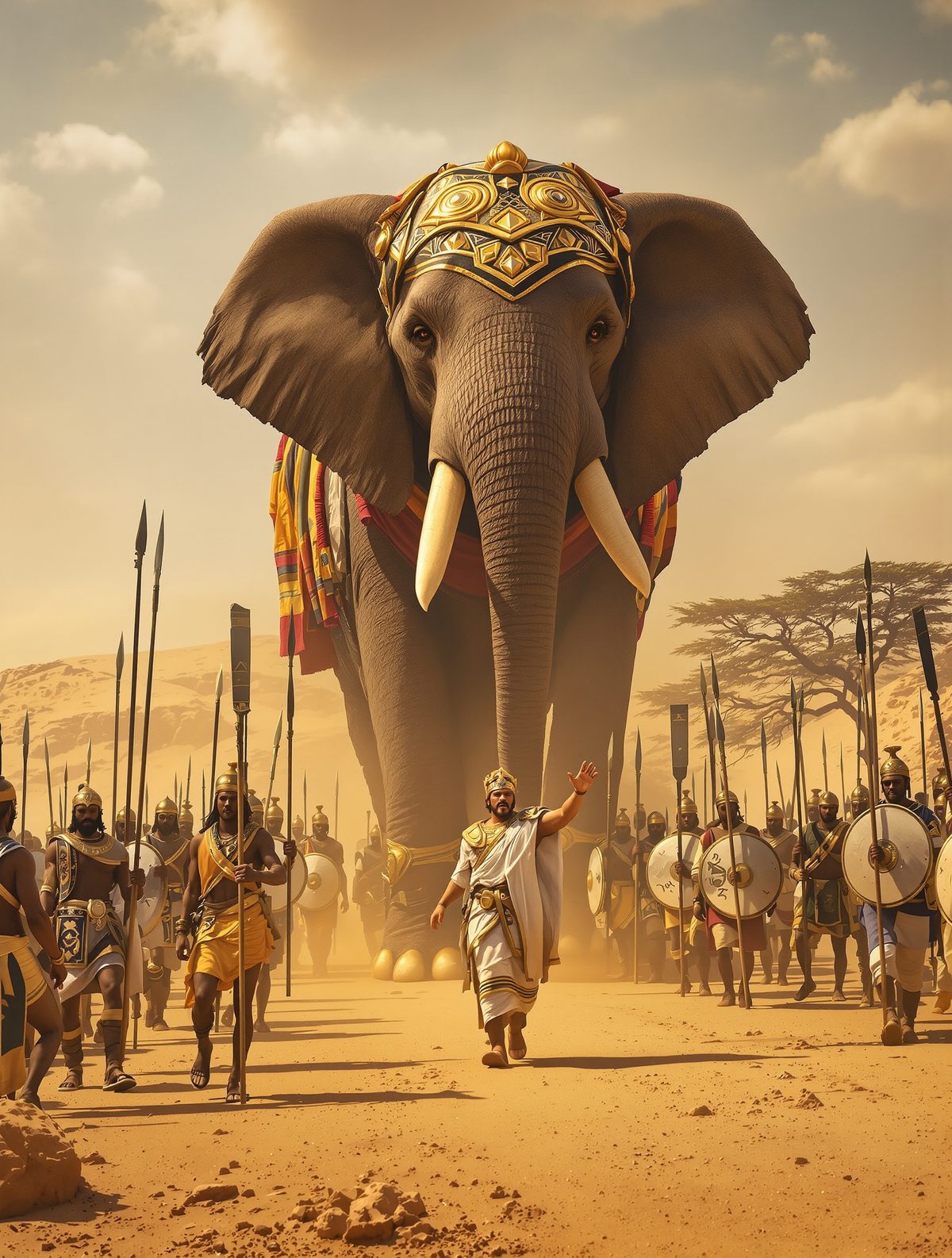
In the year 570 AD, a dust-choked dawn rolled over the barren Arabian desert, and a formidable silhouette loomed against the horizon. It was not the jagged peaks of rock or the windswept dunes that caught the eyes of young shepherds and merchant travelers but a spectacle rarely seen in these parched lands: an elephant army, resplendent in full regalia, led by a man driven by ambition. This is the story of Abraha, the Abyssinian governor who marched on Mecca with dreams of triumph—and how an extraordinary turn of fate left those dreams unfulfilled.
From Elephants to Empire: Abraha's Rise
Abraha was no ordinary governor. Appointed by the Christian Kingdom of Aksum in modern-day Ethiopia, he rose to govern Yemen, a center of trade and culture on the Arabian Peninsula. With a zeal for expansion and a devotion to his faith, Abraha saw Mecca, the burgeoning religious hub and home to the revered Kaaba, as both a threat and an opportunity. He sought not only to divert the caravan routes of Arabia to the grand cathedral he built in Sana'a but also to bring the tribes under the Christian banner. What better way to assert dominance than to capture the sacred city itself?
Thus, in the spring of 570 AD, Abraha amassed a mighty force ready to march northward. Among them were war elephants, towering creatures imported from Africa—beasts of battle meant to intimidate and crush any resistance. With these symbols of power and prestige, Abraha was confident that none could stand in his way.
The Great March: A Show of Power
The expedition to Mecca was a grand endeavor. Moving across the desert with elephants added complexity to the logistics, but these creatures were not merely for show. Historically, elephants had proven their worth on battlefields in ancient India and the Hellenistic world, and Abraha intended to harness their might to ensure a swift victory.
Yet, the journey was no ordinary military march. As the sun scorched the sands, Abraha's army cut a swath through the landscape, a parade of strength that drew the attention of nomads and tribes alike. Towns and encampments lay prostrate in his wake, offering little resistance to the Abyssinian force. The mere sight of the elephants, their tusks etched with geometric patterns and vivid dyes staining their hides, struck awe and fear into the hearts of the Arab tribes.
Despite the lack of immediate opposition, Abraha's forces were tested by the harsh desert terrain and the testy temperaments of their pachyderms. They pressed on, slowly but inexorably, towards their target—the city of Mecca.
The Standstill: A Refusal at Mecca's Gates
Just as Abraha's forces drew near their ultimate goal, fate intervened in a most peculiar fashion. Accounts from Arab tradition relay how, upon approaching Mecca, the lead elephant—said to be named Mahmoud—suddenly knelt and refused to advance. Wasi', the elephant's mahout, urged and prodded the creature, but Mahmoud would not be budged, ignoring all cues from his handlers.
History rarely records the thoughts of elephants, but this inexplicable balk became a crucial moment. The army seemed dependent on the lead beast's willingness to advance, yet Mahmoud remained motionless, unfazed by shouts or spears. As the heat shimmered across the sand, a deep discontent spread through the ranks. What should have been the final surge to victory transformed into a stalemate at the gates of the city.
A Divine Intervention or Fortuitous Turn?
The story of the elephant's refusal quickly found its way into infamy, wrapped in the mysticism of divine intervention. Local legends and Islamic tradition, as later recorded in the Quran, weave a tapestry of divine protection over Mecca. An account known as the "Year of the Elephant" describes how a mysterious affliction beset the army, either through a storm or an outbreak of disease—decimating units and causing a retreat.
Some interpretations recount a vision of a storming through the sky, unleashing flocks of birds that hurled stones upon the invaders. Whether reality or allegory, the event's significance grew in the retelling, underscoring the belief that Mecca was under the protection of a higher power. Abraha's expedition fell apart, retreating in disarray—returning to Yemen without having laid a hand on Meccan soil, leaving behind tales of divine wrath for generations to ponder.
A Legacy Written in Legend
The events of 570 AD became a defining moment in Arabian history, shaping both regional politics and religious reverence towards Mecca. This incredible episode anchored itself into the collective memory of the Arabian Peninsula, shaping the narratives that surfaced with the advent of Islam. The Prophet Muhammad was born in this very "Year of the Elephant," adding another layer to the tale—a symbolic prelude to the seismic shift this region would soon experience with the rise of Islam.
As Mecca transformed into the center of Islam, the story of Abraha's failed march endured as a celebrated instance of protection by divine grace. What began as an ill-fated journey to assert dominance instead served to consolidate cultural and religious identities in and around the city for generations to come.
The Lasting Echoes of Abraha's Campaign
Abraha's failed expedition to Mecca continues to fascinate historians and laypeople alike. It stands as a testament to the complexities of human ambition, divine belief, and the inexorable march of history as an unexpected convergence of events alters the course of a region's destiny. It reminds us that the past is filled with chapters of improbability and wonder and that the roads not traveled can be as influential as those roads that forge empires.
In today's world, where the power of belief and cultural identity remains as potent as ever, the story of Abraha's elephant army offers poignant insights. It echoes the timeless truth that great intentions, and great armies, can be humbled by the unpredictability of circumstance, a sentiment that reverberates through history and still finds relevance in the narratives of our modern age.