637 AD. A cloud of dust rose around the city walls, churned into the air by the restless feet of soldiers and the hooves of their patient horses. Jerusalem lay silent, encircled by an army of strangers, ready to thrust itself into the next chapter of its ancient story.
In that time, Jerusalem was a jewel fought over by powerful empires, a city holy to three major faiths. Encircled by high stones, its Christian defenders watched nervously as the army of the Caliph Omar tightened its suffocating grip. It wasn't the first time the city faced siege and surrendered, but what happened next marked this encounter as extraordinary, a peculiar moment seized from the jaws of war.
Sophronius, the city's patriarch, was already an old man when the lurking shadow of the expanding Islamic empire fell over Jerusalem. This was a world dominated by rapid change, a leap from the rule of the Byzantine Empire to the unexpected ascendancy of an Islamic caliphate in the arid sands far towards Mecca and Medina. The patriarch, with wisdom etched into each wrinkle of his weary face, understood the tides of history that lashed the walls around him. He decided on a course that would shape the city's future, preserving it through submission rather than sacrifice.
There was a peculiar serenity in his decision. Sophronius knew that conquest would come with or without bloodshed. History spoke of cities razed and lives extinguished in stubborn defiance. Yet here, he believed, was a chance for something different. This was the city of his God, sacred in ways language fails to capture. Opening the gates to the caliph’s representative without bloodshed might preserve its sanctified light.
With a calm resolve, Sophronius stepped out from the city walls, alone and wholly vulnerable. He walked to the military camp not as a defeated leader but as a steward of faith, a custodian seeking to uphold the dignity of his people amidst the chaos of shifting power. In the air hovered anticipation, fear, and hope—the potent mix of emotions that often herald an irreversible moment in history.
There, in that tent, Sophronius faced Caliph Omar ibn al-Khattab. The two could not have appeared more different. Omar, known for his austere lifestyle and deep devotion, cut a commanding figure, the weight of a burgeoning empire on his shoulders. Yet beneath their outward disparities lay a shared understanding, a reverence for God and the knowledge that this city transcended its walls and stones.
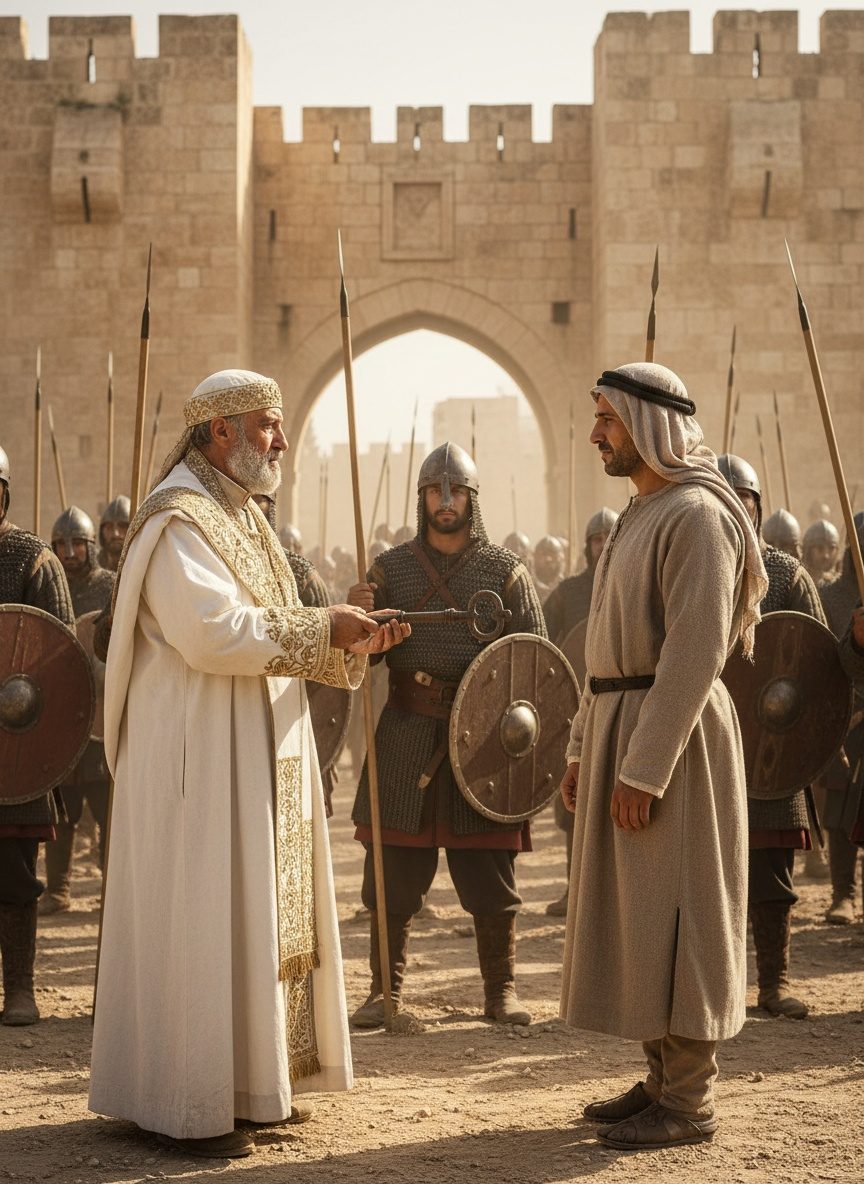
Sophronius offered the keys of Jerusalem, and in return, he had but one demand—a wish that Omar respected promptly. To protect the sacred Christian sites, to allow Christians to continue worship in peace, and to ensure the sanctity of the city was respected. Omar, who himself viewed Jerusalem with profound respect as a city mentioned in the Quran, agreed to grant these wishes. It was not a treaty signed in haste but a meaningful covenant between two men of faith.
This agreement was historical not just for its terms but for the mutual respect with which it was forged. Omar entered Jerusalem not as a conqueror but as a pilgrim, unarmored, riding a simple camel, not a steed. Despite the victory, the army did not loot the city, an act distinct from the brutal practices that usually followed conquests of the time. It was a gesture of humanity in a world that often forgot such values amid strife.
In fulfilling Sophronius’s requests, Omar allowed Christians to continue their worship uninterrupted, their holy sites preserved. In the succeeding days, the call to prayer joined the city's ancient chiming church bells, a new chapter was inked in the history of one of the world’s oldest living cities. Islam’s respect for 'Ahl al-Kitab’ or ‘People of the Book’—the faithful of previous scriptures—was demonstrated in the protection offered under the caliph's rule. For Muslims, Christians, and Jews, Jerusalem's shared sanctity seemed in that moment honored.
The image of Sophronius handing the keys to Omar has become a symbol of a rare generosity of spirit in wartime, a testament to the profound effects of human agency against the tide of history. It was this essential humanity that preserved Jerusalem from unnecessary ruin, allowing it to flourish as a city sacred to many.
Today, this narrative echoes as a story of dignity, pragmatism, and tolerance. It is a reminder that peace can be brokered in the quiet conversations between leaders, away from the clamor of swords drawn. Though empires rise and fall with time, these moments of accord endure, teaching us the value of diplomacy and humanity amid darkness. In Sophronius's lone walk to Omar, a gesture that preserved a culture through surrender, we find a reflection of what it means to choose understanding over destruction.