The air was thick with the smell of gunpowder and burning foliage as Shima Iwashita squinted ahead into the haze of smoke that hung low on the battlefield. The sharp cracks of rifle fire and the distant booms of artillery punctuated the oppressive quiet of the March afternoon. In the spring of 1945, beneath the pall of an overcast sky, the relentless battle for Okinawa unfolded—a harrowing contest of attrition and devastation that would become one of the defining moments of World War II’s Pacific Theater.
Sacred Duty on a Desolate Island
Okinawa, the largest of the Ryukyu Islands, was a crucial strategic point for both Japanese and Allied forces. Capturing it meant gaining a vital springboard for an invasion of Japan itself. The island, a patchwork of lush green fields and rugged cliffs, was torn apart, its stunning vistas now marred by the scars of war. This scene of destruction was where 22-year-old Shima Iwashita found herself, far from any place she might have once called home.
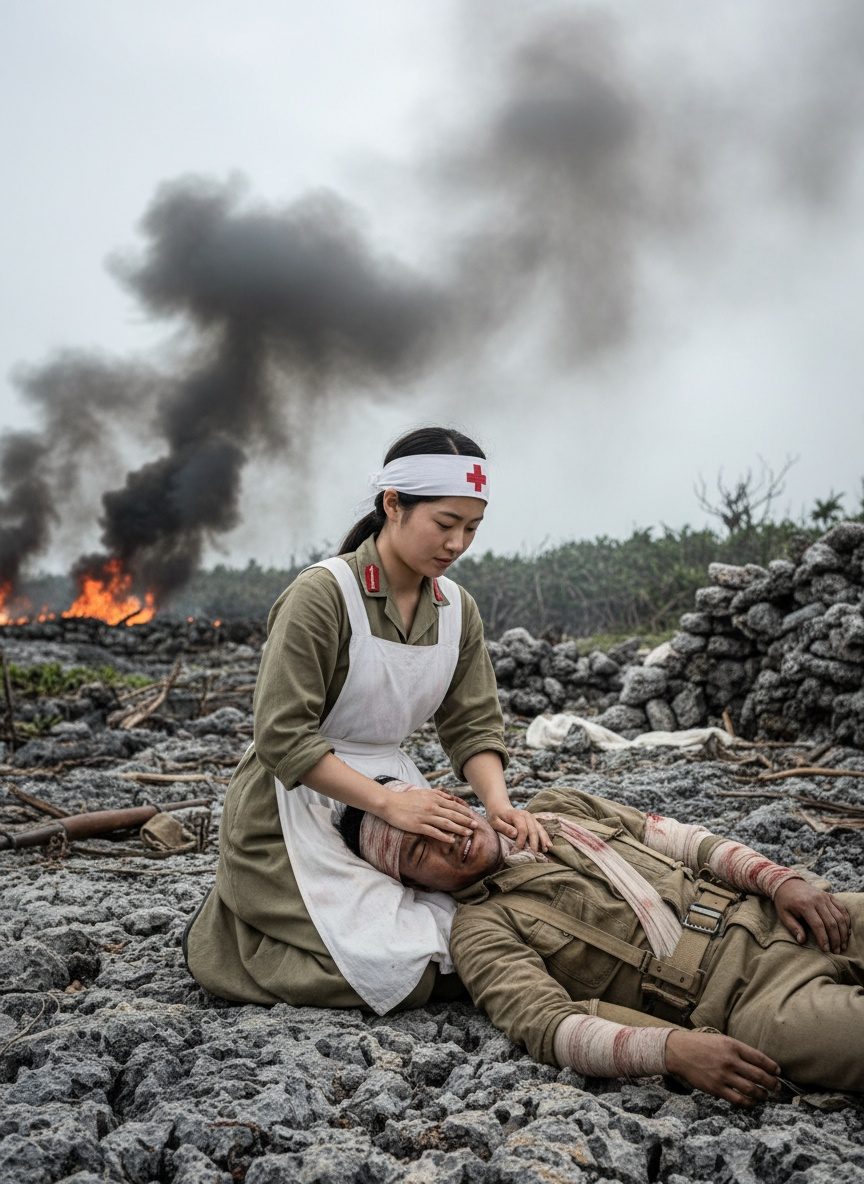
Shima was not a soldier. She wore no uniform of khaki or armor; instead, she donned the white garb of the Japanese Army Nurse Corps. Her mission was not to kill but to heal, a sacred duty she embraced, despite the futility that seemed to hover like a specter over the island. Many of her fellow nurses had been evacuated or redirected, but Shima made the resolute decision to stay behind. It was a choice that reshaped her destiny and etched her name into the annals of unsung heroes.
A March Toward the Maelstrom
The artillery shells rained down with ruthless regularity, transforming the landscape into a hellish quagmire. As the American forces advanced, the Japanese defenses crumbled under the relentless pressure, leaving wounded soldiers scattered and abandoned, their cries for help echoing across the island. With each call, Shima’s determination hardened into something unshakeable. Armed not with a rifle but with the humble tools of her trade—bandages and a small medical kit—she began her solitary journey through the madness of war.
To venture into the battlefield required a courage beyond imagination. The paths were sodden with blood, the air filled with the acrid taste of smoke and fear. Shima moved through it all like a ghost, whisper-quiet and determined, her only intention to reach the fallen. The sound of her footsteps mingled with the chaotic symphony of destruction, each step a testament to unwavering resolve.
The Virtue of Vulnerability
As Shima approached the scattered remnants of Japanese positions, clusters of grimly tenacious soldiers greeted her with incredulous looks. Her presence was both a source of fierce encouragement and a poignant reminder of the fragility of life. Each bandage she wrapped, each word of comfort she offered, was an act of defiance against the inevitable march of annihilation.
The men she tended were often too stunned to speak at first, the horror of the battle leaving them wide-eyed and silent. But as her gentle hands worked, something remarkable often unfolded. Shackled by neither weapon nor armor, Shima’s vulnerability nurtured trust and hope amidst despair. The wounded soldiers, motivated by her unwavering bravery, found they too could confront the horrors that had once seemed insurmountable.
Whispers of Survival Against the Dying Sun
The battle for Okinawa dragged into early summer, with terrifying casualties that left an indelible mark on both sides. Shima Iwashita’s actions during those grim weeks were not of grand tactical importance or political discourse. Instead, they spoke to a deeper, personal victory—the ability to persist where others faltered and bring healing into a world fractured by chaos.
As the fighting waned and the harrowing stillness settled over what remained of the field, Shima emerged as one of the last women standing. The relief she found in the sight of sunrise was mingled with grief for those left behind. The ravaged island, witnessing the first light tip-toeing on the horizon, stood as a silent witness to the sacrifices of so many lost in the fog of war. Yet, the whispers of survival began to swirl, whispers carried by Shima and the few remaining souls who had clung to life.
A Symbol of Singular Courage
Shima Iwashita’s story is not well-known outside specialized circles of World War II scholars, a shadow of the grand narratives that often dominate textbooks and media. Yet, her tale is a timeless narrative of individual courage and humanity's capacity for compassion amid darkness. In choosing to walk into the fire line alone—armed with nothing but her resolve and skill—Shima became a symbol of the quiet, sometimes hidden, acts of valor that shape the undercurrents of history.
Why revisit her story, then, in a world so far removed from those brutal days of 1945? Because history thrives not only on the grand strategic calculations of generals and leaders but equally on the actions of quiet heroes. Shima reminds us of the profound impact of a single person’s dedication to life amidst overwhelming violence. In every era, the most powerful stories are those that remind us of our shared humanity. Shima’s legacy, a gentle yet piercing reminder, urges that even in the darkest times, light still finds a way through smoke and ash.