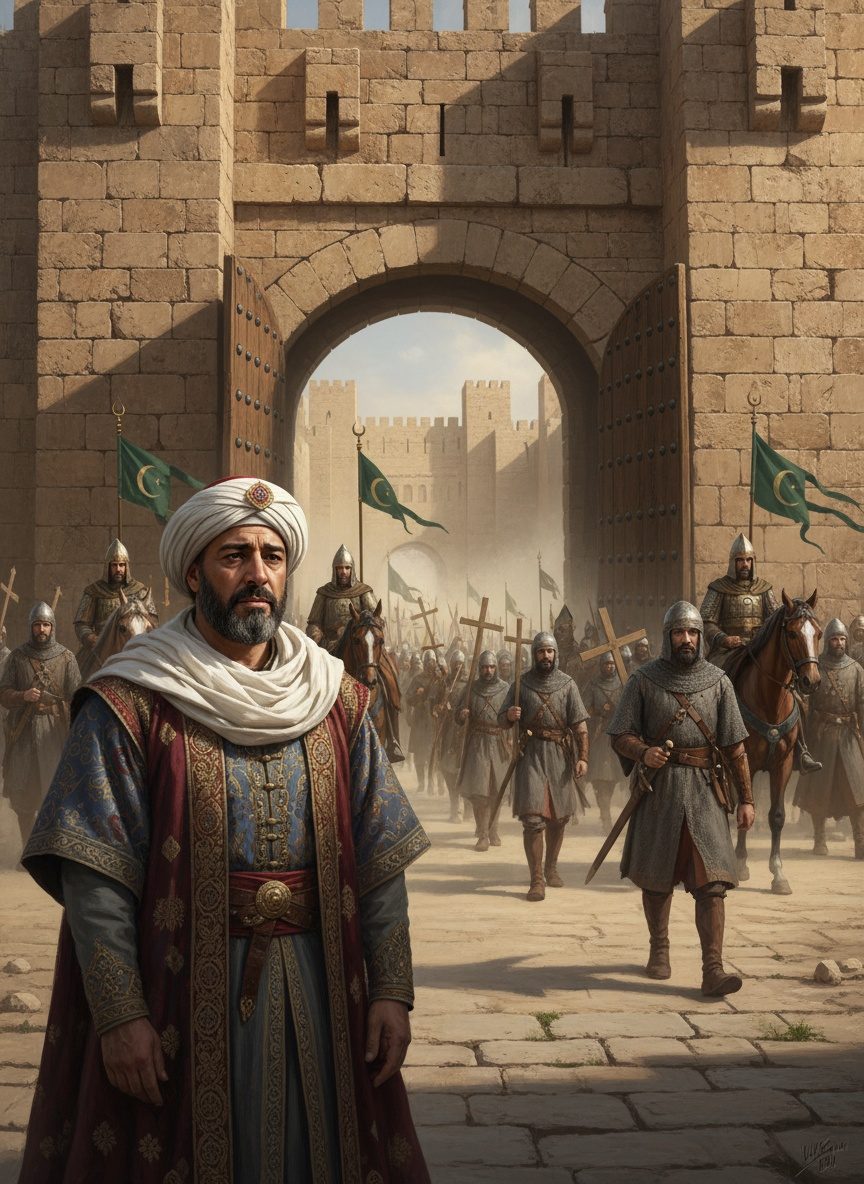
The desert sun blazed overhead as Ahmad Baba's chains clinked with each laborious step. His feet sank into the unyielding sands of the Sahara, every muscle in his body fatigued from the relentless march. The once-great scholar of Timbuktu could taste the acrid dust on his lips, which clung to his skin and filled his nostrils, leaving behind the bitter reminder of the city he was forcibly leaving behind. All around him, the members of the Moroccan convoy marched with the mechanical precision of soldiers, their stony vigilance a reminder of the authority they wielded.
Ahmad Baba’s mind, however, was elsewhere, dwelling on the echoes of whispered voices that once filled the air of his personal library. Those were the voices of scholars, of debates carried into the night by candlelight, of dusty tomes filled with the wisdom of ages. Before the fiery devastation, before the soldiers clad in foreign armor pillaged the beloved halls of Timbuktu, Ahmad Baba's library had been a bastion of knowledge, a treasure trove of African scholarship and Erudition. The clatter of brittle pages drowned in flames resounded in his ears as acutely as the dry crunch of sand underfoot.
Even in chains, transported through miles of unforgiving desert on the whims of conquerors, Ahmad Baba clung to the conviction that knowledge transcended shackles. Through the ravages of the trek, his thoughts remained as free as the wind sweeping across the shifting dunes. Upon finally reaching Marrakech, a city pulsating with a history of cultural fusion yet dominated by the martial might of its rulers, Ahmad Baba was thrust into confinement. But in budding conversations about the nature of existence, ethics, and the sciences, Ahmad Baba found the seeds of liberation that no oppressor could confiscate.
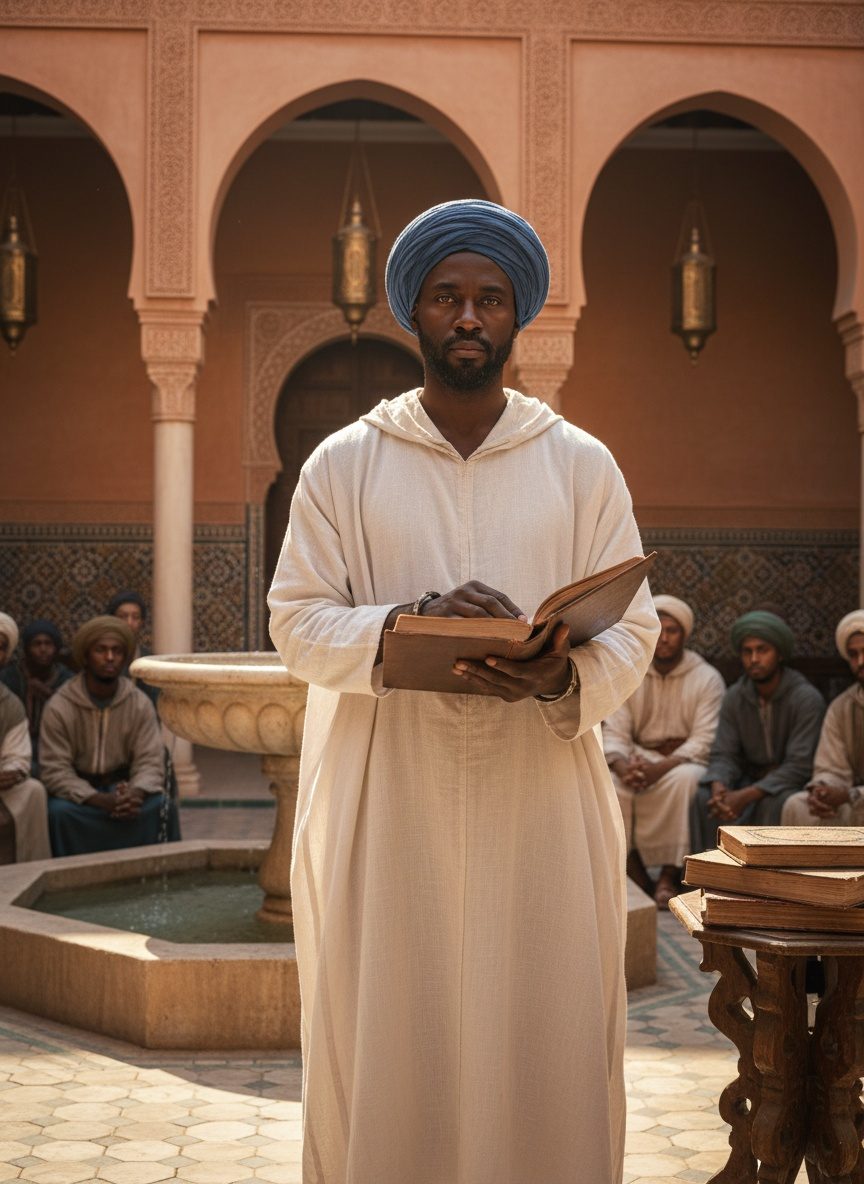
The dusty streets of Marrakech carried the whispers and cries of its residents, a gallery of voices interweaving tales of merchants and mystics under its facades of intricate Moorish arches and stately palms. Despite the chains that bound him, Ahmad Baba cultivated an audience — not by pronouncements or proclamations, but through patient conversation and by posing questions deeper than any fetter could allow. His questions blossomed into lectures and those lectures became a beacon, attracting scholars who marveled at his brilliance and resilience. Within the shadows of confinement, a school emerged, born not of bricks and mortar but of ideas and dialogue.
This new assembly, conjured from embers of discourse, defied all expectations placed upon him by his captors. Guided by Ahmad Baba's astute mind, Moroccan scholars were introduced to the vast knowledge of West Africa, enriching their understanding of the world and transcending geographical limits that the desert seemed to impose. It was an intellectual exchange faceted by the trajectories of contemporary science, religious teachings, and philosophies that crossed oceans and traversed boundaries to find solace in each word he spoke.
What Ahmad Baba achieved in the shadow of captivity was nothing short of remarkable. Here stood a man stripped of his material possessions, yet abundant in his determination to expand the horizons of humanity's collective consciousness. His quiet but profound defiance underscored the enduring power of knowledge, echoing through the corridors of time, a luminescent thread woven into the vast tapestry of human history. His legacy, built upon spoken word and shared inquiry, helped reforge the connection between African intellectualism and the rest of the world — a bridge his captors never intended to cross.
This story of Ahmad Baba is not simply one of personal resilience or intellectual endurance; it is a testament to the inexhaustible spirit of learning that transcends the chains that seek to bind it. It is a narrative that reminds us of the geographical expanses where intellectual centers thrived, far removed from the Eurocentric view that often dominates historical recitations. His life implores us to reflect upon the potential within each of us to resist oppression not through rebellion but through the transformative power of education and dialogue.
The corridors of history are filled with stories like Ahmad Baba's, tales that challenge us to reconsider our perspectives on strength and legacy. Through the footprints left in red Saharan sand, Ahmad Baba's journey illuminates an indomitable undercurrent in the history of African kingdoms — a lineage of thought leaders who, despite adversity, refused to be silenced. In an era when silence was not an option, Ahmad Baba’s voice carried on the wind, continuing to teach and reach farther than any force could restrict.