The sound of horse hooves echoed sharply off the cobbled stones as a band of traders clattered through the bustling streets of Antioch, their carts laden with silk, spices, and stories from far-off lands. To an eye untrained in the intricacies of road networks, the scene might seem like any other busy day in a flourishing city of the Roman Empire. However, for those traversing the sophisticated highways of the ancient world, the journey through Antioch was emblematic of a fascinating truth: as much as Rome was the heart of the empire, its arteries of commerce and communication favored other cities.
A Web of Ancient Highways
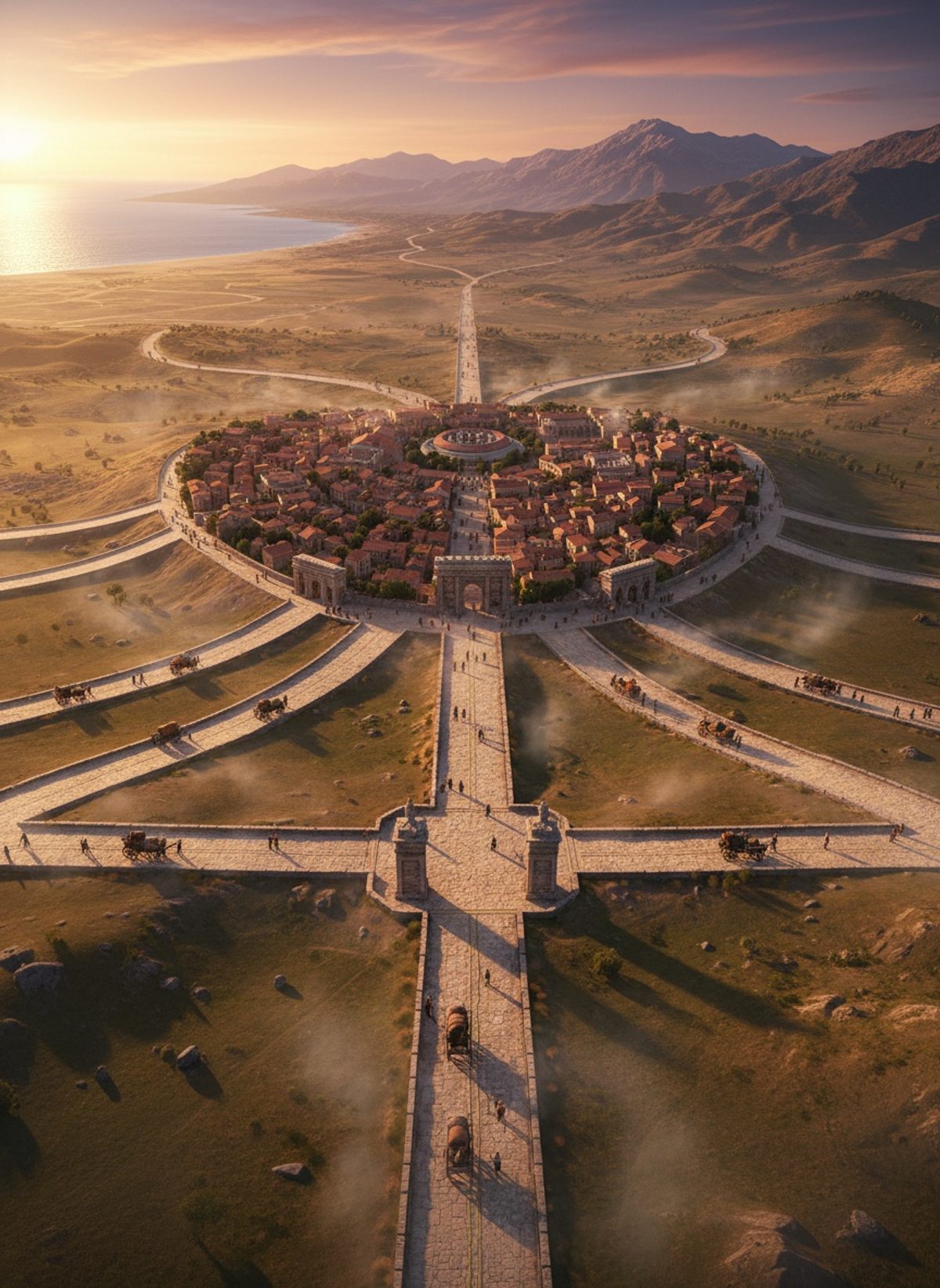
When we imagine the vastness of the Roman Empire, the phrase "all roads lead to Rome" effortlessly springs to mind. Yet, a recent study of the Roman road network spanning nearly 186,000 miles depicts a more nuanced picture. The research reveals that several cities were not just mere waystations on the route to Rome; they were actually better connected. Antioch, Ancyra (modern-day Ankara), Byzantium (known today as Istanbul), and Corinth had road networks that linked them more efficiently to the geographic tapestry of the empire than even the capital itself.
These bustling hubs proved pivotal in the Roman Empire’s grand infrastructure, functioning as vital connectors in the ancient world. Imagine hopping on a chariot in Antioch—the city infamous for its strategic military position and cultural blending—and navigating the Levantine coast. From here, a traveler could trace routes that breezed past the Aegean Sea and connected you to lands thrumming with life and trade. In this vibrant setting, the roads were arteries bringing in diverse influences and people.
The result was a network less focused on the eternal city of Rome and more on practical power and reach. The cities were connected in such a way that facilitated commerce, military expeditions, and cultural exchanges more than serving the singular purpose of directing everything toward Rome. Bold adventurers, goods from distant lands, and the circulating ideas and culture placed these cities at the fulcrum of an amazing swirling network—a network where Rome wasn't always the center, despite its prestigious reputation.
The Road Less Traveled (By Rome)
Follow the Roman road through the eastern portions of the empire, and a different route entirely emerges. This significant path wound its way through Antioch, passed near Ancyra, crossed the Bosporus at the ever-resilient Byzantium, and then branched across Europe through the Po Valley into Milan before it snaked into France. Traveling this way was to witness firsthand the vital geopolitical links that the emperor relied upon.
In particular, Byzantium served as a city unlike any other, positioned at the confluence of Europe and Asia, it was a bridge uniting cultures and conduits for armies on the move. As traders moved swiftly along these routes, from the lands of the Greeks and beyond into Persian territories, one imagines the exchange of not just spices and silks, but a rich mosaic of philosophies, technological advances, and new ways of governing empires that crossed linguistic and cultural barriers.
These roads outlined a superhighway that allowed not just Roman citizens, but all peoples governed by Rome to experience life in a cosmopolitan world. This network connected deserts to forests, mountains to valleys, creating a web through which the empire's lifeblood—commerce, ideas, and, crucially, governance—could flow. The network was less about the grandeur of Rome itself and more about integrating a wide-ranging global landscape.
The Story Rome Didn't Tell
In Rome, where the grandeur of the Colosseum and the Roman Forum represented the political might and architectural achievement of the Empire, a misapprehension lingered. Even amid Rome's monumental structures and the cacophony of its marketplaces, the empire’s most essential routes subtly directed the whispers of trade winds away from the capital's walls. This was a truth to be discovered not in the thriving core of Rome, but in the quieter interactions at its periphery.
On the ground, Roman roads served very pragmatic purposes. They were pathways to places that mattered more than simply connecting bureaucrats in the heart of Rome. For the citizens bustling through crowded streets in Ancyra, the roads meant access to Mediterranean trade winds; for Byzantium's inhabitants, they represented resilience and continuity. These routes shaped everything from military campaigns to the spread of Christianity, highlighting essential footnotes in the narratives of empires.
Today, understanding this network provides a fresh perspective on how and why the Roman Empire effectively managed such a sprawling dominion. It’s a reminder that the heart of an empire isn’t always where tradition says it is. In an ancient world where all roads supposedly led to Rome, it was the serpentine passageways of the empire that truly unified its expanse, endowing significant gravitas to cities that, while less glorified, were pivotal in the Roman narrative.
This story resonates even today, as we ponder the significance of how people and places are interconnected in our modern world. The ancient roads of the Roman Empire are a testament to the power of connectivity, a crucial element that transcends brick and mortar. They remind us that sometimes the most important connections are not always those that are seen, but those that are felt—an enduring lesson from a past that continues to shape our present.