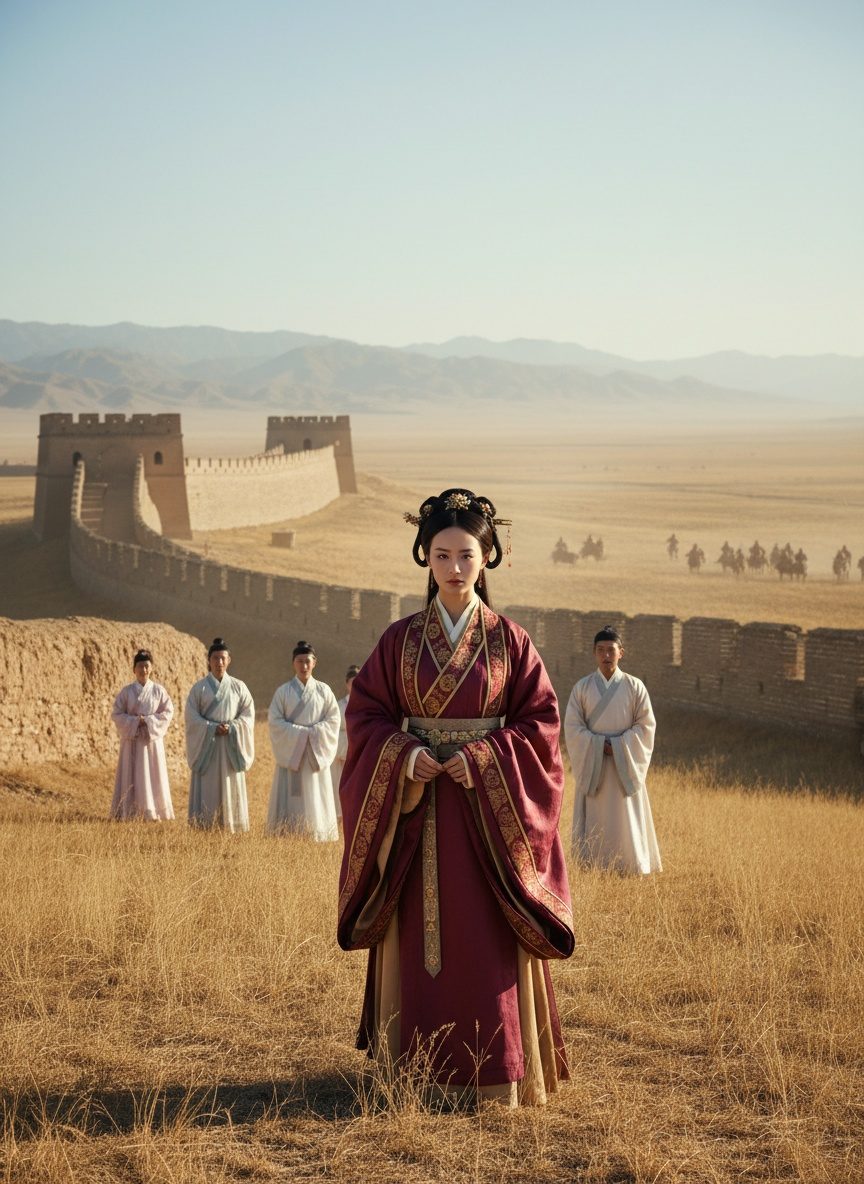
The dawn over Luoyang was muted by a shroud of mist that clung to the city's tiled rooftops. A hush lay over the imperial courtyard, broken only by the distant trill of a lark and the soft rustle of bamboo in the gentle breeze. The air was heavy with anticipation, as if the entire Tang Dynasty held its collective breath, waiting for history to unfold.
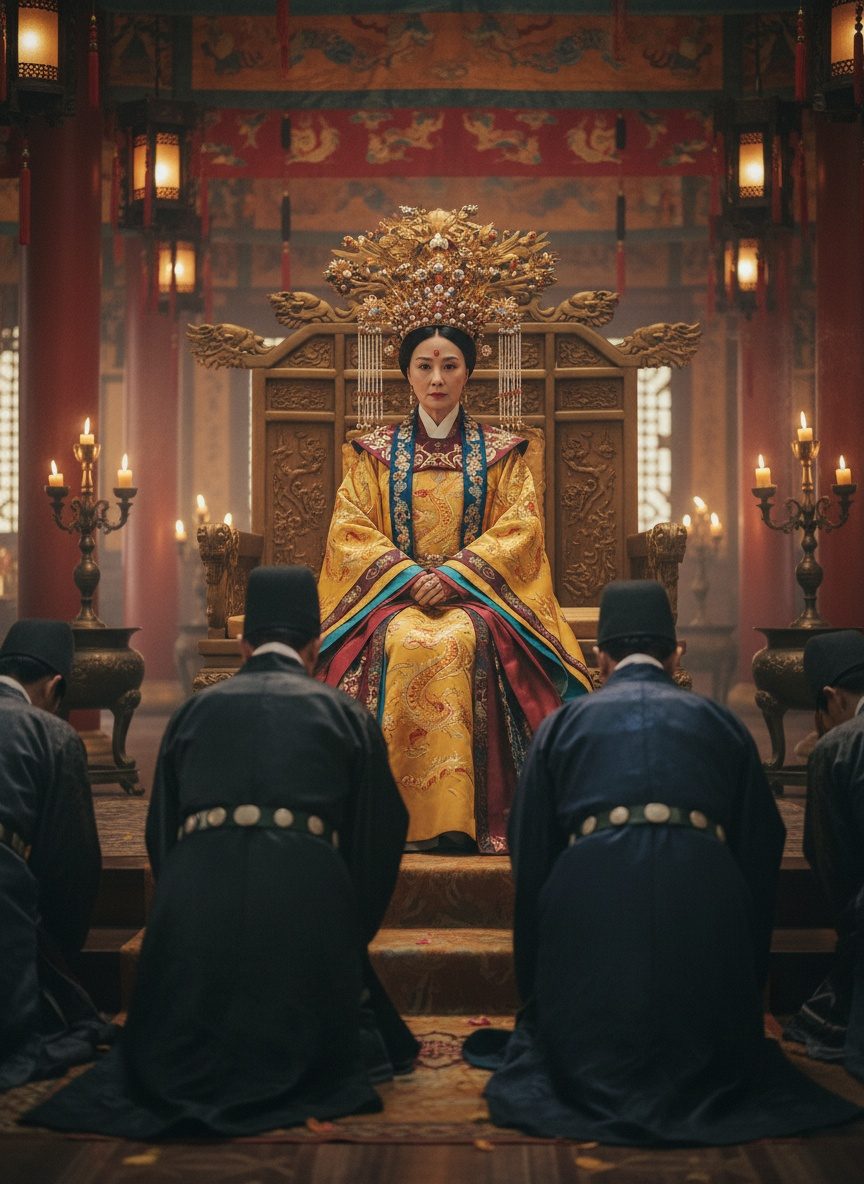
In this charged atmosphere, a solitary figure emerged from the shadows and moved with the authority of destiny itself. Wu Zetian, at sixty-seven years of age, draped in the brilliant golden robes of the Son of Heaven, stepped into the throne room and took her place on the Dragon Throne. The court watched in silence, imagining that perhaps, even they, the grandees of the Middle Kingdom, felt the world tilt on its axis. For the first and only time, China would be ruled by a woman who did not just act as regent or stand beside an emperor but claimed the title of Emperor herself.
Wu Zetian’s rise to power had been nothing short of extraordinary. Born in the year 624 during the reign of Emperor Taizong, she entered the palace as a concubine at the tender age of fourteen. Within the labyrinthine halls of the imperial palace, where ambition and intrigue flowed like wine, Wu Zetian navigated with astute political acumen that belied her youth. With beauty and wit as her allies, she captured the heart of Taizong's successor, Emperor Gaozong. Her status grew from a favored concubine to a lady of the Empress's inner circle, and eventually, her influence extended further than anyone might have predicted or dared to acknowledge.
The journey from concubine to empress dowager was not simply a climb of titles; it was a testament to Wu's remarkable strategic mind. Following Emperor Gaozong's illness, Wu’s ambitions took shape with formidable clarity. In 690 AD, she declared herself Emperor of China, founding her own Zhou Dynasty. Her reign marked a dramatic interruption in the Tang Dynasty, but it was also an era of political stability and territorial expansion. Under Wu Zetian’s control, the empire prospered economically and culturally, fueled by the policies she introduced to streamline government bureaucracy and her keen patronage of the arts and Buddhism.
Yet, Wu Zetian's ascent came at a cost. Her footsteps to power left a trail marked by cunning machinations. She was accused of brutal acts against her rivals, orchestrating the downfall of officials, and even rumored to have eliminated members of her family. These stories, part truth and part slander devised by her adversaries, painted a portrait of a ruler who would not be bound by the conventional shackles of her time. Her apparent ruthlessness, however, was not without purpose. Wu Zetian understood that a woman, reigning singularly as Emperor, had no precedence; she had to command respect and fear in equal measure.
Her governance broke gender rules and questioned the validity of male dominance in Chinese politics. Wu Zetian redefined the cultural and political landscape of her time with reforms that promoted merit over aristocracy. As a champion of Buddhism, she espoused a religious tolerance that curbed the traditional influence of Confucian scholars, who were among her fiercest critics. She leveraged Buddhism not only to support her legitimacy but to forge a common identity across a vast empire marked by a multitude of ethnicities and traditions.
Despite her focus on consolidating power, Wu Zetian did not ignore the welfare of her subjects. She placed capable officials in positions where they could implement land reforms that improved agricultural productivity. She also encouraged the proliferation of education, opening the doors of learning to a broader populace than any dynasty before her. The imperial examinations, established under the previous dynastic regime, took on greater importance, fostering a bureaucracy rooted in ability rather than pedigree.
Wu Zetian's court was also a tapestry of magnificence and innovation. She transformed the capital of Luoyang into an architectural jewel, reflecting both the might and culture of her empire. Works of art flourished in this era, as did the creation of literature that mirrored the complexity and grandeur of an age shaped by an emperor unlike any other.
Yet, her reign was not immune to the forces of time and mortality. By the year 705 AD, her enemies had grown bold. She was deposed amidst palace intrigue led by her own family, finally eclipsed by the male power structures she had so adeptly manipulated. The Tang Dynasty resumed its place on the throne, her Zhou Dynasty relegated to a historical anomaly. Wu Zetian spent the remainder of her life under house arrest, a footnote in the shadow of the empire she helped define.
The legacy of Wu Zetian endures in paradoxes that challenge the simplification of history. Was she a tyrant whose actions secured her an imperial legacy, or a feminist icon whose reign sowed seeds of administrative and social reforms? History often skims the surface, remembering her tenure as a footnote of ambition and enigma shrouded in controversy. Wu Zetian shattered the glass ceiling with the stroke of an imperial pen, rewriting what it meant to wield power in an age dominated by male emperors. It is perhaps the courage to defy the constraints of her era that paints her narrative with the hues of admiration and disdain in equal measure—whispers from the annals of an empire that, for a brief, extraordinary moment, dared to be ruled by a woman.