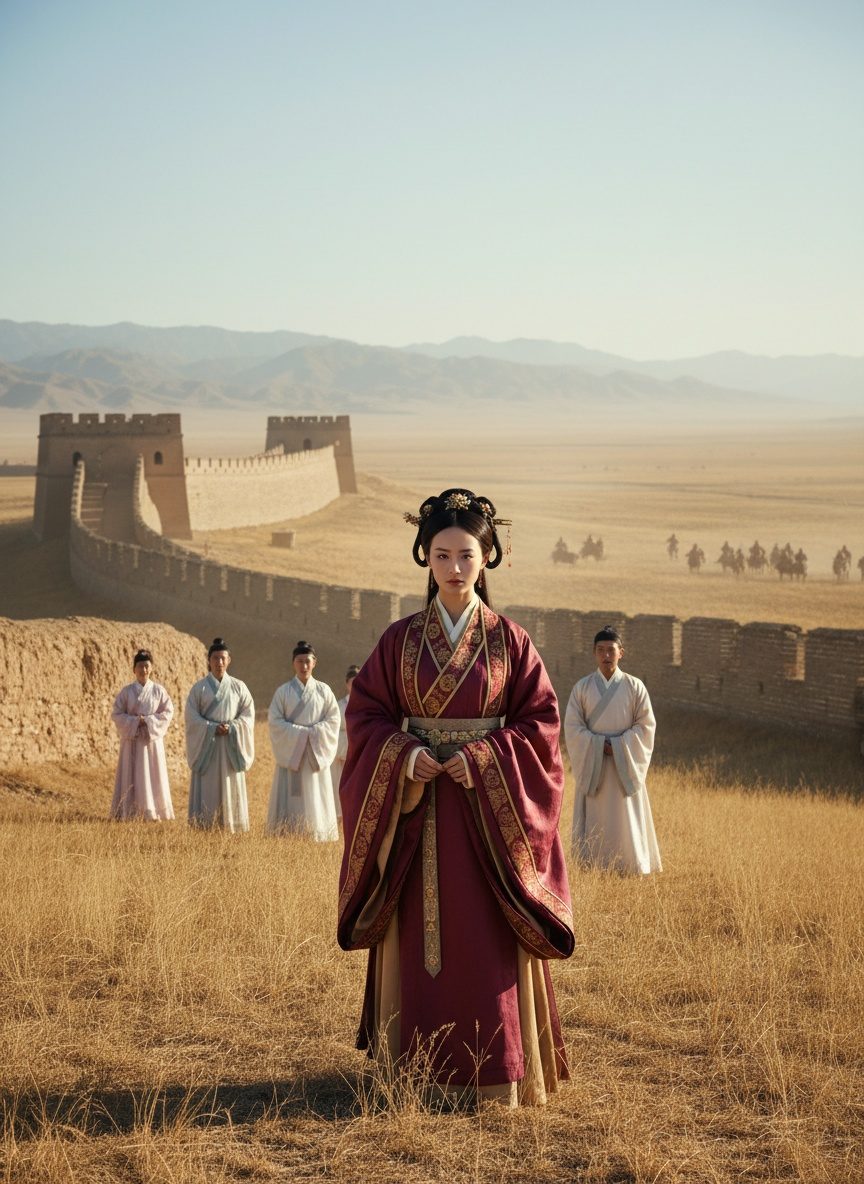
33 BC. The wind swept fiercely across the desolate expanse of the Gobi Desert, sending waves of sand rippling like the ocean’s surface during a storm. In this stark and unforgiving landscape, a lone figure symbolized an epochal union that would echo through the centuries.
Wang Zhaojun, one of the emperor’s numerous consorts, was not a name the court scribes had lavishly illuminated upon the bamboo scrolls of the Han Dynasty. She was neither prominent for political cunning nor known for wielding influence through intrigue or favoritism. In a place where selection was as much a matter of chance as imperial edict, Wang had quietly garnered reputation for her ethereal beauty that was said to outshine even the most vivid peonies in the imperial gardens. Yet it was not only beauty that set her apart; it was her willingness to embark on a journey into the unknown for the sake of her empire—a journey almost every other woman dreaded.
At the heart of Han China’s frontier challenges lay the formidable Xiongnu, a nomadic confederation that had long exerted pressure on the northern borders, their raids leaving scars on the landscape and citizens alike. On the desk of Emperor Yuan, the register of his consorts remained numerous, yet his eyes seeking one in particular found resolve in a young woman’s profile—an embodiment of goodwill to secure vital peace. Desiring alliance over aggression, he proposed a marital bond with Huhanye, chieftain of the Xiongnu. Bravery, such as heralded in the ancient annals with little room for fame-laden pretext, marked Wang Zhaojun as she volunteered to unite worlds with nobility rooted not in blood but in spirit.
The courtiers whispered as she departed the ornate halls, a vision of serenity as she mounted her horse. The path ahead led beyond the hinterlands, through wild landscapes marked not by the architectural grandeur she was accustomed to, but rather by the ancient rhythms of nomadic life and the unyielding breath of the steppes. Towns and villages thinned, the walls of Chang’an fading into memory as the monumental task at hand, the bridging of two distinct yet entwined cultural spheres, loomed large.
Their journey was as much a test of will as it was of diplomacy, the rustle of silk against leather armor a reminder of the delicate balance she must maintain. As she crossed the Gobi, its vastness challenging and unyielding, the sheer scale of Wang Zhaojun’s mission became apparent. The Xiongnu awaited her arrival not with the suspicion one might expect, but with a cautious hope, leveraging every pause in the sandstorm’s fury to glimpse this emissary of peace who was being spoken of throughout the encampments with shrouded curiosity.
This strategic marriage, more than a personal sacrifice, represented a geopolitical chess move, a venture that saw cultures intersect under skies where every dawn was greeted without the certainty of tomorrow. Wang Zhaojun’s life among the Xiongnu was transformative; she embraced customs foreign to her upbringing with a grace that won respect and admiration. Her presence flourished into a living testament to prosperity born of understanding, underpinning the peace that stretched the length of their vows.
Now a queen among nomads, her influence smoothed frayed tensions, aiding in the dissemination of Chinese culture into the expansive steppe regions while welcoming the vibrant nomadic traditions into the imperial consciousness. Trade flourished along routes previously marred by hostility, her legacy upheld as bridges were built both figuratively and literally across the shifting sands of historical divide, allowing a flow of goods, ideas, and innovations that enhanced the subsequent flourishing of Han civilization.
In the years following her marriage, Wang Zhaojun became not merely a consort of pragmatic necessity but a queen revered. Her image ingrained in the tapestry of both Han and Xiongnu, she was elevated to a legendary status. Within the myths and folktales spun across hearths, her vision served as an exemplar of peace and cooperation, the temples constructed in her honor testament to the enduring respect held for her actions.
Time has worked its way through the ancient sands where her journey began, yet the legacy of Wang Zhaojun strides through the annals of history as both a pragmatic diplomat and a culturally transcendent icon. Her choosing the desert over courtly confines speaks of rare courage, singular in its influence and monumental in memory. For it is acts such as hers that fuel our understanding of historical diplomacy—not as clinical treaties or distant edicts, but as human experiences that illuminate the common threads of aspirations and fears shared across time.