History's greatest minds never dined together. But what if they had?
The Unlikely Guest List
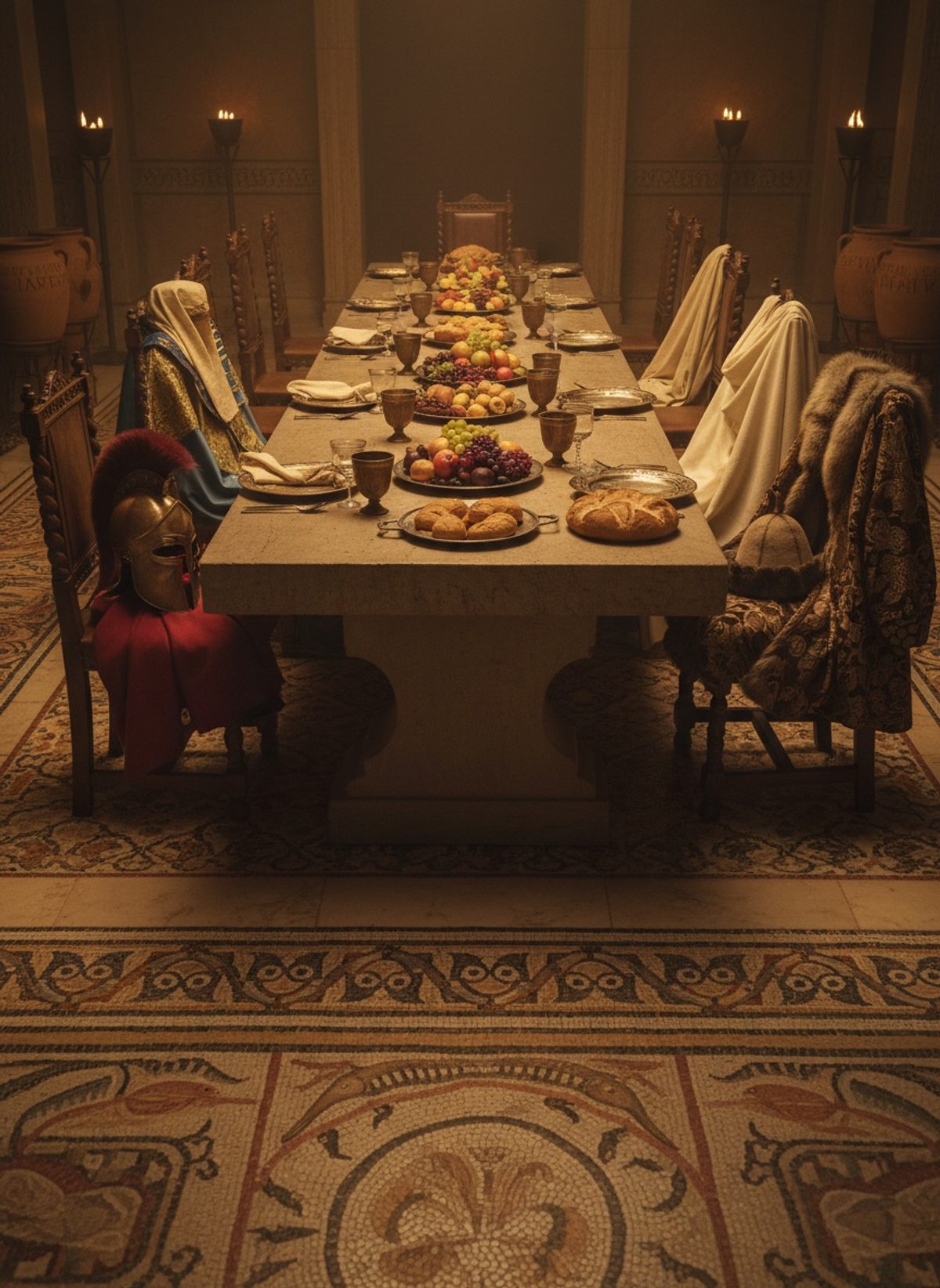
Picture this: a grand table set under a vast, candlelit canopy that seems to span the globe and time itself. At its head sits Julius Caesar, his laureled head nodding in gentle welcome as he pours rich, red wine from a terracotta jug. Beside him, Cleopatra, resplendent in jewels that catch the flickering light, scans the room with an enigmatic gaze, as if eternally waiting for Antony to arrive. Across from her, Genghis Khan sits in silent bemusement, a fork placed uselessly before him as he eyes it like a curious relic of a foreign land.
The table, impossibly long yet intimate, is filled with those who shaped the arcs of history with pivotal moments that have rippled across centuries. Napoleon Bonaparte leans in towards Catherine the Great, two voices of empire whispering about conquests won and lost. At their side, Leonardo da Vinci sketches feverishly in his notebook, lost amidst an idea he cannot wait to manifest into flesh and steel.
This thought experiment collapses time and spans cultures, uniting leaders, visionaries, and revolutionaries in a sumptuous setting far removed from their individual realities. Yet, seated together, these icons offer conversations of power, philosophy, and intrigue that illuminate the complex human tapestry of ambition and consequence.
Silence Speaks Louder
The first course of imagination's feast unveils the nature of turning points—the decisions made in silence or drawn from the depths of intense scrutiny. Julius Caesar's Rome embodies a pinnacle of ambition and political maneuvering, each successful campaign more of a calculated gamble against fate than a mere military engagement. His assassination, a silenced echo of the Ides of March, resonates through this assembly. A whisper of understanding passes through to his modern counterpart—Napoleon, whose imperial ventures similarly ended in abrupt exile.
Contrasting silence fills the air as Cleopatra, the last Pharaoh of Egypt, surveys the faces. She embodies the end of an era, her reign as luminous and complex as the Nile. Her life punctuated by alliances and earth-shaking romances, she sits in conversation only with herself, carrying the unspoken burden of a dynasty's fall. It is perhaps Genghis Khan, with his empire’s disciplined silence and swift conquest, who understands her stillness best. Yet, there's a finality to Cleopatra’s presence—one civilization passing its history on as another rises to rewrite it.
The interwoven threads of individual fates bind these figures together, each a node of influence turning history's wheel. The conqueror beside the philosopher, separated by oceans of time, yet united in these timeless moments, speaks little but knows deeply. What more powerful reflection than the knowledge that the decisions made in silence, by individuals endowed with momentous power, dictated the course of the world?
The Tables We Set
Imagine as the evening unfolds, lesser figures—Emily Dickinson pens quietly at a corner, unseen by most but inspiring many; Confucius, his teachings and wisdom undiminished across millennia, listens in thoughtful repose. They represent thoughts and movements, an undercurrent to the politics of might, adding the texture of human spirit and philosophy to the proceedings.
As the final course is served, Isaac Newton observes the celestial dance of candle flames with the same intensity he once gave an apple’s fall. His calculated universe, seated with faith and fury, draws a bridge of thought over time’s endless river. Across from him, a solemn Greta Garbo breaks her silence with a challenge—an untold mystery left open to inspire curiosity beyond cinema’s realm. Their presence is a reminder that history is not solely written by those who hold power, but by those who dare to question and create.
Each pressed cranberry and succulent fig upon the table bears the weight of human endeavor—food for thought from a banquet of lives lived boldly. As the night draws to a close, each luminary drifts back into their own timeline, leaving behind conversations unfinished and ideas that would take lifetimes to explore. Yet, for a fleeting moment, the world's turning points held council—an indelible mark upon the imagination.
Such a gathering implores us to consider the impact of our own tables, the decisions and conversations that may yet change the world. In this thought experiment of collective histories, we find ourselves asking, which silences might yet speak, and which voices, still absent, await their place? The table, temporarily set with figures across time, reminds us of the possibilities inherent in each of our small, yet potent, spheres of influence. What might we do with the seat we hold, in the precise moment when history pauses just long enough for the next course of action?