The courtyard stones lay slick with the morning's rain, their smooth surfaces reflecting a gray sky still heavy with lingering clouds. The air was thick with the scent of damp earth, mingling with the faint aroma of incense drifting from the distant temple. Here, amid the gentle patter of drips from tiled roofs and the murmur of a city waking to life, an unimaginable gamble was about to unfold. At its heart was a man named Hai Rui, a mere official in the vast machinery of the Ming Dynasty. This was no ordinary day, for on this day in 1566, Hai Rui would do the unthinkable: he would dare to confront an Emperor's tyranny with the stark truth.
The Unyielding Scholar
Hai Rui was born into a modest family, his rise not one of privilege but of sheer scholarly perseverance. Known for his unbending integrity, he earned a reputation as a man who could not be swayed by bribes or threats. In an era where officials often sought personal gain, Hai Rui stood out—a solitary figure committed to Confucian ideals of justice and righteousness. Yet it was precisely these qualities that laid the groundwork for his perilous decision. For decades, Emperor Jiajing held the throne, an enigmatic ruler whose disdain for governance was matched only by his obsession with alchemy and immortality. The empire suffered as imperial interests waned, choked by corruption and negligence. Hai Rui, witnessing the decay, felt a moral summons that could not be ignored.
The Coffin and the Letter
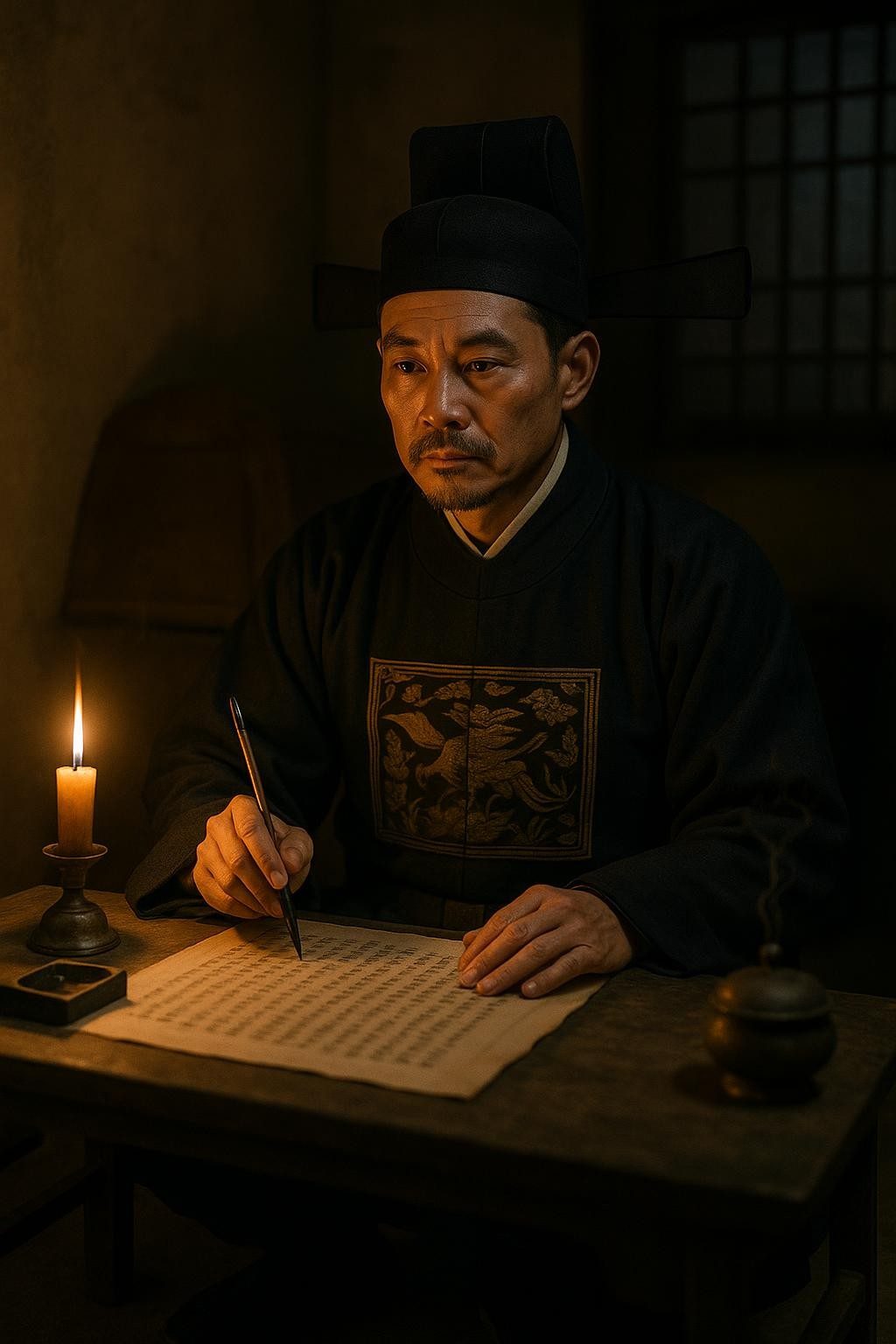
Every step of preparation was tinged with an acceptance of fate. Hai Rui went to the market, not to purchase fine silks or aromatic teas, but something far more macabre—a coffin. Walking through stalls buzzing with vibrant life, he chose the simplest of vessels, a wooden coffin that spoke of resignation rather than vanity. This act was no morbid fascination; it was a clear acknowledgment of the potential consequence of his next action. With his affairs in order and farewells whispered to those he held dear, Hai Rui sat down at his desk. The ink felt heavy on the brush as he etched characters onto a scroll—a letter destined for the Emperor himself. It was a document of spare language yet immense weight, a censure that spared no truth. Hai Rui decried Jiajing's neglect and vanity—a condemnation of imperial neglect that few dared to voice, let alone commit to paper.
The Emperor's Wrath
The letter, once dispatched, traveled swiftly through the channels of imperial bureaucracy before landing in the hands of the Emperor. Known for his temper and unpredictability, Emperor Jiajing's reaction was as fierce as a storm breaking over a serene landscape. Rage burned through the palace walls; how dare a mere official question the mandate of the Son of Heaven? The imperial edict was swift and harsh—Hai Rui was to be imprisoned immediately. Yet, as the gallows’ shadow loomed, the world outside the palace continued in its rhythm, seemingly unfazed. To the citizens receiving favor in small gestures of bureaucratic mercy or justice, Hai Rui’s courage was a beacon. He had shown that honesty had a place, even in a court dominated by sycophancy.
Imprisonment and Reflection
Held in a cell that was little more than stone and shadow, Hai Rui awaited his uncertain fate. Silence was his companion, punctuated only by distant echoes from the outer courtyard. Yet in that solitude, Hai Rui found a serene relief. He was the source of his own peace, unregretting of his choices. This wasn’t the end he wished for, but it was an end he could embrace. It was defiance manifest, not against authority for the sake of rebellion, but for the sake of rectitude and moral courage. Meanwhile, his actions resonated beyond the prison walls, rippling through the echelons of power and inspiring those who craved reform.
The Legacy of Courage
Though time and rulers would pass, the story of Hai Rui endured, preserved in the annals of history not as a cautionary tale, but as one of timeless relevance. His bold stand against despotic rule is a reminder that the pursuit of justice requires bravery—not only to act against wrongdoing but to accept the consequences that may follow. By standing firm in his conviction, Hai Rui became an immortal figure in Chinese culture, regarded as an exemplar of incorruptibility and principled action. In a world often dominated by power and position, Hai Rui's legacy challenges us to consider the profound impact of a single voice raised in truth. His story remains, etched in the consciousness of a nation, a narrative of a man who defiantly chose to speak—long before the last breath was drawn.