519 BC. The sun cast long shadows over the opulent halls of Susa.
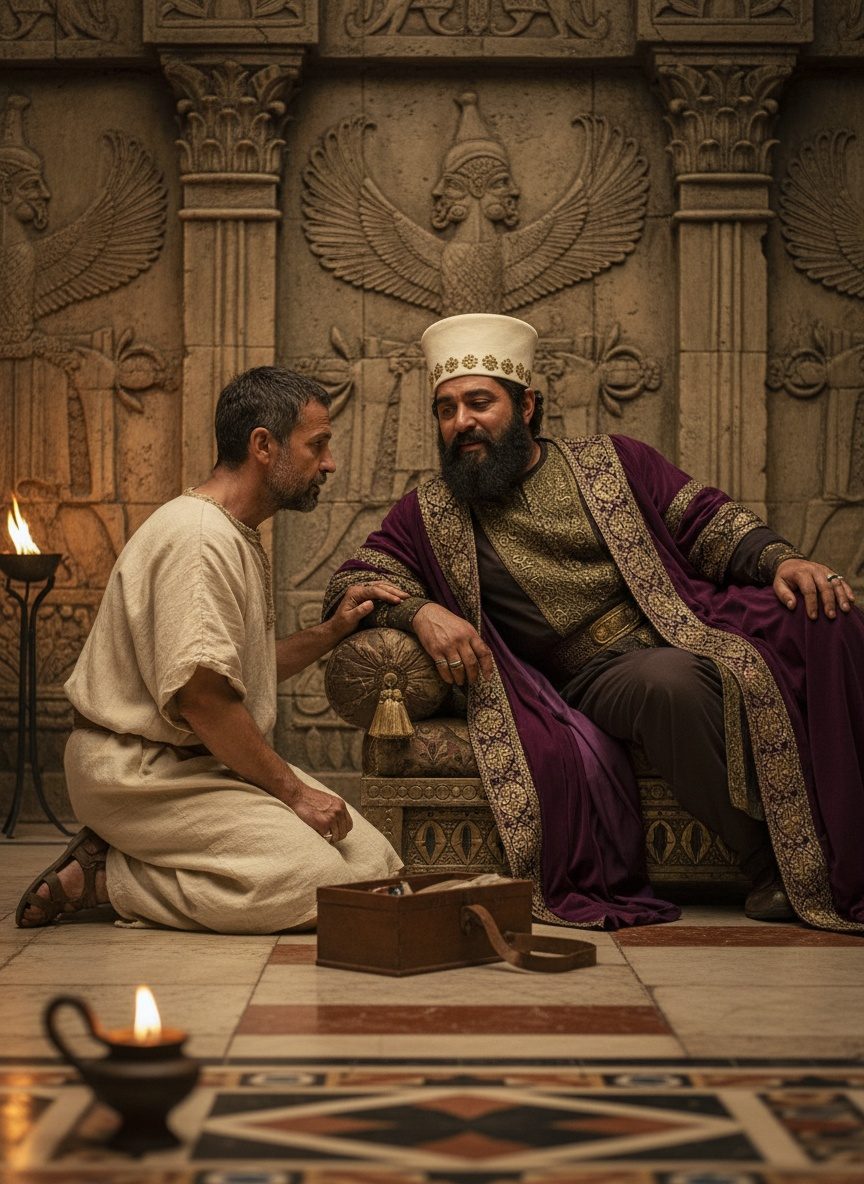
In the heart of the Persian Empire, amidst marble floors and towering columns, a king lay in distress. Darius the Great, celebrated ruler of lands stretching from the Indus Valley to Thrace, was in pain. The mighty empire he commanded seemed to tremble as physicians scurried about, seeking remedies to ease his suffering. Yet none could find success until a foreign hand reached forward to touch the king's brow, a Greek slave named Democedes of Croton.
The story of Democedes is found woven into the annals of history, testament to both his skill and fate. Born in the Greek city-state of Croton, known for its intellectual prowess and athletic excellence, Democedes was not a man of war but one of healing. His path to the Persian court was marred by misfortune. Captured during a raid, he was sold into slavery—a common fate for many whose cities fell to greater powers. Yet his captivity led him to a place where his talents would not only be tested but revered.
On that particular day in 519 BC, the silence in Darius’s chamber was punctuated only by the king's labored breaths and the soft shuffling of servants. None present had suspected that a Greek could succeed where esteemed Persian healers had failed. But Democedes was no ordinary physician. Whispered tales of his healing prowess had spread through the court, reaching Darius's ears.
Methodically, Democedes began his work, combining his knowledge of Greek medicine with the resources available in the Persian court. He employed mixtures unfamiliar to the Persian doctors, adjusted the diet and rest of the great king, and watched as, day by day, the powerful Darius rose from his bed, strength returning to his limbs. The king was healed, and in his wake, admiration for Democedes blossomed. Gratitude coursed through the chambers of Susa, reaching its pinnacle when a sovereign offered freedom to his savior.
Darius, in a gesture of generosity that was both unexpected and magnanimous, offered Democedes anything his heart desired. It was a choice few slaves would ever dream of: wealth, land, perhaps even a place of honor in the king’s court. But Democedes's wish was simple—freedom and passage home to Greece. His request was met with an emotion unexpected from a ruler hardened by battles and governance. Darius wept.
These tears were not those of anger or loss but of a bittersweet realization that, sometimes, true loyalty and freedom dwell hand in hand. Moved by Democedes's longing for home, Darius acceded to his request but with the added weight of wisdom. He extended an offer: to remain at the court, not as a slave but as the royal physician, a free man in service to an empire like no other.
The Greek physician chose to stay, bound not by chains this time, but by a newfound respect and kinship with a king who had shown him a rare grace. It was an arrangement few could have anticipated, a melding of cultures separated by vast seas and languages. Yet through medicine, Democedes found not only freedom but an unlikely companion in one of the ancient world's most formidable figures.
As Herodotus recorded, this episode was more than just a tale of service and reward. It marked a moment where the boundaries between conqueror and captive blurred, replaced by an understanding intrinsically human. The decision of Democedes to remain by Darius's side may seem perplexing, yet it underscores a deeper truth about identity and belonging. For Democedes, the Persian Empire, with its grandiosity and power, had become his stage, one where his talents could not just be exhibited but celebrated.
In the years that followed, the physician's influence would ripple through the corridors of power, advising not just on matters of health but serving as a bridge between the sophisticated world of Greek antiquity and the formidable Persian state. His story, recorded by Herodotus, teaches that sometimes our greatest allies come from distant lands, and our greatest choices come from the heart.
The significance of Democedes's decision resonates through time. In a world that often sees power in opposition, his life illustrates how bridges can be built through shared human experiences, transcending the circumstances of one's birth or the borders of one's homeland. More than a simple healer, he became a symbol of reconciliation and cooperation, whose legacy challenges the notion of freedom, loyalty, and the unseen ties that bind us all.