The evening air kissed the mountaintops with a peculiar softness, the sun painting vibrant streaks of orange and violet across the endless sky. In the valley below, shadows stretched long, threading through the dense forest that clung to the rugged landscape. It was a tranquillity that belied the danger weaving through this serene tapestry—Nezahualcoyotl, the fugitive prince, was being pursued, the decrees of death echoing behind him like the relentless call of an ominous drum.
Tezozomoc, the ruthless ruler of the Tepanec kingdom, had already extinguished the life of Nezahualcoyotl's father, plunging the once-thriving city of Texcoco into turmoil. Now, the prince was his next target. With Tezozomoc's hawk-eyed warriors scouring every ridge and valley, Nezahualcoyotl remained one step ahead, evading capture across the mountains that cradled the ancient Mexican landscape. It was a game of cat and mouse, driven not just by the lust for vengeance from Tezozomoc but also by the undeniable will of a young prince who had yet to craft his own legacy.
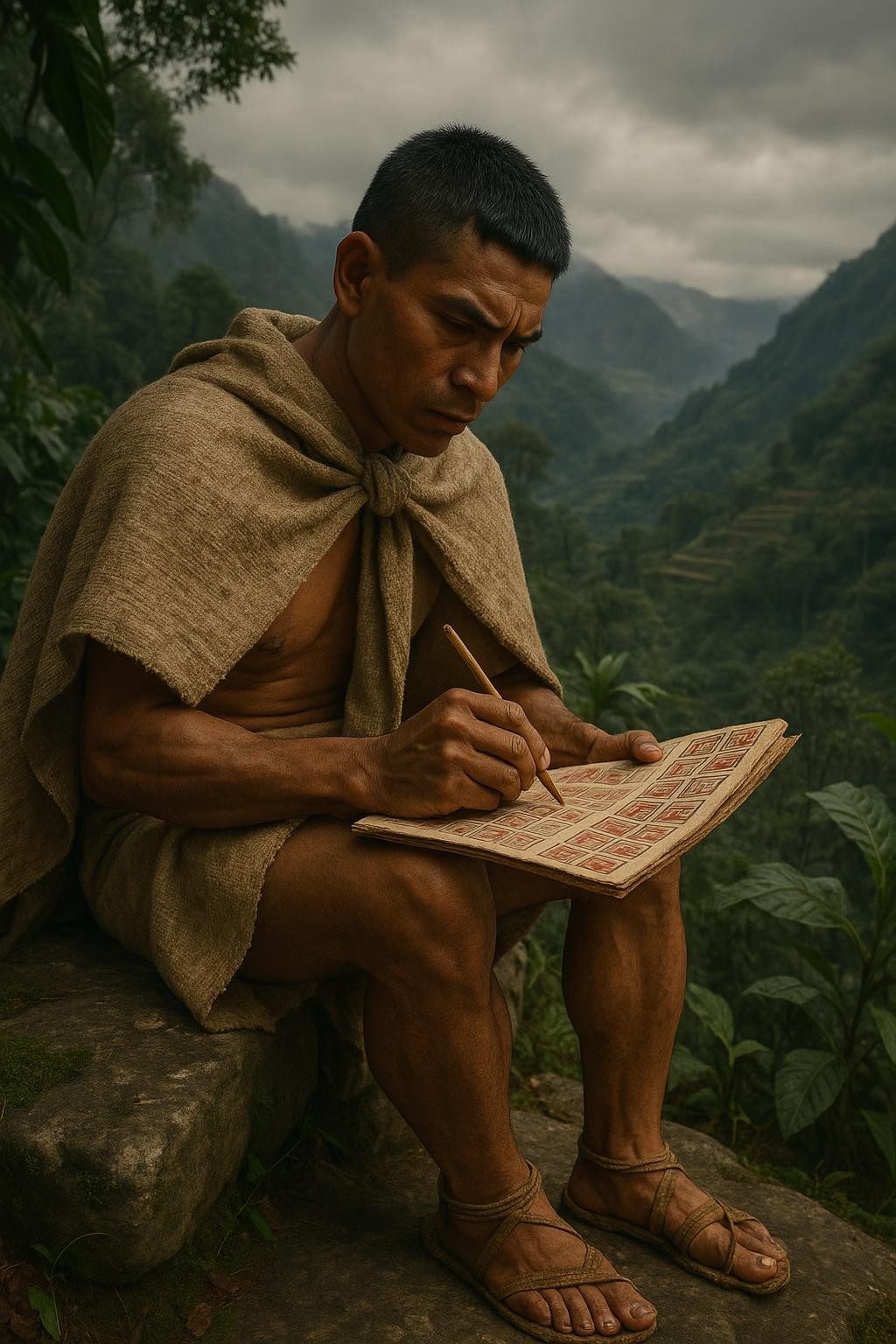
The prince's thoughts were not consumed by the clang of arms or the thrill of combat. Instead, in those moments snatched in respite, he turned to the solace of poetry. Nezahualcoyotl picked up a humble reed, its tip dipped in ink, and began to write. His poetry was not roused by the bloodshed that threatened to seal his fate, but by the captivating beauty he perceived around him—by the fleeting nature of life, by the ephemeral existence of flowers, and by the divine symphony he believed to resonate in the cosmos. In a world torn asunder by conflict and ambition, Nezahualcoyotl channeled his thoughts into verses that captured the essence of a life lived close to the edge.
Hidden amidst the verdant canopies or alongside the whispering brooks, Nezahualcoyotl found inspiration even in the looming presence of death—an ever-present adversary. His words gave voice to his yearning for peace and reflection, their cadence echoing the duality of existence, where every moment of beauty was shadowed by mortality. The very act of penning those words became his shield and solace, each stanza a defiant beat against the tyranny that sought to silence him.
Tezozomoc's forces were relentless, their footsteps resonating through the corridors of history, yet Nezahualcoyotl's words became an eternal testament that resonated far beyond the temporal reach of his enemy's power. As Tezozomoc’s demise loomed—a consequence of both time and the alliances that rallied against him—the seeds of Nezahualcoyotl's poetic musings were quietly taking root in a world that yearned for the wisdom of his verses.
The prince's narratives didn't only dwell upon the fragility of life. They delved into the profound questions of existence, exploring themes that connected the ethereal beauty of a flower to the profound mystery of the divine. His verses pondered the nature of deities, depicting God as a creator intertwined with creation, weaving together a tapestry wherein humans played their part, albeit transiently. These reflections transformed from private ruminations into public declarations of faith and understanding, drawing the minds and hearts of those who, like him, found themselves navigating a chaotic world.
Following the eventual fall of Tezozomoc, Nezahualcoyotl returned to Texcoco, assuming the throne that had been his birthright. Yet, power did not deter him from his poetic pursuits. On the contrary, the sacred role of ruler added new dimensions to his poetry. He constructed gardens filled with flowers that mirrored the subjects of his poems, while his verses multiplied and spread, echoing across generations. Nezahualcoyotl's courts became renowned not just for their political significance but also as bastions of cultural revival—centers where art, architecture, and philosophy flourished under his patronage and personal involvement.
Nezahualcoyotl's reign saw the construction of majestic aqueducts, palaces, and temples, designed with such ingenuity that the echoes of their innovation reverberate down to our time. Yet it was his poetry, those quiet musings crafted under the shadow of a tyrannical reign, that transcended the march of time more profoundly than any stone edifice. His writings, preserved in the hearts and minds of his people, became lasting testaments to the resilience of the human spirit, surviving well beyond the architectural masterpieces he left behind.
Today, Nezahualcoyotl is remembered not just as a king, but as the sage monarch of Texcoco—a ruler whose life was a testament to the enduring strength of words and ideas. His poetry, clandestinely scribed amidst the splendor and precariousness of a fugitive life, invites us to ponder the brevity of life and the indomitable power of creativity. Each line and stanza created by Nezahualcoyotl challenges us to look beyond the face of adversity, to find beauty in transient moments, to question the essence of the divine, and, above all, to understand that even when power fails, poetry can rise on wings of eternity.