Most people today wouldn't recognize the name Cincinnatus. Yet, his legacy is imprinted on the very concept of leadership and civic duty.
The Fields of Rome
Amid the gentle rolling landscape of early Rome, farmers toiled diligently, nurturing the earth under the Mediterranean sun. Among these fields was Lucius Quinctius Cincinnatus, draped in a simple tunic, his rough hands clutching the handles of a plow. Born to a life typical of Roman citizens at the time, Cincinnatus' heart was tied to the soil, unaware of the impending events that would place him at the forefront of Roman history.
Life in the Roman Republic was a precarious balance of politics, military strategy, and agriculture. When the Republic was threatened by external assaults, there was often little warning before citizens like Cincinnatus were called away from their plows to pick up the sword. In the year 458 BCE, this equilibrium was threatened when Rome found itself under siege by the Aequi, a neighboring rival intent on Roman destruction. Hard-pressed to fend off the well-organized enemy, the Roman Senate faced a grim decision.
The Call to Power
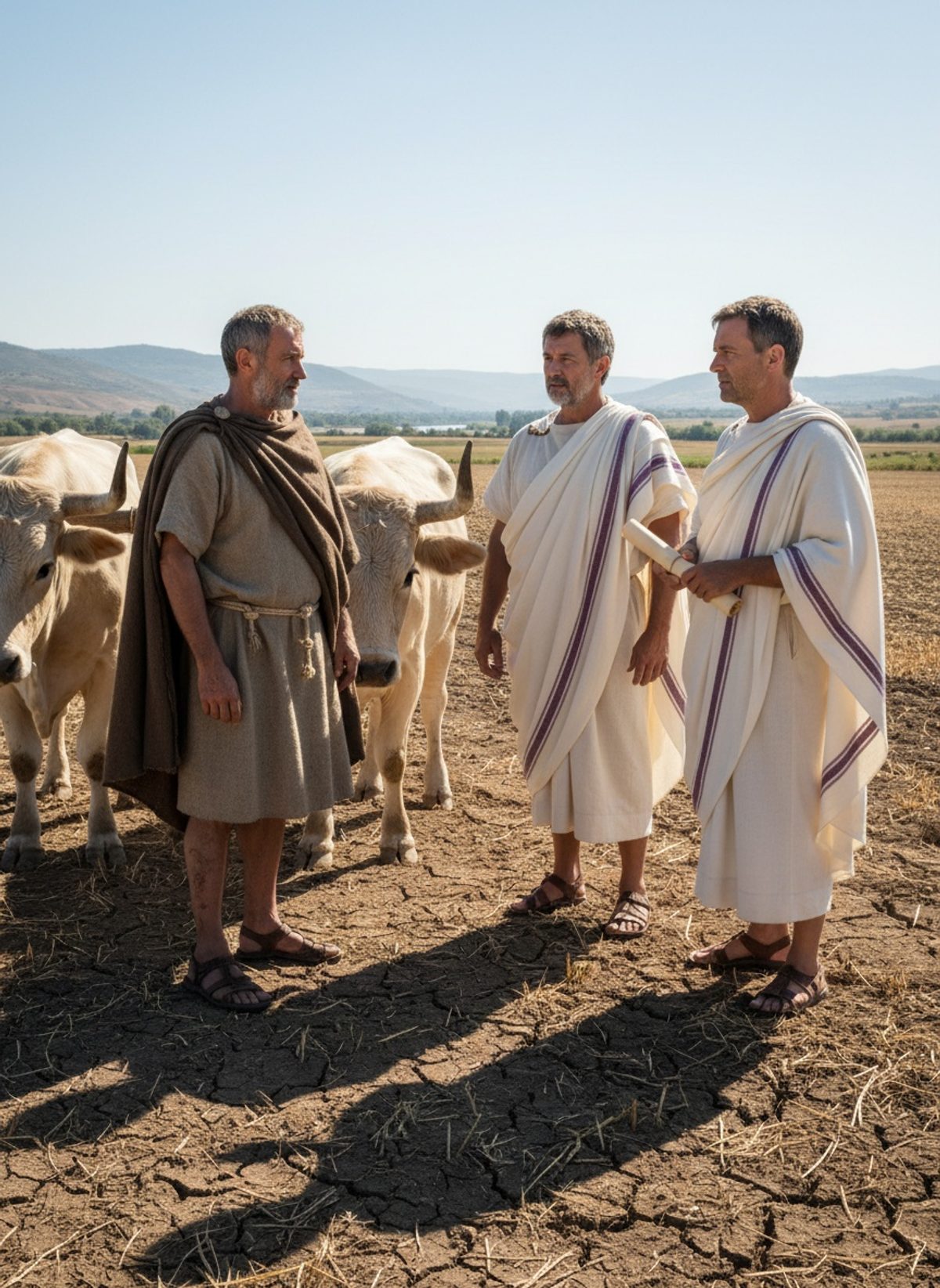
Desperation drove the Roman government to a drastic measure—appoint a dictator, a role given absolute power but intended to be temporary. In this crisis, the Senate’s choice fell to Cincinnatus, a man well-acquainted with the military and political spheres despite his modest civilian occupation. The envoys sent to find him arrived not at a Senate meeting or a grand villa but at his small farm. Cincinnatus embodied the humility of Rome, a reflection of traditional values that extolled the virtues of hard work and service.
The scene of his appointment is rife with contrasting imagery: the dusty fields, the simple tools of his trade, and the weighty togas of the senators who pleaded with him to leave his plow in the dirt. The urgency in their voices cut through the serene pastoral landscape; Rome’s survival hung in the balance, and its savior was a farmer-citizen. This juxtaposition of the provincial and the political highlights Rome’s foundational belief in duty over desire.
The Triumph of Rome
Once clad in the military garb of a Roman leader, Cincinnatus acted swiftly, embodying the very efficiency the Republic required. Rome’s legions were hastily rallied, invigorated by his inspiring leadership. The march against the Aequi was relentless, culminating in a decisive encounter on the battlefield. Within a mere fifteen days, the skirmishes saw the disciplined forces of Rome crush their foes, with Cincinnatus orchestrating a victory both strategic and swift.
This military campaign was as much about tactic as it was about fortitude. Cincinnatus’ ability to unite the fragmented Roman forces under a single purpose speaks to his adept command and inspiring persona. As the Aequi were subjugated, the victory echoed throughout the Republic. Yet amid the triumphant celebrations, Cincinnatus’ actions would soon create even greater ripples through history.
A Return to the Soil
In the monumental aftermath of their victory, Cincinnatus made a decision that would define his legacy. Despite the Supreme power vested in him, he chose to relinquish it, abiding by the unwritten creed that governed Roman civic life. With the Republic secure, Cincinnatus restored authority to the Senate and returned to his plow, enacting the very essence of restraint and civic responsibility.
This gesture captivated the Roman people, his reputation for humility shining with vibrant clarity. While others might have clung to dictatorial power, his actions mirrored the spirit of the Republic itself. Cincinnatus became an enduring symbol of virtue and selflessness. The image of a man who could hold the reins of power, yet choose his plow over the trappings of authority, transcended time; echoing through Roman culture and the annals of history.
In recalling the story of Cincinnatus, we confront one of the most profound paradigms of governance: the value of power lies not in its exercise but in understanding when to let it go. His legacy challenges our perceptions of leadership, reminding us of the enduring power of humility, integrity, and lifelong service. It’s a narrative not merely of one man's triumph but an insight into the heart of a civilization profoundly shaped by its ideals.