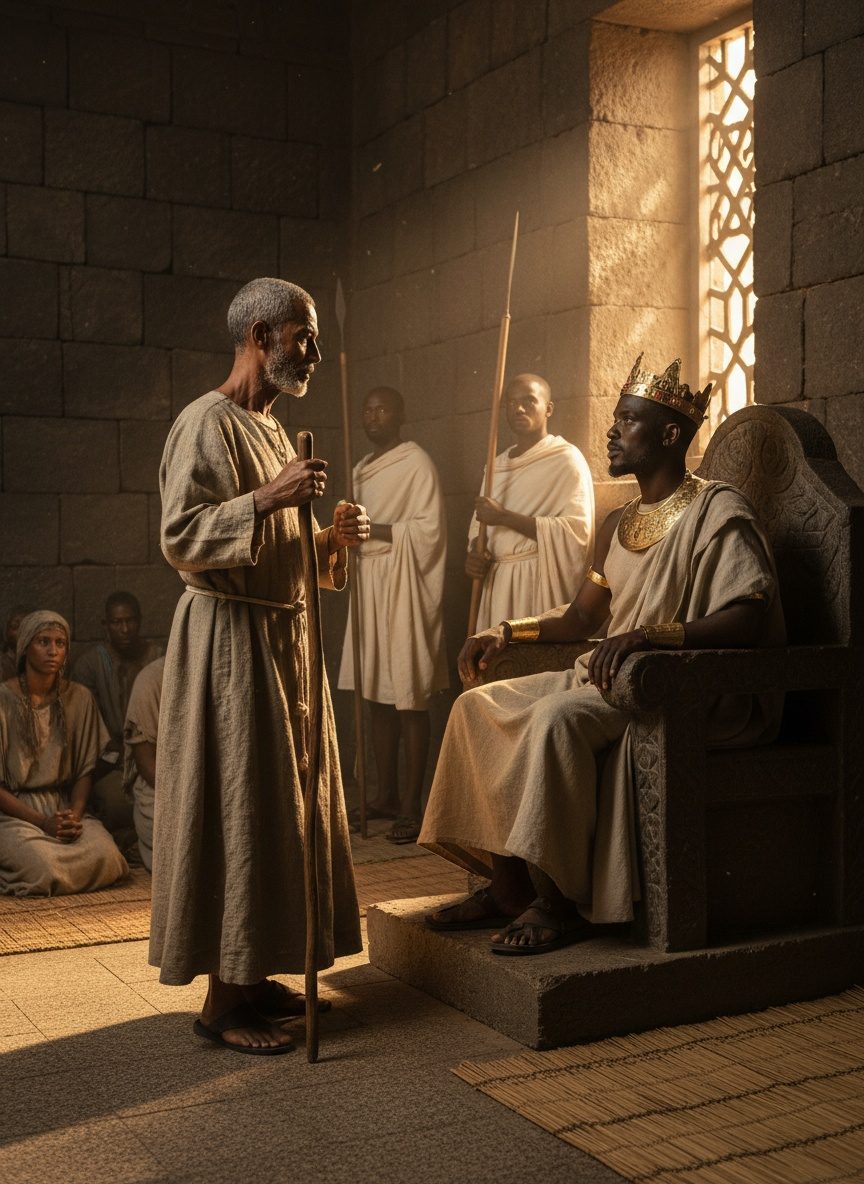
Most visitors to the court of King Kaleb came laden with wealth and requests. Abba Libanos asked for nothing but freedom.
In the kingdom of Aksum, around 520 AD, tales of extravagance and might often held sway. Aksum, a powerhouse of ancient Africa, stretched its influence across the Red Sea and into the Arabian Peninsula. King Kaleb, the sovereign ruler, commanded a kingdom where the distribution of immense wealth was the norm, often serving as a gesture of goodwill or diplomacy. This world of material splendor seemed a stark contrast to the humble entrance of Abba Libanos, a monk known not for his riches or an army, but for his unyielding faith.
The court of King Kaleb was a place of formidable presence, a realm echoing with stone pillars and whispers carried through shadows. Carpets of intricate designs adorned the floors where the esteemed ruler presided, hearing petitioners who approached him with tributes and gifts. Each visitor hoped to sway the king’s mind with treasures that spoke of power and loyalty. Yet it was into this opulent setting that Abba Libanos strode, unadorned and with nothing in hand.
Abba Libanos was a figure marked by simplicity. A man of God whose life was dictated by the precepts of faith and service, he sought the king's audience, not for personal gain but for the freedom of those held captive by the whims of fate. The Aksumite court was accustomed to deals brokered with gold; now faced a new kind of negotiation, one not scaffolded by wealth but by the moral weight of justice and compassion.
Kaleb was known for his exploits beyond warfare, entangled with stories of both conquest and faith. His reign bore witness to religious transformations, as Christianity steadily spread across his kingdom, leaving indelible marks on Aksum’s identity. Yet, in this encounter, it was not the pious king who appealed to the holy man, but the monk who sought to stir the heart of the king.
Libanos cut a solitary figure as he presented himself in the king's court. His words, clear and resonant, carried a singular request. He didn’t speak of wealth or empire, but of liberty. “Free those who are bound,” he beseeched, advocating for lives held captive, individuals swallowed by the machinations of politics and conflict, whose names flickered uncertainly, absent from record or registry.
This was an era where the practice of captivity intertwined with warfare, trade, and territorial disputes. It was routine for prisoners to be retained as collateral, their fate determined by political expediency. Abba Libanos’s plea was thus radical; he stood before Kaleb not to argue with might or wealth but to evoke a sense of moral rectitude, appealing to the king’s burgeoning faith and the Christian virtues he sought to embrace.
The court held its breath. Kaleb, himself a figure of remarkable insight, observed how this unadorned monk had managed to tilt the scales without any leverage other than the power of his plea. Here was a man whose demands were void of personal gain, whose argument lay rooted in ideals transcending the temporal desires that often fueled the polity’s decisions.
Lo and behold, Kaleb heard him. In a gesture that defied expectations, the king acceded to the monk’s petition. Each captive walked free, the chains that once defined their existence left behind like echoes dissipating into the ephemeral winds of change. This act of mercy rippled outward, bearing testimony to a peculiar yet profound moment where the confluence of power and servitude crafted an unexpected harmony.
This account stirred amongst those who understood the social and political chessboards of Aksum, sparking a narrative not of a transaction but of transformation. Word spread of how a mere monk wrought a king’s hand without the traditional implements of negotiation. It took root as an allegory, whispered in marketplace tales, scribed onto the annals that chronicled the kingdom's fabled deeds.
Not many instances in history speak of a monarch bending so completely to an unarmed, unwealthy supplicant. The court’s narrative was redefined that day, where visitors learned that sometimes a change of heart could be more potent than coins or swords.
Kaleb’s decision remains a mysterious blend of faith and political strategy. Some suggest his motivations were deeply personal, an act in alignment with the Christian doctrines he worked to embed within his kingdom. Others propose it as a shrewd display of magnanimity, ensuring loyalty amongst his subjects by demonstrating benevolence to those subjugated by his rule.
The legacy of Abba Libanos's bold request and King Kaleb's acquiescence continues to resonate. It shapes how we perceive the capacity for human compassion in leadership, urging us to consider the power inherent in moral authority. Beyond the conquest tales and celebrations of empire, it offers a luminous counterpoint: an example of how change can be wrought through the less visible forces of humility and conviction.
It is a story often untold in schoolbooks, where history focuses on grand battles and systemic evolutions. Yet here lies a reminder—we are also shaped by moments of quiet courage and unexpected grace, stories that compel us to believe in the impossible. The singular presence of Abba Libanos stood against convention, and that solitary act of advocacy left a kaleidoscope of reflections on the essence of power, the role of faith, and the enduring possibility of redemption.