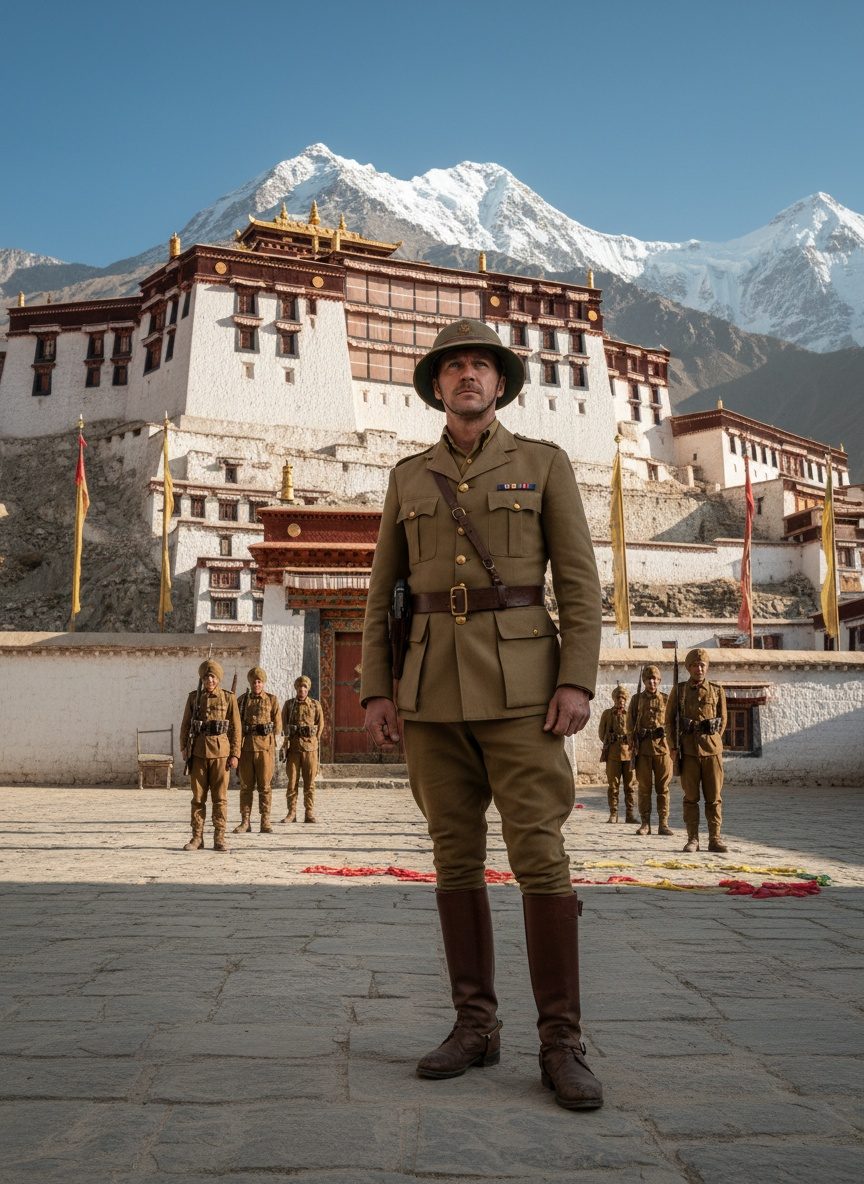
The thin air at the top of the world seemed to hold its breath as Francis Younghusband rode at the head of his column through the gates of Lhasa. Above them, the sky stretched in a blue arc unmarred by clouds, while the distant mountains stood in silent witness to this unprecedented event. A low hum of wind whispered through the narrow streets, carrying with it a palpable sense of anticipation, as if even the city itself trembled at the audacity of this foreign intrusion. For centuries, Lhasa had been the sacred heart of a secluded kingdom, unyielding and inviolate. Now, in August 1904, its most hallowed grounds lay exposed to foreign eyes.
The Path Through the Himalayas
Long before Younghusband and his column ever set their sights on Lhasa, the daunting mountain range of the Himalayas had stood as a natural fortress, deterring outsiders with its treacherous paths and towering peaks. The British Empire, at the zenith of its global influence, had often cast a covetous eye toward Tibet. Yet, the tales of peril and the lack of reliable maps had so far kept imperial ambitions at bay. But as the new century dawned, so too did a more determined resolve from British officials to penetrate the mysteries that lay beyond those foreboding ridges.
Francis Younghusband, then a young British political officer, was tasked with what many considered an impossible mission: navigate the perilous passes and reach the forbidden city of Lhasa. This was no simple expedition. As Younghusband led his small force over the frozen expanse, it was not just the sheer elevation that challenged them but the thin, oxygen-deprived air that threatened every breath they took. With creaking ice underfoot and distant drumming of potential conflict over every rise, the journey was as much a test of human will as it was of strategic planning.
Into the Quiet Heart of a Forbidden City
On the day they entered Lhasa, what awaited Younghusband and his troops was not the fierce resistance they had braced for, but rather an eerie, unsettling silence. The towering golden temples of Lhasa glimmered in the morning light, their brilliant hues reflected off gilded rooftops in what should have been a celebratory dance of color. Yet, the air buzzed instead with an unnerving tranquility. The spiritual leader, the Dalai Lama, had fled in anticipation of their arrival, leaving the city and its people to greet the newcomers in a solemn and wary stillness.
The streets of Lhasa, usually bustling with the rhythm of daily life, now echoed with the clipped march of British-issue boots on cobblestone. As they advanced through the narrow alleys, lined with prayer flags that fluttered like guardian spirits in the Himalayan wind, they met gazes of a populace cloaked in resignation. The British, having prepared for conflict, now found themselves confronting a profound emptiness instead.
The Ghostly Audience with the Dalai Lama's Absence
Younghusband’s objective had been clear: negotiate trade and diplomatic relations with the Tibetan government under the watchful eyes of the Dalai Lama. However, the latter's strategic departure left Younghusband negotiating with shadows—in a city haunted by the absence of its spiritual and political leader. The vistas of Lhasa were lush with colors and scents of incense drifting from unseen corners, yet hollow without the expected council present in his pursuit of diplomacy.
In a twist of fate that none had anticipated, Younghusband found himself convening with intermediaries and lesser clerical officials. Every conversation felt like whispers exchanged in a grand hall now empty of its central throne. Yet, in the developing agreements, albeit piecemeal and tentative, the British would nonetheless etch their mark into Lhasa's silent stones.
The Unseen Legacy of the Lhasa Expedition
As the dust settled from the newcomers’ boots and the bravado of the expedition faded into history’s annals, the implications of Younghusband's sojourn in Lhasa began to echo more enduringly. The British presence on the Tibetan plateau, however brief, had cracked the centuries-old shell of isolation, intertwining the fate of this secluded land with the larger currents of emerging global politics. The treaties forged in the wake of the expedition carried the weight of imperial influence, yet it was the ripples of cultural exchange and geopolitical awareness that commenced here, which began to color in the grayed-out areas of maps back home.
The moments capturing Younghusband amid those sacred streets offer a multifaceted tableau—a reflection not only of imperial ambition and the weight of destiny on unfamiliar soil, but also of the currents of change that begin in whispers yet finish in tsunamis upon foreign shores. The endeavor, immortalized not in triumphalism but in the echoes of diplomatic forays and cultural curiosity, ensures that the tale of Younghusband entering an empty Lhasa is one of the most enigmatic and underexplored narratives of its time.
In the quiet of Lhasa, a powerful lesson lay ensconced—that the heart of an empire is not merely measured by the lands it traverses, but by the trails it leaves behind in lives forever altered and histories reimagined. As we reflect on Younghusband's expedition over a century later, it serves as a stark reminder of how deeply seeking the unknown reshapes all who venture into its depths, even, and perhaps especially, those who find not conflict, but quiet.