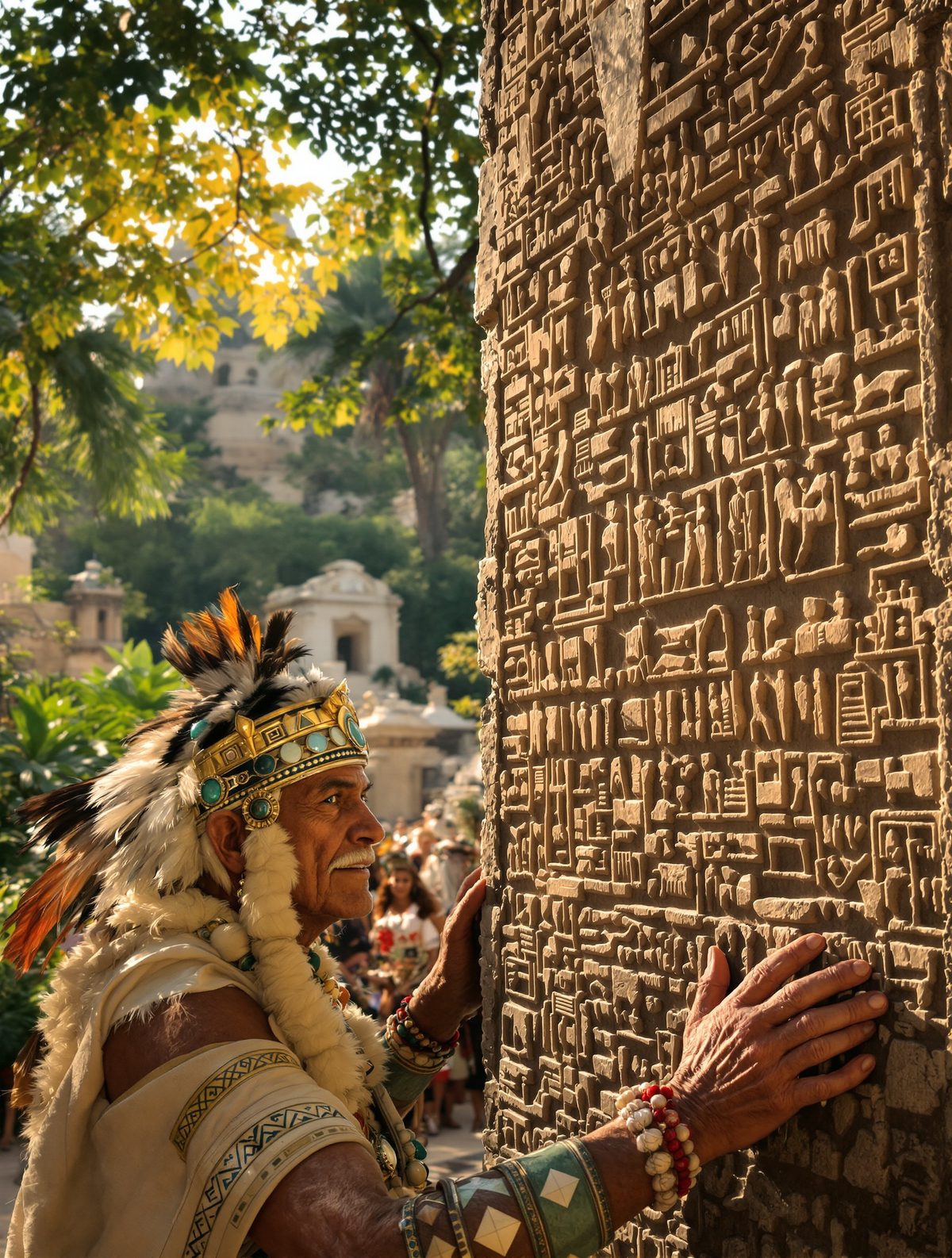
Picture this: teams of workers balanced on wooden scaffolds, their copper chisels glinting in the Egyptian sun as they systematically hack away at stone hieroglyphs. Chip by chip, strike by strike, they're erasing a pharaoh from existence. Not just any pharaoh—a woman who had ruled the most powerful empire on Earth for over two decades. The year is approximately 1458 BC, and Thutmose III has launched history's most methodical campaign of damnatio memoriae—the deliberate erasure of someone from official records.
For twenty years, this work continued across Egypt. From the towering temples of Karnak to the distant quarries of Aswan, craftsmen obliterated cartouches, defaced statues, and rewrote inscriptions. Their target? Hatshepsut, the stepmother who had stolen his throne and ruled as pharaoh while he waited in the shadows. Thutmose III came closer than almost anyone in history to successfully deleting a person from the historical record. Almost.
The Woman Who Became King
To understand the fury behind this erasure, we need to travel back to 1479 BC. When Thutmose II died unexpectedly, he left behind a complex succession crisis. His heir, Thutmose III, was likely just a child—perhaps six or seven years old. In the Egyptian system, he needed a regent, someone to rule until he came of age. That someone was Hatshepsut, his stepmother and the daughter of the great Thutmose I.
But Hatshepsut had grander plans than simply keeping the throne warm. Within a few years of her regency, she had done something almost unprecedented in Egyptian history: she declared herself pharaoh. Not queen, not regent, but pharaoh—a title so sacred that it was considered the earthly embodiment of the god Horus.
What makes this even more remarkable is how thoroughly she committed to the role. Hatshepsut didn't just claim the title; she literally transformed herself into a male pharaoh. Statues show her wearing the false beard of kingship, the nemes headdress, and the traditional pharaonic regalia. In hieroglyphic inscriptions, she even referred to herself using masculine pronouns and titles. She became, in every official sense, a king.
For 22 years, she ruled Egypt during what historians now recognize as one of its most prosperous and peaceful periods. She launched ambitious building projects, established trade networks that brought exotic goods from the mysterious land of Punt, and expanded Egypt's wealth and influence. By any measure, she was a successful pharaoh. But she had committed an unforgivable sin in the eyes of her stepson: she had stolen what was rightfully his.
The Silent Prince
Throughout Hatshepsut's reign, Thutmose III remained in an impossible position. He held the technical title of pharaoh—Egyptian records sometimes show them as co-rulers—but wielded none of the actual power. Imagine spending your entire youth and young adulthood watching someone else live the life that destiny had promised you.
Some evidence suggests he wasn't completely powerless. Military records hint that Thutmose III may have led some campaigns during Hatshepsut's later years, possibly as a way for her to gradually include him in governance. But these were crumbs compared to the feast of absolute power she commanded.
What was he thinking during those long decades? Did he seethe in private, planning his revenge? Or did he simply accept his fate until circumstances changed? The historical record gives us few clues about his inner state, but his later actions speak volumes about the resentment that must have been building like pressure in a sealed tomb.
Then, sometime around 1458 BC, Hatshepsut disappears from the historical record. The exact circumstances of her death remain mysterious—no obvious signs of violence or palace coup, just a sudden absence where once there had been the most powerful person in the known world. Finally, after more than two decades of waiting, Thutmose III stood alone on the throne of Egypt.
The Great Erasure Begins
Here's where the story takes a chilling turn. For the first fifteen to twenty years of his solo reign, Thutmose III seemed content to let his stepmother's monuments stand. He focused on military campaigns, expanding Egypt's empire to its greatest extent and earning himself the nickname "Egypt's Napoleon" from later historians.
But then, sometime around 1440 BC, something changed. Perhaps it was advancing age making him think about his legacy. Perhaps it was pressure from conservative priests and nobles who had never accepted a female pharaoh. Or perhaps the old resentment finally boiled over into action. Whatever the trigger, Thutmose III launched the most systematic campaign of historical destruction the ancient world had ever seen.
The scale was breathtaking. Teams of workers spread across the entire Egyptian kingdom with a single mission: find every trace of Hatshepsut and destroy it. They chiseled her cartouches—the oval hieroglyphic frames containing her royal names—from temple walls and replaced them with inscriptions honoring Thutmose I, II, or III. They toppled her statues and either smashed them or buried them in pits. They rewrote historical inscriptions to skip directly from Thutmose II to Thutmose III, as if she had never existed.
At Karnak Temple, workers systematically erased her name from the walls of the chapel she had built. At Deir el-Bahari, they defaced her magnificent mortuary temple, one of the architectural marvels of the ancient world. The destruction was so thorough that when early Egyptologists began studying these sites in the 19th century, they found walls covered in mysterious gaps where hieroglyphs had once been.
The Monuments That Survived
But here's what Thutmose III couldn't have anticipated: his workers were sometimes too efficient for their own good. When they toppled Hatshepsut's statues, instead of smashing them completely, they often simply buried them in pits or used them as fill material for new construction projects. This inadvertent preservation would prove to be Hatshepsut's salvation.
In the 1920s and 1930s, archaeologists began discovering these buried statues. The Metropolitan Museum of Art's Egyptian Expedition, led by Herbert Winlock, uncovered hundreds of fragments of Hatshepsut's statues that had been buried in pits near her temple at Deir el-Bahari. These fragments told a fascinating story of deliberate destruction—clean breaks that suggested careful dismantling rather than random vandalism.
Even more remarkably, some inscriptions survived in places that were simply too difficult or dangerous to reach. High up on temple walls, in the deepest recesses of tombs, and in remote locations far from the major centers of power, Hatshepsut's name and image endured. These scattered survivors would eventually allow modern scholars to piece together the story of Egypt's forgotten female pharaoh.
The irony is exquisite: in his attempt to erase Hatshepsut completely, Thutmose III actually preserved her for posterity. If he had simply left her monuments alone, many would have been destroyed by natural weathering, earthquakes, and later construction projects. Instead, by burying her statues and inscriptions, he created a time capsule that would eventually restore her to her rightful place in history.
The Pharaoh's Dilemma
Modern scholars debate whether Thutmose III's campaign was driven by personal vendetta or political necessity. Some argue that he needed to legitimize his own reign by erasing the memory of a female pharaoh who had violated traditional gender roles. Others suggest that the erasure was part of a broader effort to present an unbroken line of male succession to the gods and to future generations.
There's also the intriguing possibility that Thutmose III wasn't acting entirely from spite. Some Egyptologists propose that he may have been responding to pressure from priests and nobles who viewed Hatshepsut's reign as religiously illegitimate. In this interpretation, the erasure wasn't personal revenge but a necessary restoration of cosmic order.
Whatever his motivations, Thutmose III's campaign reveals something profound about the power of historical narrative. He understood, perhaps better than most rulers of his era, that controlling the past was essential to controlling the future. By erasing Hatshepsut, he wasn't just settling old scores—he was ensuring that no future female would have a precedent to follow.
The Woman Who Wouldn't Stay Buried
Fast-forward 3,500 years, and Hatshepsut has achieved a kind of immortality that Thutmose III could never have imagined. Far from being forgotten, she has become one of ancient Egypt's most celebrated pharaohs. Books, documentaries, museum exhibitions, and even an opera have been dedicated to her story. Her temple at Deir el-Bahari is one of Egypt's most visited archaeological sites.
In 2007, archaeologists announced they had likely identified her mummy—a discovery that made international headlines and sparked renewed interest in her reign. Today, she is often cited as one of history's most successful female rulers, mentioned alongside figures like Queen Elizabeth I and Catherine the Great.
The attempted erasure of Hatshepsut serves as a powerful reminder of how fragile historical memory can be, and how the stories we tell about the past are often shaped by the prejudices and political needs of those in power. Every generation rewrites history to some degree, emphasizing certain figures while forgetting others. But Hatshepsut's story also demonstrates the resilience of truth—how it can survive even the most systematic attempts at suppression.
In our own era of information warfare and "alternative facts," there's something both sobering and hopeful about this ancient tale. It reminds us that those who seek to control history by erasing inconvenient truths may find that their very efforts to destroy evidence become evidence themselves. Thutmose III wanted to be remembered as the great pharaoh who expanded Egypt's empire to its greatest extent. Instead, he's increasingly known as the man who tried, and failed, to delete one of history's most remarkable women.
Perhaps that's the ultimate irony: in his determination to erase Hatshepsut from history, Thutmose III ensured that their stories would be forever intertwined. Today, you cannot tell one without telling the other.