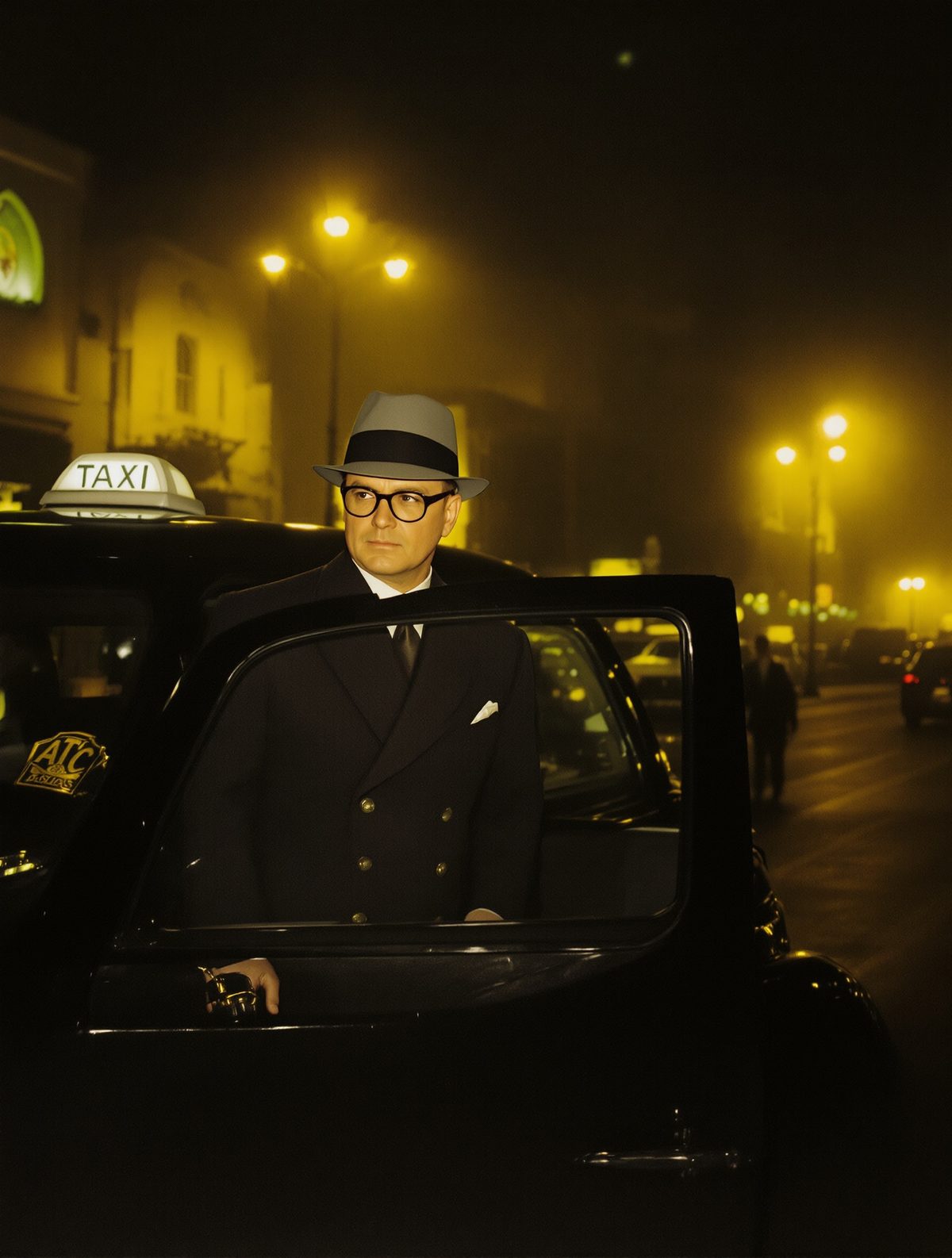
The summer rain drummed against the windows of Billy Haas's Chophouse on West 45th Street as Justice Joseph Force Crater adjusted his bow tie and checked his pocket watch. It was just past 9:30 PM on August 6, 1930, and the distinguished judge had enjoyed another fine meal in the heart of Manhattan's theater district. Outside, the neon glow of Broadway beckoned through the humid August evening. Crater stepped onto the sidewalk, his polished shoes clicking against the wet pavement as he raised his hand to hail a taxi. A yellow cab pulled to the curb. The judge climbed in, the door slammed shut, and the vehicle disappeared into the river of traffic flowing down the Great White Way.
Justice Joseph Crater would never be seen again.
In the 94 years since that fateful night, his disappearance has remained one of America's most confounding mysteries—a case that spawned the phrase "to pull a Crater" and launched what became the largest missing person investigation in NYPD history. But the story of the vanishing judge reveals far more than just an unsolved mystery; it exposes the shadowy world of Tammany Hall corruption, the excesses of Jazz Age New York, and the lengths powerful men would go to protect their secrets.
The Judge Who Had Everything to Lose
Joseph Force Crater seemed to embody the American dream of the Roaring Twenties. Born in Pennsylvania in 1889, he had clawed his way up from modest beginnings to become one of New York's most prominent legal figures. By 1930, at just 41 years old, he sat on the New York Supreme Court—a position he'd secured through his connections to the notorious Tammany Hall political machine that controlled the city's Democratic Party.
But Crater's rise came with a price. Like many judges appointed through Tammany's patronage system, he owed his $22,500-a-year position (equivalent to roughly $400,000 today) to political bosses who expected favors in return. The judge lived lavishly, maintaining apartments in both Manhattan and the Bronx, along with a summer cabin in Maine where his wife Stella spent most of her time. He was known to frequent the city's speakeasies during Prohibition, rubbing shoulders with showgirls, politicians, and the occasional gangster.
What made Crater's lifestyle particularly suspicious was his apparent wealth. On a judge's salary, he somehow managed to afford luxury accommodations, expensive dinners, and regular nights on the town. Federal investigators would later discover that in the months before his disappearance, Crater had withdrawn over $7,500 from his bank accounts—money that was never found and represented nearly a third of his annual salary.
The Last Days of a Doomed Man
The final chapter of Joseph Crater's documented life began on July 28, 1930, when he received an urgent telephone call at his summer retreat in Maine. His wife Stella later recalled that the call seemed to agitate him greatly, though he refused to tell her who had called or what they had discussed. Within hours, Crater was packing his bags for an immediate return to New York City, telling his wife he had to "straighten those fellows out."
Those would be the last words Stella Crater would ever hear from her husband.
Back in Manhattan, Crater spent his final days in a flurry of suspicious activity. On August 3, he went to his courthouse office despite court being in summer recess—highly unusual behavior. He spent hours behind closed doors with his assistant, Joseph Mara, reportedly going through files and removing several folders whose contents would never be determined. Mara later told investigators that Crater had two suitcases with him and appeared to be destroying documents.
Even more mysteriously, Crater liquidated several financial holdings during these final days, converting stocks and bonds into cash. He also made arrangements to have his personal safe opened, though what he removed remains unknown. These actions painted the picture of a man either preparing to flee or settling his affairs—but which one, and why, remained maddeningly unclear.
A Night at the Theater and a Date with Destiny
August 6, 1930, began like any other summer day in New York. The temperature soared into the 80s, and the city sweltered under a blanket of humidity that seemed to trap the exhaust fumes and human energy of eight million souls. Crater spent the afternoon at his courthouse office, where he was seen sorting through more papers with his assistant.
At around 5:15 PM, something extraordinary happened: Crater sent his assistant home early, telling him not to return until the following week. He then made a phone call—to whom, nobody knows—before gathering his belongings and leaving the courthouse. This would be the last time Joseph Crater was seen in his official capacity as a judge.
That evening, Crater met two acquaintances for dinner: William Klein, a lawyer, and Sally Lou Ritz, a showgirl who performed in Broadway revues. They dined at Billy Haas's Chophouse, a popular hangout for theater people and politicians. Klein later told police that Crater seemed in good spirits during dinner, showing no signs of distress or unusual behavior. They discussed seeing a show together, but Crater ultimately decided to head home instead.
After dinner, the three walked together toward the subway station. Klein and Ritz boarded a train, while Crater lingered on the platform. Then, in what would become the most analyzed moment in the case, Crater walked back up to street level and hailed a taxi. Multiple witnesses saw him enter the cab, but nobody thought to note the license plate number or the driver's appearance. The taxi pulled into traffic, carrying Justice Crater into history and mystery.
The Investigation That Consumed a City
When Crater failed to appear for court on August 25, 1930, the wheels of what would become a legendary investigation began to turn. Initially, court officials assumed he was simply extending his vacation, but when September arrived with no word from the judge, panic set in. His wife Stella returned from Maine to find their apartment exactly as he had left it—his checkbook on the dresser, his toiletries untouched, even his dentures still in their container.
The NYPD launched the most intensive missing person investigation in the city's history. Over 300 detectives were assigned to the case, and the search extended across three states. Police interviewed over 2,000 people, from Broadway chorus girls to Tammany Hall bosses. They dredged rivers, searched abandoned buildings, and followed up on thousands of tips from a public obsessed with the vanishing judge.
The investigation revealed a web of corruption that reached into the highest levels of New York's government. Crater had been involved in questionable real estate deals, including the purchase of a Manhattan hotel that netted him a suspicious $75,000 profit. His appointment to the bench had cost him $22,500—exactly one year's salary—paid to Tammany Hall leaders as a "contribution." But despite these revelations, investigators found no smoking gun, no clear motive for murder, and no evidence of where Crater might have gone.
Perhaps most frustratingly, the investigation uncovered what appeared to be a deliberate cover-up. Crater's personal files had been cleaned out, his safe had been emptied, and several key documents had vanished. Even more suspicious, his life insurance policy had a double indemnity clause for accidental death—but the insurance company refused to pay out without proof of death.
Theories, Hoaxes, and False Hopes
In the decades that followed, the Crater case generated hundreds of theories and alleged solutions. Some believed he had been murdered by gangsters who feared his testimony in corruption investigations. Others suggested he had been killed by Tammany Hall associates who saw him as a liability. A few investigators theorized that Crater had orchestrated his own disappearance, fleeing to Europe or South America with stolen money and a new identity.
The case spawned numerous hoaxes and false confessions. In 1937, a woman claimed to have Crater's body buried in her basement—it turned out to be a pig carcass. In 1959, a dying gangster allegedly confessed to killing the judge, but his story contained factual errors that discredited his account. Throughout the 1960s and 1970s, people claiming to be Crater surfaced periodically, but none could prove their identity.
One of the most tantalizing leads came in 2005, when investigators received a tip based on a decades-old confession. A woman claimed that her late husband had told her that Crater was murdered and buried under a Coney Island boardwalk. Police investigated but found no evidence. In 2012, the NYPD finally closed the case officially, though they acknowledged that the mystery would likely never be solved.
The Ghost Who Haunts American Justice
Nearly a century later, the disappearance of Joseph Crater continues to fascinate because it represents something larger than one man's fate. His vanishing act occurred at a pivotal moment in American history, when the excesses of the 1920s were about to collide with the harsh realities of the Great Depression. The corruption and moral ambiguity that defined his world would soon be swept away by economic collapse and social reform.
Crater's story serves as a dark mirror to our contemporary concerns about judicial integrity and political corruption. In an age where public trust in institutions remains fragile, the image of a judge who may have been murdered to silence his testimony—or who fled justice with stolen money—resonates with modern anxieties about power and accountability.
Perhaps most haunting is the possibility that we'll never know the truth. In our data-driven age of surveillance cameras and digital footprints, it's almost impossible to imagine someone simply vanishing without a trace. Yet Joseph Crater managed exactly that, stepping into a taxi on a humid August evening and disappearing so completely that after 94 years, we're no closer to solving his mystery than we were on the day he vanished. His ghost continues to haunt not just the streets of Manhattan, but our collective imagination—a reminder that some secrets are buried so deep they may never see the light of day.