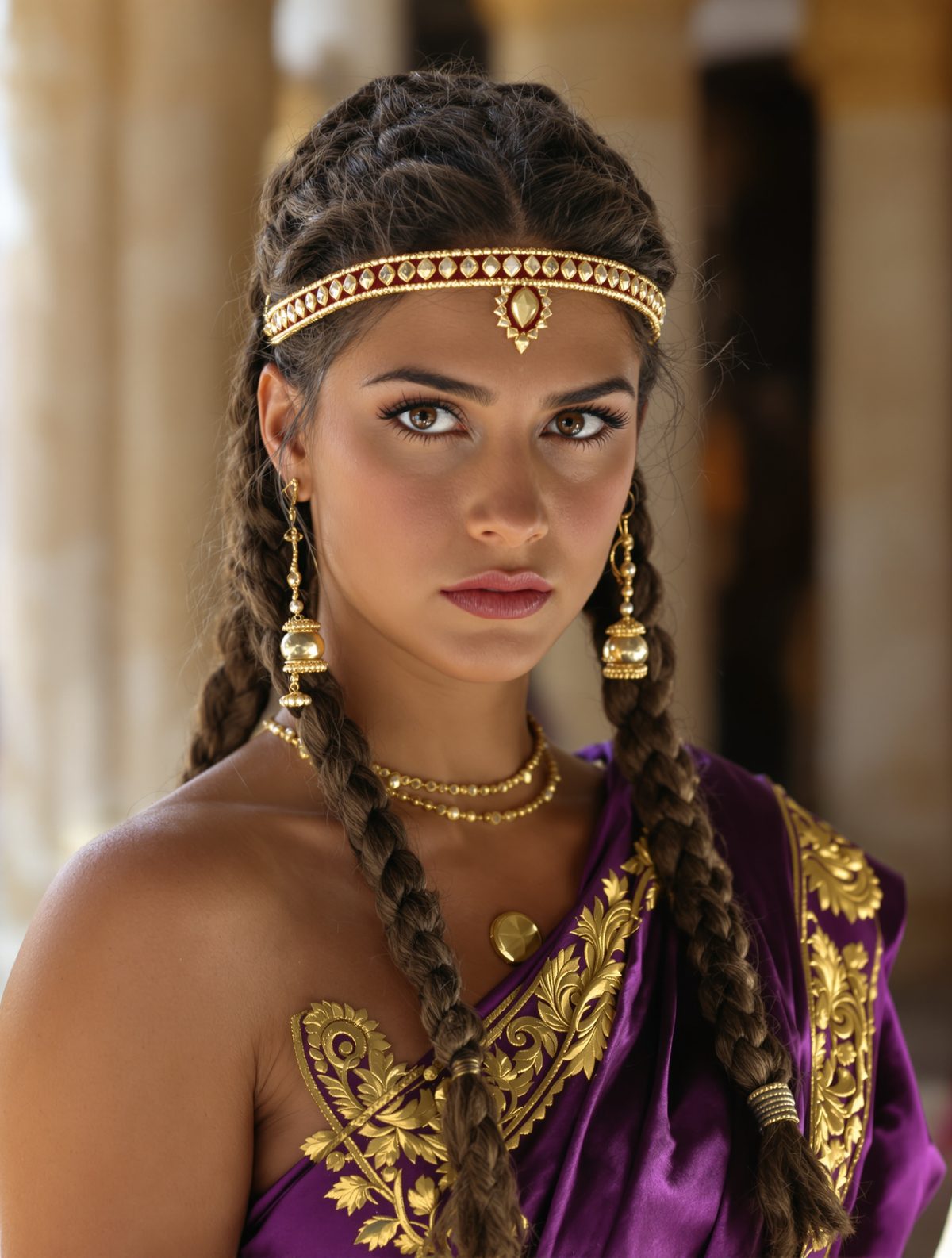
Picture this: It's 2285 BC, and in the bustling temple complex of Ur, a woman sits cross-legged on a reed mat, her fingers gripping a sharp stylus. The clay tablet before her is still soft and pliable, waiting. Around her, the sounds of ancient Mesopotamia drift through the temple walls—merchants haggling in the marketplace, children playing by the Euphrates, the distant bleating of sacrificial goats. But in this moment, something extraordinary is about to happen. This woman, Enheduanna, is about to do something no human being has ever done before: she's about to sign her name to a piece of literature, making herself the world's first known author.
What she couldn't have known, as she pressed that reed stylus into clay, was that her words would outlast empires, survive the fall of civilizations, and still be read 4,300 years later. The woman who invented authorship was about to change the course of human expression forever.
The Princess Who Became a Priestess
Enheduanna wasn't just any temple priestess—she was royalty with a divine mission. Born around 2285 BC, she was the daughter of Sargon of Akkad, the world's first emperor who had conquered much of Mesopotamia and created history's first multi-ethnic empire. But rather than living a life of palace luxury, Enheduanna was appointed to one of the most powerful religious positions in the ancient world: high priestess of the moon god Nanna in the city of Ur.
This wasn't merely a spiritual role—it was a masterstroke of ancient politics. By installing his daughter as high priestess in the Sumerian heartland, Sargon was essentially placing an Akkadian ruler in charge of Sumerian religious life, helping to unite his diverse empire under both political and spiritual authority. Enheduanna became a bridge between cultures, speaking both Akkadian and Sumerian, and ultimately writing in both languages.
But here's what makes her story truly remarkable: she wasn't content to simply perform ritual duties. She picked up a stylus and began to write—not administrative records or royal decrees, but passionate, personal poetry that revealed her inner spiritual world to anyone who could read cuneiform.
The Goddess Who Inspired a Literary Revolution
Enheduanna's most famous works were hymns dedicated to Inanna (known as Ishtar to the Akkadians), the goddess of love, beauty, sex, and war. But these weren't your typical ancient religious texts. They were intensely personal, emotionally raw, and surprisingly modern in their psychological complexity.
In her most celebrated work, "The Exaltation of Inanna," Enheduanna writes with startling intimacy: "My lady, I will proclaim your greatness in all lands and your glory! Your way and form are unknown. Your way and form are magnificent, unknown to anyone!" But then the poem takes a dramatic turn as Enheduanna describes her own political troubles—apparently, she had been exiled from her temple position during a rebellion against her father's rule.
What's extraordinary is how she weaves her personal suffering into her religious devotion. She doesn't just praise the goddess abstractly; she begs for Inanna's intervention in her very real political crisis. "I am yours! This will always be so! May your heart be cooled toward me!" she pleads, making this perhaps history's first autobiographical literature.
The goddess Inanna herself was no conventional deity. She was fierce, sexual, and unpredictable—a goddess who descended to the underworld and returned, who could grant both love and destruction. In choosing to focus her literary efforts on Inanna, Enheduanna was aligning herself with divine feminine power at its most complex and compelling.
Carving Her Name in Clay and Time
Here's what truly sets Enheduanna apart from every other writer who came before her: she signed her work. While other ancient texts were anonymous, passed down through oral tradition or recorded by nameless scribes, Enheduanna boldly claimed ownership of her words.
In "The Exaltation of Inanna," she writes: "The compiler of the tablets was Enheduanna. My king, something has been created that no one has created before." That final line sends chills down your spine—she knew she was doing something unprecedented. She understood that she was creating something entirely new in human culture: literature with a named author, personal voice, and individual perspective.
Archaeological evidence supports her fame even in her own time. A remarkable alabaster disk was discovered showing Enheduanna performing religious duties, with her name and title clearly inscribed. She's shown directing a religious ceremony, wearing the traditional tufted skirt and headband of a high priestess. This wasn't just any priestess—this was a celebrity, someone important enough to have her image carved in stone.
Even more stunning: copies of her hymns have been found dating from hundreds of years after her death, proving that her works were still being read, copied, and studied centuries later. She had become a classic author before the concept of classical literature even existed.
The Feminist Pioneer Who Didn't Know She Was One
Perhaps the most surprising aspect of Enheduanna's legacy is how thoroughly modern her voice sounds. Reading her poetry today, you encounter a woman grappling with political power, spiritual doubt, and personal identity in ways that feel remarkably contemporary.
When she describes her exile from the temple, her words burn with frustration: "He has turned that temple, whose attractions were inexhaustible, whose beauty was endless, into a place to inspire fearfulness, and has reduced all its people to malevolence." This isn't the voice of a passive religious figure—this is someone fighting for her position, her beliefs, and her right to serve the goddess she loves.
What's even more remarkable is that she lived in a society where women could hold significant religious and political power. As high priestess, Enheduanna controlled vast temple wealth, owned property, and wielded considerable influence over both spiritual and secular affairs. The fact that history's first known author was a woman wasn't an accident—it reflected the complex gender dynamics of ancient Mesopotamian society, where certain religious roles gave women access to education, resources, and authority.
Her writings also reveal sophisticated theological thinking. She didn't just recite traditional prayers; she developed new ways of understanding the divine. Her hymns show Inanna as a goddess who transcends traditional categories, embodying both creation and destruction, love and war. Enheduanna was doing theology, creating new religious concepts that would influence Middle Eastern spirituality for millennia.
The Templates That Outlasted Empires
The physical survival of Enheduanna's works borders on miraculous. Clay tablets might seem fragile, but they've proven more durable than papyrus, parchment, or paper. When buildings burned, the intense heat actually baked the clay harder, preserving the cuneiform script inside. Copies of her hymns have been found across Mesopotamia, from Babylon to Assyria, proving that her influence spread far beyond her home temple in Ur.
But it wasn't just the physical tablets that survived—it was her literary innovations. Enheduanna essentially invented the template for Western autobiography, the personal religious testimony, and the signed literary work. She established the idea that individual human experience was worthy of preservation and that a writer's personal identity mattered to readers.
Her influence on later Mesopotamian literature was profound. The Epic of Gilgamesh, written centuries later, shows clear influences from her work in its combination of personal struggle with cosmic themes. The Hebrew Psalms, written more than a millennium after Enheduanna, employ similar techniques of weaving personal crisis with divine praise.
Why History's First Author Still Matters Today
In our age of social media, personal branding, and individual expression, Enheduanna feels like a spiritual ancestor. She understood something that we're still grappling with today: that personal voice and authentic individual expression have the power to transcend time and speak across millennia.
Her story also challenges our assumptions about ancient history. We often imagine the deep past as a time when individuals were subsumed into collective identity, when personal expression was unknown, when women's voices were silenced. But here's a woman from 4,300 years ago who was fighting for her position, expressing her doubts and desires, and signing her name to ensure her thoughts would survive.
Perhaps most importantly, Enheduanna reminds us that literature has always been an act of rebellion. By claiming authorship of her works, she was asserting that her individual perspective mattered, that her words deserved to survive, that future readers would want to know not just what she wrote, but who she was. Every writer who has ever signed their name to their work, from Shakespeare to Maya Angelou, follows in the footsteps of a Sumerian priestess who first dared to say: "These words are mine, and they matter."
In a world where we're constantly told that everything has been done before, Enheduanna stands as proof that someone, somewhere, had to be first. And sometimes, being first means changing everything that comes after.