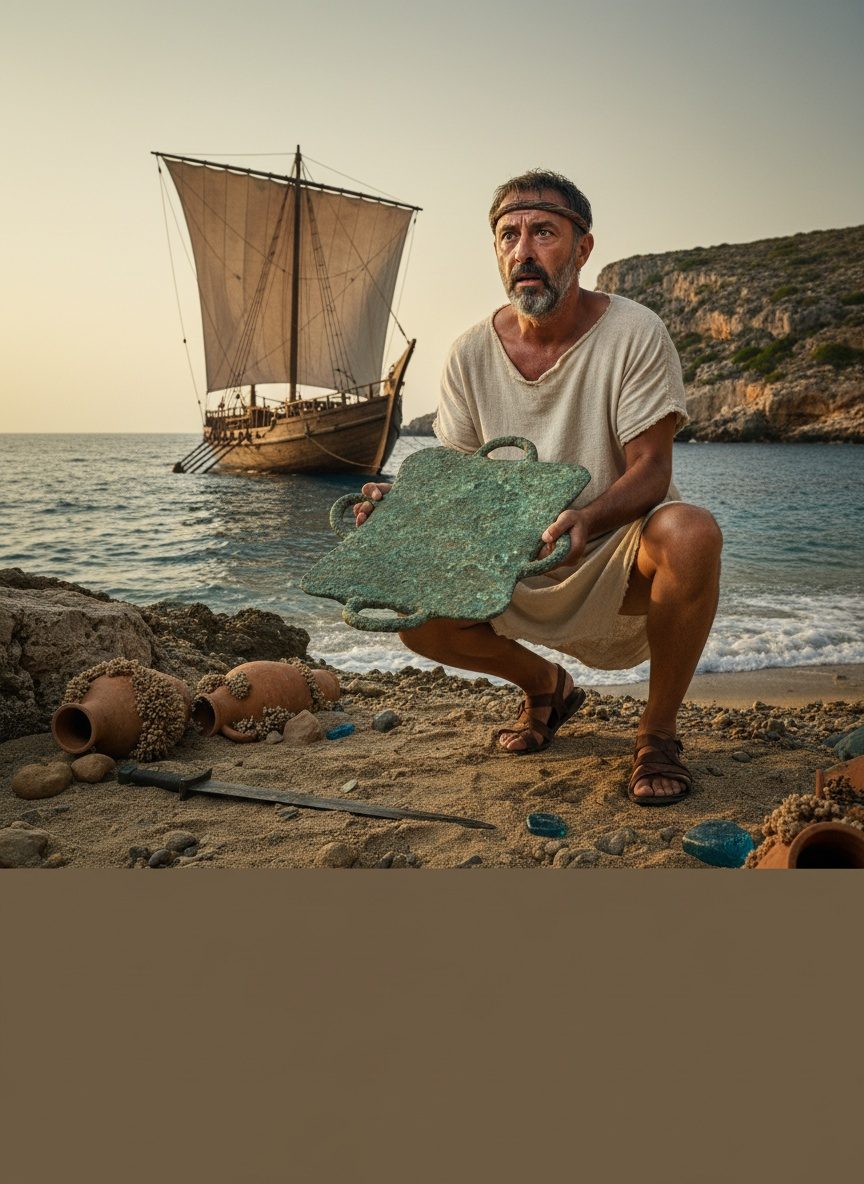
Most ships vanish into the abyss, lost forever to the waves. But one, the shipwreck off Cape Uluburun, left behind a tantalizing mystery that has kept historians guessing for decades.
A Cargo of Civilization
The warm waters off the coast of modern-day Turkey once hid a time capsule of the Late Bronze Age—an era bustling with trade and cultural exchanges. When divers discovered the Uluburun shipwreck in 1982, they revealed a sunken trove that read like a list of the ancient world’s greatest civilizations. Within its wooden skeleton, cargo from Egypt, Mesopotamia, and beyond shared space, each telling its own story in rich detail.
Amidst the sun-dappled debris of the seabed were copper ingots from Cyprus, shaped like ox hides and stacked like bricks, the currency of ancient metalworkers. These ingots were a testament to Cyprus's status as a crucial hub in the Mediterranean trade network, a source of the metal so valued that it helped drive the era’s economy. Yet copper alone wasn’t the only highlight.
There was glass from ancient Egypt, crafted with such skill it seemed to shimmer even under the weight of centuries. These blue and turquoise glass beads likely had origins as premium items destined for the elite, a symbol of both wealth and advanced craftsmanship. Alongside these lay tin from Persia—each a pivotal component in the creation of bronze. The presence of tin suggests links to distant lands, possibly Anatolia or even farther, making it clear this ship connected the dots in a vast web of trade.
The Mycenaean swords, sharp even after millennia, spoke of warriors and legends passed down through Greek epics. Canaanite jars held fragrant remains, remnants of the perfumed life in the Levant. Gold jewelry from Egypt adorned with scarab motifs hinted at the eventual resting place of their wealth—Egyptian palaces and tombs.
This cargo, sporadically documented in the records of dozens of ancient powers, came together in a remarkable way, preserved beneath the sea. Yet amidst these treasures, none held the answer as to who exactly guided this floating bazaar across the seas.
Lost Origins and Countless Theories
The ship itself, once a vibrant vessel skimming over Mediterranean waves, now lay silently beneath the water. As remarkable as its contents were, the greatest enigma lay in the absence of any clear origin or destination. Whose hands worked its oars? Whose home ports welcomed it? Which merchants or monarchs hoped for its successful return?
Archaeologists and historians have pieced together hints but remain divided on conclusions. The sheer diversity of artifacts points towards a multicultural crew or an ambitious conglomerate of traders, yet the ship’s construction offers few distinct clues. Its hull, a robust assembly of planks, gives only the broadest hints at design trends common to various empires.
Some suggest the Mycenaeans, known for their adventuresome pursuits, may have bankrolled the expedition. Others point to the Canaanites or even a coalition of city-states—each invested in seeing the ship sail. Perhaps, it represented a cooperative endeavor, an embodiment of the era’s interconnected world.
The lack of inscriptions or ship logs leaves these hypotheses in limbo. Ancient contracts or labels, typically etched onto cargo such as the Uluburun's, likely fell victim to the relentless toll of saltwater and time. A tangible record, a whisper from the past, could unlock this mystery forever, and yet, it remains elusive.
Theories about the ship's route provoke even further questions. Was it destined for Aegean markets packed with eager buyers? Or perhaps returning eastward, its hull hanging low with goods meant for royal courts? The mysteries grow deeper with every finding, each clue acting as both a revelation and a riddle.
A Legacy Across Millennia
Beyond the allure of its mystery, the Uluburun shipwreck serves a more profound purpose, acting as a vivid snapshot of the late Bronze Age, a decisive epoch bridging ancient traditions with emergent powers. The complexities of its buried cargo reflect a time when distant cultures collided and collaborated across sparkling seas.
This ship, preserved in salt and silt, captures the spirit of ancient globalism. It speaks of journeys fraught with peril and reward, where sailors dared the dangers of storms and pirates, driven by the promise of exchange. It tells of a world in flux, of societies as vibrant and connected as any today, strung together by the thin lines of trade routes spanning leagues of sea.
The Uluburun wreck, therefore, is more than an archaeological treasure—it is a vivid dialogue with the past, offering lessons in human ambition, adaptability, and the innate drive to connect with others, despite the boundaries of geography and culture. In an age where technology links us instantaneously, this lost vessel cautions that the spirit of profound connectivity has its roots deep in history.
In its silence, the ship asks us to reconsider our understanding of ancient worlds, to marvel at the profound depth and breadth of human interaction long before borders were drawn and maps were made. It's a haunting reminder that some stories, no matter how submerged, never truly vanish. Only their storytellers do.