August 24, 79 CE. The air was thick with heat in Herculaneum, where life ticked away like any other day under the looming silhouette of Mount Vesuvius. But beneath this facade of serenity lay a destiny etched in ash, awaiting its sudden, furious partner.
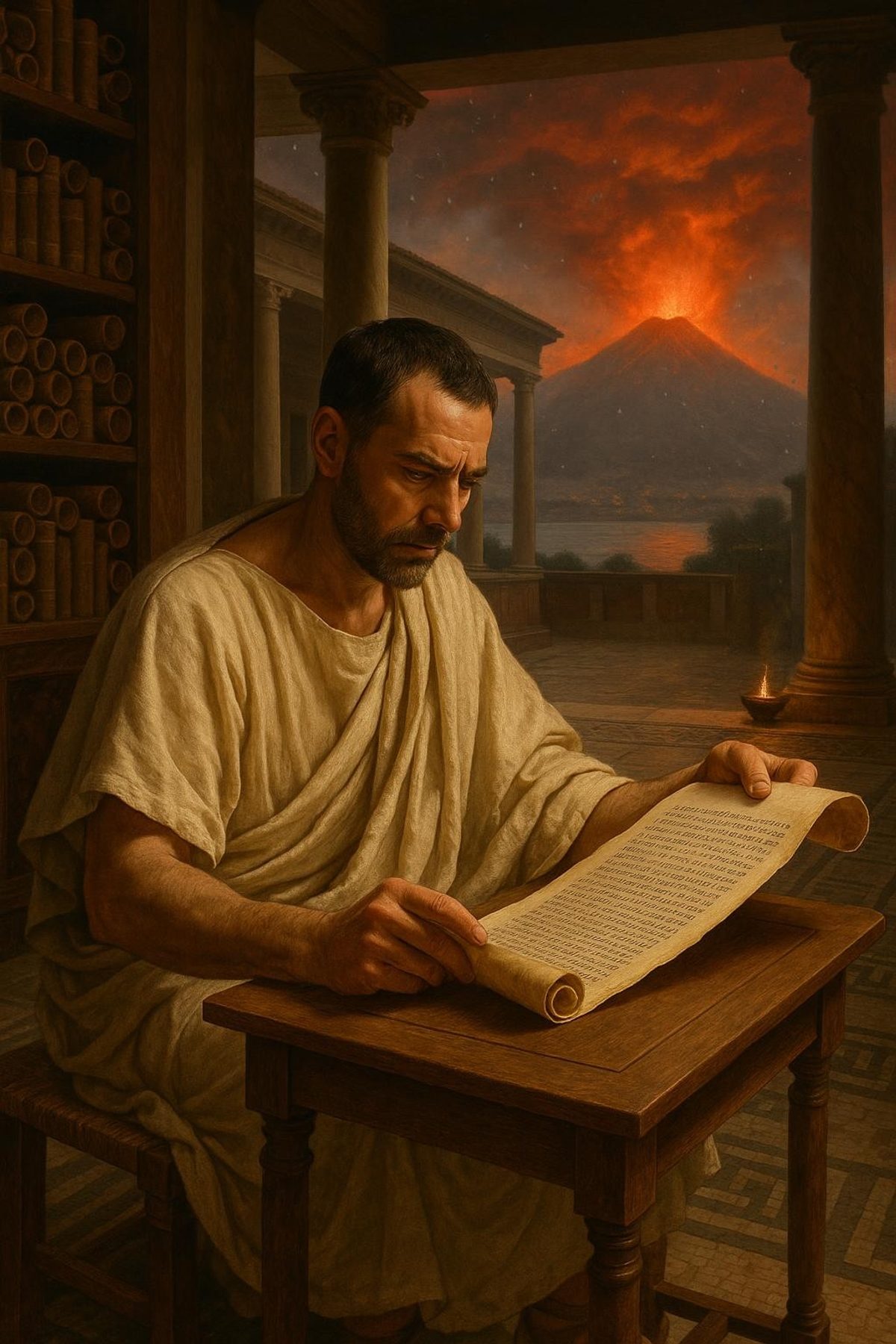
The day unfolded with little suggestion of the calamity about to explode into being. Fishermen brought their catches from the tranquil Bay of Naples, merchants peddled in the markets, children played in the streets, and scholars gathered in contemplative silence within the grandeur of the Villa of the Papyri. This villa was a marvel of its time, a lavish estate perched near the shimmering coast, named for its invaluable library of scrolls — over 1,800 of them, carefully housed in rooms dedicated to the pursuit of knowledge.
These scrolls whispered stories of ancient philosophies, most notably those of the Greek philosopher Epicurus, who dared challenge the gods with his teachings on pleasure, gods, and the nature of the universe. Epicurus had once written that "death is nothing to us," a poignant creed that would hang over that fateful day as Vesuvius claimed its place in history.
As the morning stretched into afternoon, the mountain awoke with a rage long simmering beneath its crust. A violent plume of smoke and ash burst forth in a pyroclastic surge, drowning Herculaneum and its sister city Pompeii in molten misery. The world was choked by darkness and sulfurous clouds. As Vesuvius expelled its furious contents, the inhabitants' cries mingled with the roar of the eruption, echoes of lives and stories incinerated to obscurity.
Yet within the inferno's reach lay a paradox of preservation. The relentless surge of ash engulfed everything in its path, suffocating life but sealing history in its heated embrace. The Villa of the Papyri was entombed, its precious contents carbonized yet miraculously surviving the crossing from ancient to modern times.
For nearly two millennia, the villa's library lay undisturbed, a spectral whisper in the narrative of Rome's golden era. With each passing century, the scrolls waited, their secrets locked away in darkness, until curiosity and technology would finally intersect with destiny in the modern era.
The catalyst for revelation came in a fitting echo of antiquity's sudden turns and fortuitous finds. In the 18th century, archaeologists probing the buried cities unearthed the villa. Among ornate statues and delicate frescoes, they discovered the charred remains of the scrolls. These delicate relics, fragile as moth's wings, posed a daunting challenge: how to unfurl the brittle curls without destroying them? The very act of touching risked transforming history to dust.
The centuries rolled on. Then, in the 21st century, scientific advancements dared to promise new hope. The mysterious dance between technology and antiquity reached a crescendo as scholars turned to non-invasive methods to unlock the writings. For the first time since the Roman Empire surveyed the world, the Epicurean musings stored within the Villa of the Papyri could rise from the cinders to be read by human eyes.
With painstaking precision, researchers applied cutting-edge imaging technology akin to medical CT scans. These techniques allowed them to painstakingly peel back the layers of history without breaking the seal of time that had crusted over each scroll. Bit by bit, words emerged—a language awoken from its slumber, letters crafted by Cyriax and his peers traced by the beams of modern science.
The content revealed was as captivating as the story of its preservation. Here was a treasury of Epicurean thought, a philosophy that sought to liberate humanity from fear and ignorance. Epicurus' teachings had once spread languidly through the minds of Romans, posing profound questions about the divine and the purpose of life. They had lingered in the hands of scholars like Cicero and Horace, inspiring debates from sun-drenched porticos to shadowed, candle-lit rooms.
Reading phrases unspoken for two thousand years gave scholars today a profound sense of connection to their distant ancestors. This was not simply an intellectual rediscovery but a compelling invitation into the ancient world—a world that grappled with concepts of free will and pleasure amidst an empire defined by power and conquest.
It is a story that underscores the tension between mortality and memory, and the capacity for ancient voices to speak across the chasm of time. Just as Vesuvius had sought to obliterate this small universe of human endeavor, chance and modern ingenuity uncovered it anew, demonstrating the enduring nature of curiosity and legacy.
And thus, what began as a calamity cloaked in ash birthed a cultural resurrection. The papyri of Herculaneum remind us of the complexities and wonders of human thought. Their words transport us not just to a city on the cusp of obliteration, but to rich dialogues about existence itself. In their preservation, one finds a metaphor for the human condition—a testament to the resilience of ideas against the wrecking ball of oblivion.
This extraordinary intersection of ancient philosophy and modern discovery reminds us that history is never truly lost but merely waiting to be found. In the scrolls of Herculaneum, lies a narrative as spellbinding and instructive today as when first penned. It captures our imaginations because it tells us something essential about humanity, uniting us with our past and promising a future where knowledge, though tested by time, can forever endure.