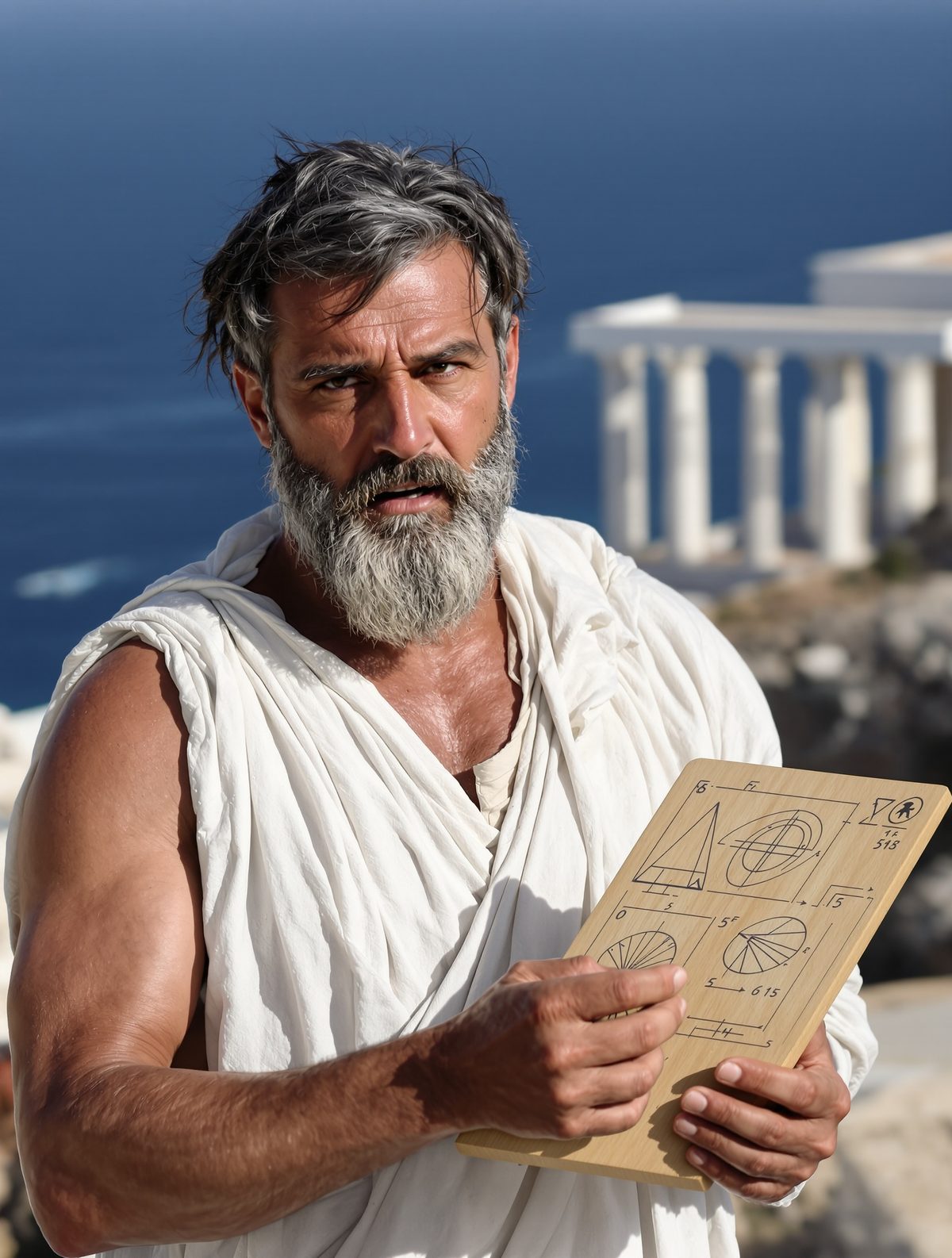
The morning mist clung to the jagged peaks of Egypt's Eastern Desert as Marcus Crassus Calvus pressed his signet ring into the warm wax beside the mine entrance. The emerald deposits of Mons Smaragdus stretched before him—a labyrinth of tunnels that locals whispered had swallowed men whole for generations. But Crassus wasn't superstitious. He was Rome's tax collector, and Egypt owed tribute. The mine's workers had vanished three days earlier, abandoning carts full of precious stones. Someone had to venture into the darkness to claim what belonged to Caesar.
That wax seal, bearing the eagle and fasces of Roman authority, would be the last anyone ever saw of Marcus Crassus Calvus. His footprints led deep into the mine's throat, growing fainter with each step until they disappeared entirely into Egypt's most cursed earth.
The Emerald Mountains of Ancient Egypt
In 47 BC, Egypt's Eastern Desert held secrets that would make modern gemologists weep with envy. The mines of Mons Smaragdus—literally "Emerald Mountain"—produced the finest green stones in the ancient world, gems so perfect they adorned the crowns of pharaohs and later graced the fingers of Roman senators. These weren't just any emeralds; geological surveys conducted in the 20th century revealed that the ancient Egyptian mines produced stones of exceptional clarity, some weighing over 200 carats.
The mining complex sprawled across nearly fifty square kilometers of brutal desert terrain, honeycombed with over 700 shafts and galleries that plunged as deep as 200 meters into the earth. Workers—mostly prisoners, slaves, and condemned criminals—descended into these tunnels by rope and ladder, chipping away at quartz veins by lamplight in temperatures that could reach 50 degrees Celsius.
But the mines held darker secrets than mere geological wealth. Local Bedouin tribes spoke of djinn that dwelt in the deepest shafts, and even hardened Roman overseers reported strange phenomena: tools that moved on their own, voices echoing from empty tunnels, and workers who claimed to see figures in the shadows that vanished when approached.
Rome's Hungry Tax Machine
Marcus Crassus Calvus arrived in Egypt during one of Rome's most turbulent periods. Julius Caesar had just secured his victory over Pompey at the Battle of Pharsalus, and the Roman war machine desperately needed funding. Egypt, recently conquered and still reeling from its own civil war between Cleopatra VII and her brother Ptolemy XIII, represented a treasure trove of untapped revenue.
Crassus came from a family synonymous with Roman taxation—his distant relative, Marcus Licinius Crassus, had famously declared that no man could be considered wealthy unless he could maintain a legion from his own pocket. The younger Crassus inherited both the family name and their ruthless approach to collecting what Rome considered its due.
His mandate was simple: extract 50 talents of emeralds from Mons Smaragdus—roughly equivalent to 1,300 kilograms of precious stones, worth approximately 2 million denarii. To put this in perspective, a Roman soldier earned about 225 denarii per year. Caesar wasn't asking for pocket change; he wanted a fortune.
The tax collector arrived at the mines on the Ides of Julius (July 15th) with a small retinue of scribes and guards, expecting to find bustling activity and overflowing treasure chests. Instead, he discovered abandoned equipment, scattered tools, and not a single worker in sight.
The Seal in the Wax
What happened next comes to us through the meticulous records of Gaius Scribonius, Crassus's chief scribe, whose account survived in fragmentary papyri discovered in Oxyrhynchus in 1906. According to Scribonius, the tax collector's frustration grew with each empty shaft they explored. The missing workers represented more than just a logistical problem—they were a direct affront to Roman authority.
On his third day at the site, Crassus focused his attention on the largest shaft complex, known locally as "The Serpent's Throat." This particular mine had produced some of the finest emeralds in recent memory, but its reputation among workers was darker than most. Even the hardest criminals assigned to work there often emerged speaking of voices in the darkness and an oppressive sensation of being watched.
Before descending, Crassus followed standard Roman administrative protocol. He pressed his signet ring into a prepared wax tablet, creating an official record of his entry. The seal bore his personal insignia: an eagle clutching emeralds in its talons, surrounded by the inscription "M. CRASSUS CALVUS TRIBUTI COLLECTOR"—Marcus Crassus Calvus, Tax Collector.
Scribonius recorded the exact time: the sixth hour after dawn. Crassus carried with him a bronze oil lamp, measuring instruments for assessing gem quality, and a leather satchel for samples. He wore standard Roman dress—tunic, cloak, and hobnailed sandals that would leave distinctive impressions in the mine's soft earth.
Footprints in the Darkness
When Crassus failed to emerge by nightfall, Scribonius organized a search party. What they found defied explanation and would haunt the remaining members of the expedition for the rest of their lives.
The tax collector's footprints were clearly visible in the fine dust and clay of the mine floor, pressed deep by his heavy Roman sandals. The searchers followed the trail through the main gallery, down a steep incline, and into a series of narrow passages that branched like veins through the rock. For nearly 400 meters, the prints remained clear and consistent, showing a man walking at a steady pace with no signs of struggle or distress.
But then something extraordinary occurred. At a depth Scribonius estimated as "three times the height of a tall man below the third gallery"—roughly 180 meters underground—the footprints simply stopped. Not faded, not obscured by rockfall or flooding, but completely absent, as if Marcus Crassus Calvus had simply ceased to exist mid-stride.
More disturbing still, the searchers found Crassus's oil lamp sitting upright on a ledge beside the final footprint, its wick still warm but no longer burning. The lamp showed no signs of having been dropped or placed hastily; it sat as carefully as if someone had deliberately set it down before continuing into the impenetrable darkness beyond.
Three separate search expeditions over the following weeks found exactly the same evidence: the wax seal at the entrance, the clear trail of footprints, the carefully placed lamp, and then... nothing.
The Cursed Legacy
News of Crassus's disappearance spread quickly through Roman administrative circles, but the official response was swift and decisive: silence. Caesar's government, already struggling with public confidence after years of civil war, couldn't afford stories of tax collectors vanishing into cursed mines. The incident was classified, the surviving expedition members sworn to secrecy, and Scribonius's detailed account buried in the imperial archives.
But stories have a way of surviving official suppression. Within months, Roman soldiers stationed in Egypt were whispering about the mine that swallowed tax collectors whole. Local Egyptian workers, already suspicious of the Mons Smaragdus complex, abandoned it entirely. By 45 BC, one of the ancient world's most productive emerald sources sat completely deserted.
The mine remained closed for nearly three centuries. When Emperor Diocletian finally ordered its reopening in 294 AD, the first work crews discovered something that sent chills through even hardened criminals: Crassus's wax seal, perfectly preserved in the dry desert air, still sitting exactly where he had pressed it 341 years earlier.
But they never found his body.
Echoes from the Ancient World
The disappearance of Marcus Crassus Calvus represents more than just an unsolved historical mystery—it offers a window into the complex relationship between imperial power and the unknown. Here was a man who embodied Roman confidence and authority, descended from one of the republic's wealthiest families, armed with the full backing of Julius Caesar's government. Yet something in those tunnels proved stronger than Roman steel and more permanent than imperial decree.
Modern attempts to explore the Mons Smaragdus complex have been hampered by political instability and the region's remote location, but geological surveys suggest that extensive underground chambers and passages remain unexplored. The same seismic activity that created the emerald deposits also carved out vast caverns and underground rivers that could easily swallow a man without a trace.
Perhaps most intriguingly, the story of Crassus forces us to confront the limits of historical certainty. We have his seal, his footprints preserved in ancient accounts, and multiple independent confirmations of his disappearance. Yet the man himself vanished as completely as if he had never existed, leaving behind only questions that echo through the centuries like voices in an abandoned mine shaft.
In our age of GPS tracking and constant connectivity, the idea that someone could simply disappear seems almost impossible. But Marcus Crassus Calvus reminds us that some mysteries resist solution, and that sometimes the most powerful thing any of us can do is press our seal into wax and step boldly into the unknown—even if we never emerge from the other side.