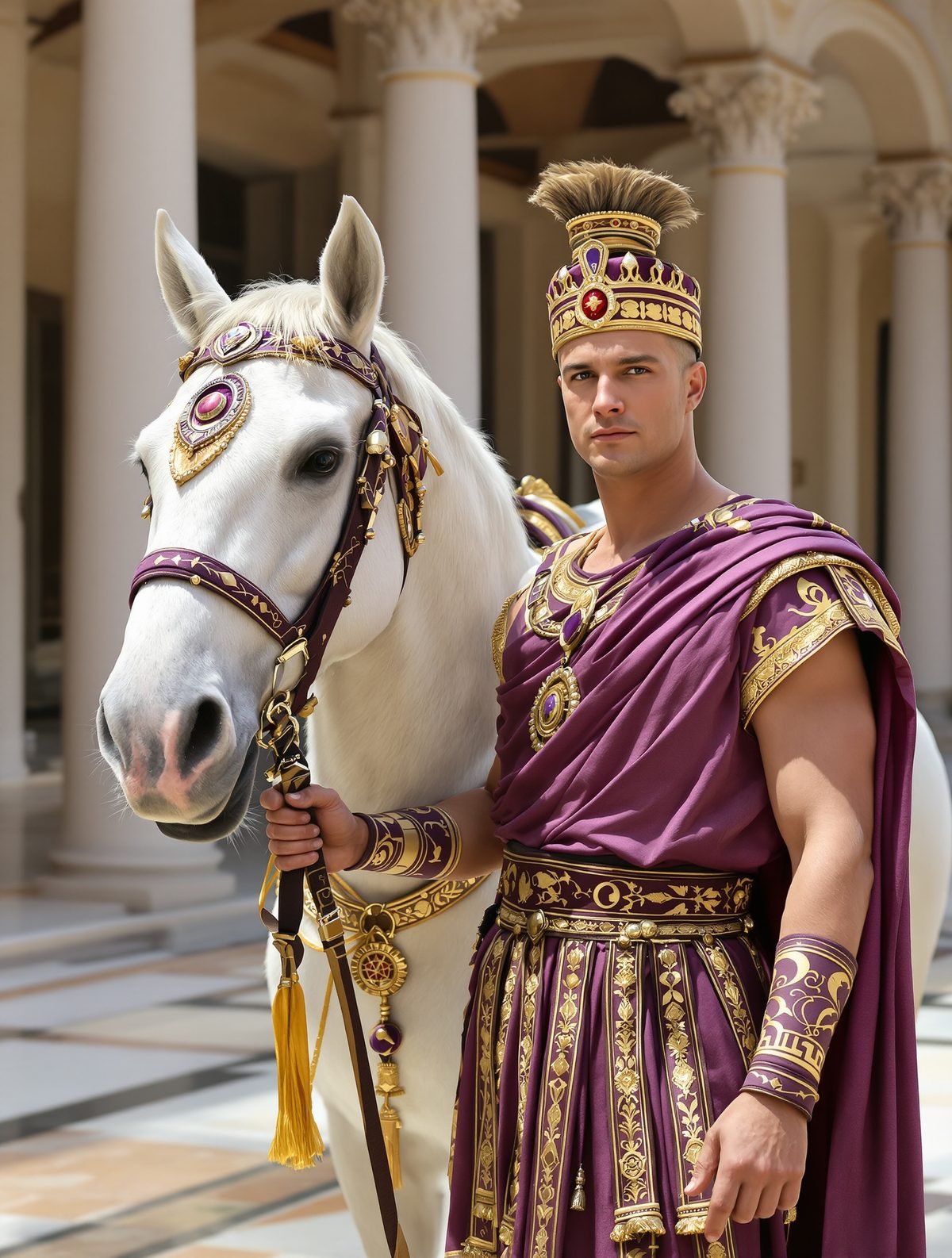
In the pre-dawn darkness of June 9th, 68 AD, a steady hand gripped a razor-sharp blade just inches from the most feared throat in the Roman Empire. Emperor Nero lay still as his personal barber, Narcissus, performed the same ritual he had carried out for twelve years—scraping away stubble from the neck of a man who had murdered his own mother, burned Christians as human torches, and allegedly fiddled while Rome itself went up in flames. But on this morning, everything would change. Within hours, that same trusted hand would guide Roman soldiers straight to their fugitive emperor's hiding place, sealing the fate of one of history's most notorious tyrants with thirty pieces of gold.
The Razor's Edge of Power
Every morning at sunrise, Narcissus entered Nero's private chambers in the Domus Aurea—the emperor's sprawling golden palace that covered nearly a third of Rome. The ritual never varied: warm water scented with exotic oils, Egyptian bronze mirrors polished to perfection, and a selection of razors honed to surgical sharpness. For twelve years, this Greek freedman had wielded absolute power over the emperor's most vulnerable moment.
Think about it—while senators trembled before Nero's whims and Praetorian Guards feared his paranoid rages, Narcissus alone held a blade to the imperial jugular every single day. The emperor trusted him completely, often conducting state business during his morning shave. Narcissus heard everything: execution orders whispered over lathered cheeks, confiscation lists murmured through steam, and the emperor's increasingly erratic plans delivered in the intimate vulnerability of the barber's chair.
The relationship between a Roman emperor and his personal barber was far more than functional—it was sacred. These men weren't mere servants but confidants, keepers of secrets, witnesses to moments of weakness that could never be shared. Narcissus had seen Nero weep over his murdered wife Octavia, rage about imaginary conspiracies, and practice his theatrical performances with desperate intensity. He had shaved the emperor's head for disguises, trimmed his beard for public appearances, and even helped apply cosmetics for Nero's scandalous stage performances—something that horrified traditional Romans who believed emperors should never appear as actors.
The Year Rome Turned on Its Emperor
By 68 AD, Nero's fourteen-year reign was crumbling faster than a house built on Vesuvian ash. The Great Fire of Rome in 64 AD had destroyed ten of the city's fourteen districts, and while historians debate whether Nero actually started it, his decision to build his massive golden palace on the cleared land sparked rumors that never died. The emperor's response to Christian "arsonists" was particularly grotesque—he had them sewn into animal skins and fed to dogs, or covered in pitch and burned alive as garden torches for his evening parties.
But it wasn't just his cruelty that doomed Nero—it was his theatrical obsessions. Roman emperors were expected to be military commanders and dignified statesmen, not prancing actors and lyre players. When Nero began performing publicly in 64 AD, traditional Romans were scandalized. By 68 AD, he had toured Greece, participating in every major artistic competition and "winning" over 1,800 crowns through obvious bribery and intimidation. Meanwhile, revolts erupted across the empire.
The dominoes began falling in March 68 AD when Gaius Julius Vindex, governor of Gallia Lugdunensis, declared rebellion. Though Vindex was quickly defeated, his revolt inspired Servius Sulpicius Galba, the governor of Hispania Tarraconensis, to march on Rome. When the Praetorian Guard—Nero's own bodyguards—declared their support for Galba, the emperor's fate was sealed.
On June 8th, the Roman Senate officially declared Nero a public enemy and condemned him to be beaten to death with rods—a punishment typically reserved for runaway slaves. For a man who had lived in absolute luxury and commanded the deaths of thousands with a gesture, the irony was devastating.
The Flight of a Fallen God
When Nero learned of the Senate's declaration, he reportedly cried, "What an artist dies with me!"—a final testament to his misplaced priorities. Rather than face capture and public execution, he fled Rome in the dead of night on June 8th, accompanied by only four loyal servants. Among them, incredibly, was Narcissus.
The fugitive party made their way to a villa owned by Phaon, one of Nero's freedmen, about four miles outside Rome's walls. Picture this scene: the man who once claimed to be a living god, who had built a 120-foot bronze statue of himself, was now crawling through thorns and hiding in a suburban basement. Nero, who had never walked anywhere without a retinue of hundreds, was reduced to drinking warm water from a muddy pond with his bare hands.
At the villa, Nero spent his final hours composing bad poetry and practicing suicide techniques—even in his last moments, he remained theatrical. He repeatedly brought a dagger to his throat but couldn't summon the courage to press it home. "I haven't the heart to kill myself," he allegedly whimpered, asking his companions to set an example by killing themselves first. None volunteered.
But while Nero wallowed in self-pity and theatrical despair, Narcissus was making calculations. For twelve years, he had served faithfully, but loyalty to a dead emperor was worthless. The new regime would need to prove its legitimacy by capturing Nero alive or dead. That information—Nero's exact location—was suddenly the most valuable commodity in the Roman world.
Thirty Coins and the Ultimate Betrayal
The precise details of Narcissus's betrayal remain murky—Roman historians were more interested in Nero's dramatic final words than a servant's treachery. But the essential facts are clear: someone revealed Nero's location to the approaching Praetorian cavalry, and that someone was almost certainly Narcissus. The payment was reportedly thirty gold aurei—a deliberately symbolic amount that echoed Judas's betrayal of Christ, though whether this parallel was intentional or added by later Christian historians remains debated.
Thirty gold coins represented roughly ten years' salary for a common laborer, but for Narcissus, the payment likely mattered less than survival. The new emperor Galba was known for his harsh justice and fiscal conservatism. Former servants of Nero faced an uncertain future at best—and execution for complicity at worst. By betraying his master's location, Narcissus demonstrated his loyalty to the new regime and purchased his own safety.
When the Praetorian horsemen surrounded Phaon's villa on June 9th, Nero finally found the courage for his final theatrical performance. According to Suetonius, as the sound of hooves grew closer, Nero pressed a dagger to his throat and uttered his famous last words: "Too late! This is fidelity!" His secretary Epaphroditus helped guide the blade home, ending the Julio-Claudian dynasty that had ruled Rome for nearly a century.
But here's the detail that will make your skin crawl: Narcissus had likely shaved that same throat just hours earlier, performing his familiar morning ritual one final time before selling his master's location. The intimacy of the betrayal—the trusted hand that had carefully preserved Nero's life for twelve years now ensuring his death—adds a chilling personal dimension to this political assassination.
The Barber's Gamble Pays Off
History doesn't record what happened to Narcissus after Nero's death, but we can make educated guesses. Unlike many of Nero's associates who faced execution or exile, the barber likely prospered under the new regime. His betrayal proved his loyalty to Galba, and his intimate knowledge of Nero's habits and secrets would have made him valuable for intelligence purposes.
The thirty gold coins were just the beginning. Informants who helped topple unpopular emperors typically received ongoing rewards—property confiscated from other Nero loyalists, positions in the new imperial household, or simply the invaluable currency of imperial favor. Narcissus had read the political winds perfectly and positioned himself on the winning side at exactly the right moment.
This wasn't unusual in Roman politics, where survival often depended on knowing when to switch sides. But the personal nature of Narcissus's betrayal—the daily intimacy followed by ultimate treachery—makes it particularly memorable. He had literally held Nero's life in his hands every morning for over a decade, then finally decided to let it slip away.
Why This Matters: Trust, Power, and the People We Least Suspect
The story of Narcissus and Nero reveals a timeless truth about power: it's often the people closest to us who pose the greatest threat. Dictators throughout history have obsessed over grand conspiracies and obvious enemies while remaining vulnerable to the servants, bodyguards, and confidants who witness their daily routines.
Consider how many modern leaders have fallen not to rival armies or political opponents, but to the people they trusted most. Nicolae Ceaușescu was betrayed by his personal security detail. Muammar Gaddafi was killed by rebels who knew his convoy's exact route. Even in democratic societies, the most damaging revelations often come from insiders—personal assistants, family members, or long-time associates who finally decide the cost of loyalty has become too high.
Narcissus's betrayal also illustrates the dangerous intimacy of personal service to powerful figures. Every morning, this Greek freedman could have ended the life of Rome's emperor with a simple flick of his wrist. The fact that he chose loyalty for twelve years, then betrayal at the crucial moment, suggests a calculating intelligence that historians have largely overlooked. He wasn't just a servant—he was a survivor who understood that empires rise and fall, but skilled barbers always find work.
In our own age of 24/7 security details and sophisticated protection protocols, it's worth remembering that the most dangerous threats often come from within. The person who brings your coffee, cuts your hair, or guards your door doesn't just have access to your schedule—they have access to your humanity. And as Nero learned too late, that access can be deadly when trust meets the ultimate betrayal, one razor-sharp cut at a time.