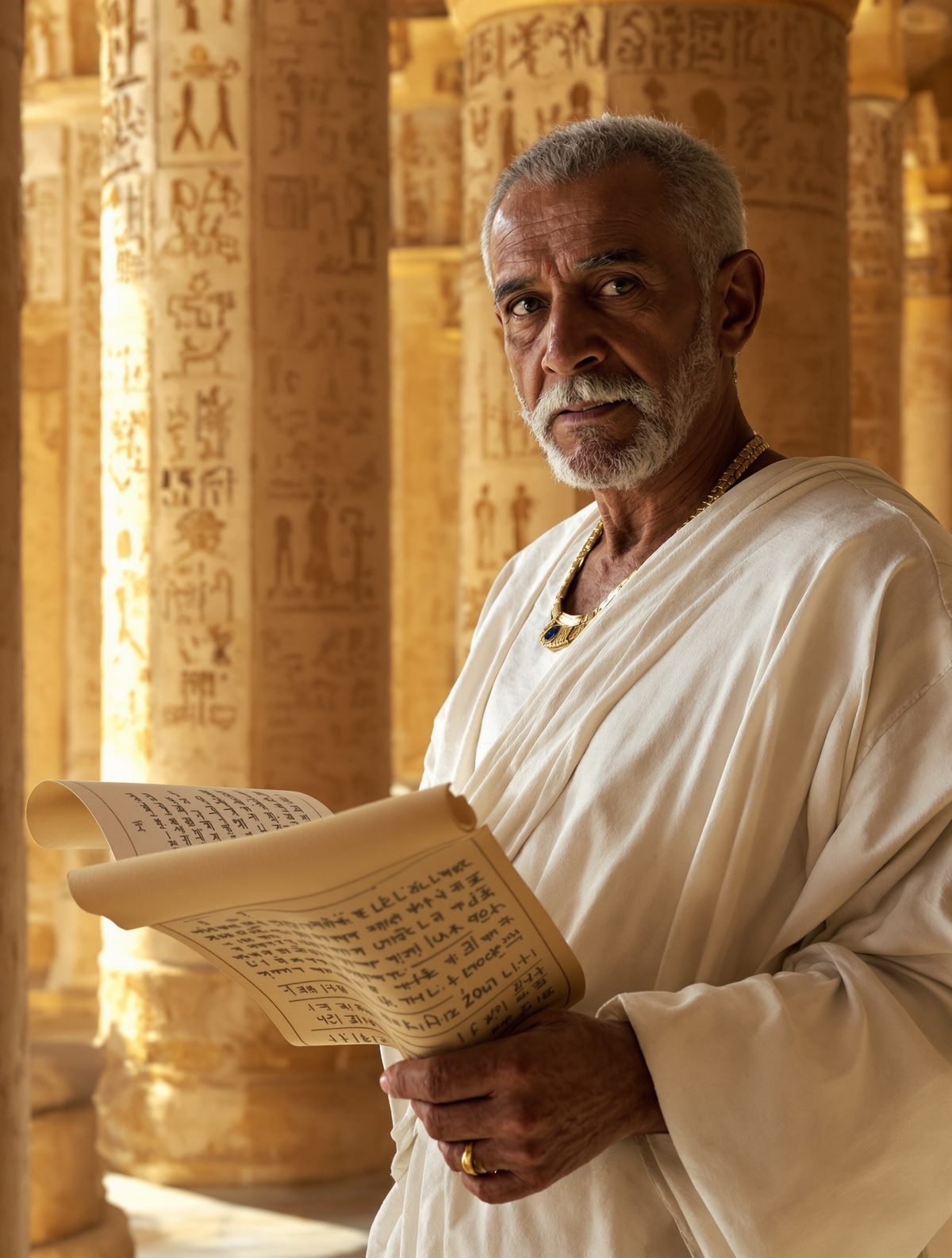
Picture this: one of history's greatest mathematical minds, gasping for breath as angry voices echo behind him through the narrow streets of ancient Metapontum. His sandaled feet pound against sun-baked earth as he flees for his life. Ahead lies salvation—a vast field stretching to the horizon. But as Pythagoras reaches the edge of this green expanse, he stops dead. Before him grow thousands upon thousands of bean plants, their leaves rustling gently in the Mediterranean breeze. The man who unlocked the secrets of right triangles faces an impossible choice: trample these sacred legumes and live, or honor his bizarre religious convictions and die.
He chooses death.
This is the story of how the father of geometry met his end in 495 BC—not in a blaze of mathematical glory, but cowering before a bean field, victim of one of history's most absurd philosophical principles.
The Cult Leader Masquerading as a Mathematician
Most people remember Pythagoras for a² + b² = c², but few realize that the brilliant mathematician was also the leader of one of antiquity's most bizarre religious cults. Around 530 BC, Pythagoras fled political turmoil in his native Samos and established himself in Croton, a prosperous Greek colony in southern Italy. There, he founded what appeared to be a school of mathematics and philosophy but was actually a secretive religious brotherhood with rules so strange they'd make a medieval monastery look like a libertarian commune.
The Pythagoreans, as his followers called themselves, lived by a bewildering code of conduct. Members couldn't eat meat or fish—fairly reasonable by today's standards. But they also couldn't touch white roosters, look in mirrors beside a light, or let swallows nest under their roofs. Most bizarrely of all, they were absolutely forbidden from eating or even touching beans.
This wasn't some ancient gluten-free diet trend. Pythagoras believed beans were literally connected to human souls. According to his doctrine, when people died, their souls could transmigrate into beans during the reincarnation process. Eating a bean, therefore, was tantamount to cannibalism—or worse, it might prevent a soul from completing its cosmic journey. Some ancient sources suggest Pythagoras taught that beans were actually formed from the same primordial matter as humans, making them sacred cousins in the great chain of being.
When Math Meets Politics: A Dangerous Equation
For nearly four decades, Pythagoras and his followers wielded enormous influence in Croton and surrounding cities. The Pythagorean brotherhood wasn't content with contemplating triangles and avoiding legumes—they actively participated in politics, often supporting aristocratic factions against democratic movements sweeping through the Greek world.
This political involvement proved their undoing. Around 510 BC, a wealthy Crotonian named Cylon sought admission to the brotherhood but was rejected—possibly for his violent temperament or democratic sympathies. Humiliated and furious, Cylon became the brotherhood's most dangerous enemy, methodically building a coalition against Pythagorean influence.
The breaking point came around 500 BC when anti-Pythagorean sentiment exploded across the region. In Croton, rebels attacked a house where forty leading Pythagoreans were meeting, burning it to the ground with most members trapped inside. Only two escaped the flames. Similar purges erupted in other cities where the brotherhood had gained power. Suddenly, being a Pythagorean wasn't just philosophically challenging—it was a death sentence.
The Final Flight: A Theorem in Terror
Pythagoras himself initially escaped the carnage, fleeing from city to city as his followers were systematically hunted down. By 495 BC, the aging philosopher—now in his seventies—had taken refuge in Metapontum, another Greek colony about 150 miles from Croton. But even there, his enemies tracked him down.
The details of what happened next come to us through ancient historians like Diogenes Laertius and Iamblichus, though their accounts differ in specifics while agreeing on the essential absurdity. On that fateful day in 495 BC, Cylon's supporters finally cornered their quarry. Pythagoras fled through Metapontum's streets, his white beard streaming behind him as younger, stronger men gave chase.
The pursuit led through the city's residential quarters, past temples and marketplaces, until Pythagoras found himself at the urban edge. Before him stretched a field of bean plants, their broad leaves creating a green carpet that extended to safety. A healthy man could easily outrun his pursuers by cutting straight across this agricultural expanse.
But Pythagoras wasn't just any man—he was the prisoner of his own philosophical convictions.
The Mathematics of Martyrdom
As his enemies closed in, Pythagoras stood frozen at the field's edge. Every step forward would crush dozens of bean plants. Every crushed plant represented, in his cosmology, a potential vessel for human souls. To flee across this field would be to commit mass spiritual murder—an act that would damn his own soul in the cosmic cycles of reincarnation he'd spent a lifetime contemplating.
The irony was mathematical in its precision: the man who'd demonstrated that the shortest distance between two points was a straight line couldn't bring himself to travel that straight line. The philosopher who'd proven that a² + b² = c² discovered that sometimes the hypotenuse of survival requires violating the sacred geometry of one's beliefs.
Ancient sources suggest Pythagoras attempted to negotiate with his captors, perhaps hoping to convert them through philosophical discourse. These were not, however, men interested in discussing the transmigration of souls or the mystical properties of numbers. They wanted revenge for decades of Pythagorean political dominance, and they'd finally cornered their greatest prize.
Some accounts claim they cut Pythagoras down immediately. Others suggest they took him prisoner and executed him later. A few romantic versions have him voluntarily choosing death rather than betraying his principles. But all sources agree on one crucial detail: the father of the Pythagorean theorem died because he wouldn't run through a bean field.
Legacy of the Sacred Bean
Pythagoras's death marked the effective end of his brotherhood as a political force, though scattered communities of Pythagoreans continued practicing his mathematical and mystical teachings for centuries. Remarkably, many maintained the bean prohibition long after its founder's bizarre martyrdom. Even Plato, writing a century later, referenced Pythagorean bean-avoidance as a well-known quirk of the philosophical school.
The bean taboo persisted in various forms throughout antiquity. Roman priests called flamens were forbidden from touching beans. Some scholars believe these restrictions influenced early Christian monasticism, where dietary prohibitions became expressions of spiritual devotion. The Pythagorean equation of food choices with cosmic significance echoes in modern movements that ascribe moral or spiritual meaning to dietary decisions.
But perhaps the most lasting legacy of Pythagoras's final moment lies in its perfect encapsulation of philosophy's eternal dilemma: the sometimes fatal gap between abstract principles and concrete reality. Here was a man whose mathematical insights had unlocked fundamental truths about physical space, yet whose mystical beliefs left him paralyzed when practical geometry—running in a straight line—could have saved his life.
The Eternal Right Triangle of Choice
Today, millions of students learn the Pythagorean theorem without knowing that its namesake died fleeing from legumes. This historical amnesia isn't accidental—it's easier to teach a² + b² = c² than to explain why brilliant people sometimes hold inexplicable beliefs, or why the pursuit of absolute truth can lead to absolutely absurd conclusions.
Yet Pythagoras's bean-field martyrdom offers a strangely relevant lesson for our own age of ideological polarization. In a world where people routinely destroy relationships over political beliefs, refuse medical treatments based on conspiracy theories, or make life-altering decisions based on social media posts, perhaps we shouldn't be too quick to mock a philosopher who chose death over dietary compromise.
The real tragedy isn't that Pythagoras died for a ridiculous principle—it's that such a brilliant mind convinced itself that beans were more important than breathing. His final theorem was the most human equation of all: when abstract conviction meets concrete reality, the result is often both profound and profoundly absurd. In the end, the man who taught us to calculate the dimensions of right triangles learned that life's most important calculations can't always be solved with mathematics.