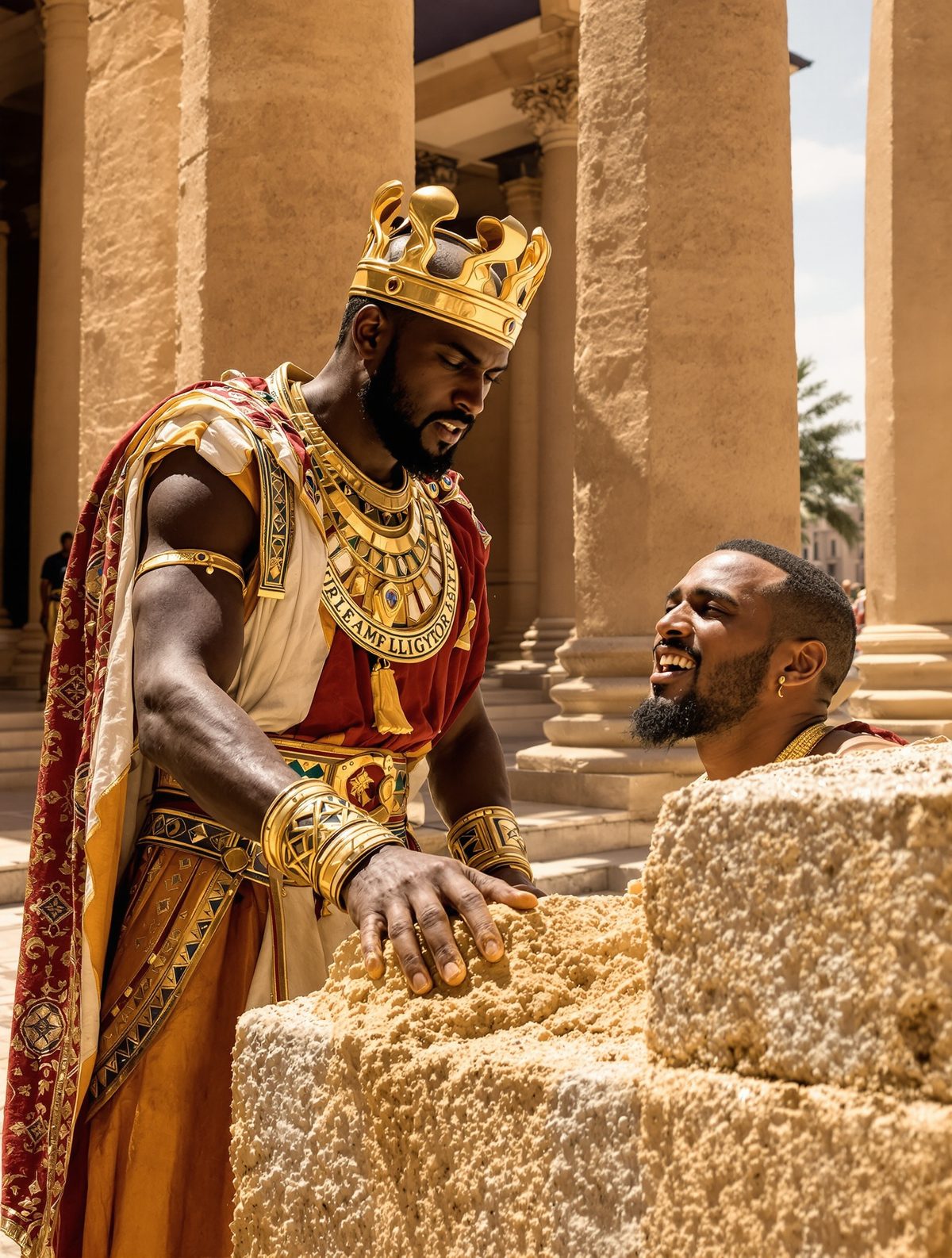
In the scorching heat of a Jordanian morning in 63 BC, water trickled through carved stone channels for the first time in forty years of backbreaking labor. The impossible had happened—water was flowing uphill through solid rock, defying gravity itself through nothing more than mathematical precision and human determination. But the man who had dedicated his entire adult life to this feat, the Nabataean engineer known simply as Khalil, lay cold in his workshop, having died just hours before witnessing his masterpiece come to life.
The irony was as cruel as the desert sun that had beaten down on him for four decades. After carving nearly twelve miles of channels through rose-red sandstone with gradients so precise that modern hydraulic engineers struggle to understand them, Khalil never saw a single drop reach the magnificent city of Petra.
The Desert Masters of the Impossible
To understand Khalil's obsession, you must first grasp the sheer audacity of Petra itself. Rising from the harsh Arabian Desert like a fever dream carved in stone, this Nabataean capital shouldn't have existed at all. The Nabataeans—Arab traders who controlled the frankincense routes between Arabia and the Mediterranean—had chosen to build their greatest city in one of the most water-scarce regions on Earth.
While other civilizations settled near rivers or springs, the Nabataeans looked at the towering sandstone cliffs of southern Jordan around 300 BC and saw something different: the perfect fortress. Hidden canyon entrances, natural rock walls rising 200 feet high, and strategic positions along trade routes made Petra militarily unassailable. There was just one problem—water.
The nearest reliable water source lay in the hills of Ain Musa, roughly eight miles northeast of the city and, crucially, downhill from Petra's elevated position. Simple gravity-fed aqueducts, the engineering marvel that supplied Rome and other great cities, wouldn't work here. The water had to climb.
This is where Khalil entered history. According to Nabataean inscriptions discovered in 1958 by archaeologist Peter Parr, Khalil was appointed as qa'im al-miyah—literally "water-master"—by King Obodas II around 103 BC. His mission was as simple as it was impossible: bring fresh water to Petra's growing population of nearly 30,000 people.
The Mathematics of Madness
What Khalil proposed would have seemed like fantasy to most ancient engineers. He planned to carve a channel system that would use a combination of physics principles that wouldn't be formally described until centuries later: the Venturi effect, pressure differentials, and what we now call the siphon principle.
The key lay in Khalil's understanding that water doesn't actually flow "uphill"—it follows the path of least resistance in a closed system. By carving channels with varying widths and depths, creating pressure chambers, and maintaining incredibly precise gradients, he could trick water into climbing elevations that seemed to defy nature.
The numbers are staggering. Khalil's channel system, known as the Siq al-Barid (Cold Canyon), maintained an average gradient of just 0.3 degrees—a variance so slight that being off by even a millimeter per meter would cause the entire system to fail. Over the course of twelve miles, the water would rise a total of 347 feet while traveling through carved stone channels that measured exactly 18 inches wide and 24 inches deep for most of their length.
Here's the mind-blowing part: When modern engineers surveyed the ruins in 1994, they found that Khalil's measurements were accurate to within 2 millimeters over the entire twelve-mile distance. Using only bronze tools, wooden measuring rods, and an intuitive understanding of hydraulics, he had achieved a level of precision that rivals modern laser-guided construction.
Four Decades of Stone and Sweat
The scale of Khalil's undertaking becomes clear when you consider the physical labor involved. Working with a team that rarely exceeded twenty men, he had to carve through solid sandstone using bronze chisels, wooden mallets, and primitive measuring instruments. The rock was removed one chip at a time.
Nabataean records, preserved in the dry desert air and translated in the 1980s, provide glimpses into the grueling work. In one inscription, dated to approximately 85 BC, Khalil writes: "The stone fights us each day, but we are patient as the desert wind that carves mountains grain by grain."
The project consumed his life entirely. Khalil never married, never owned property beyond his simple workshop, and rarely left the construction site for more than a few days. Fellow Nabataeans considered him either a visionary or a madman—possibly both. King Aretas III, who succeeded Obodas II, nearly canceled the project in 87 BC when costs had already consumed the equivalent of three years of Petra's tax revenue.
But Khalil had become something of a folk hero among Petra's common people, who saw him as their salvation from the daily struggle for water. Women would bring him food, children would help carry away stone chips, and merchants would donate tools and materials. The entire city had invested emotionally in this impossible dream.
The Perfect System That Almost Wasn't
By 65 BC, after thirty-eight years of work, Khalil's system was nearly complete—but it wasn't working. Water would travel about two-thirds of the distance before stalling in the channels. Modern analysis suggests the problem was air bubbles disrupting the flow in the siphon sections. Khalil had solved the mathematics of moving water uphill, but physics had one more cruel lesson to teach.
The solution came to him, according to his final inscription, in a dream. He began installing what he called "breath holes"—small vertical shafts that allowed air to escape from high points in the system while maintaining water pressure. It was a brilliant innovation that wouldn't appear in European engineering for another 800 years.
These final modifications took two more years to complete. Khalil, now in his seventies and suffering from what his writings describe as "stone lung" (likely silicosis from decades of breathing rock dust), worked with increasing desperation. He knew his body was failing, and the system remained untested.
On the morning of what we now calculate as March 15, 63 BC, Khalil made his final inspection of the completed channel system. That evening, he collapsed in his workshop. A young apprentice found him the next morning, surrounded by scrolls covered in hydraulic calculations, his bronze measuring rod still clutched in his weathered hands.
The Water Flows at Last
The cruel irony of timing haunts this story. Just hours after Khalil's death, the spring rains began—the first substantial precipitation in three years. As dawn broke on March 17, water from the Ain Musa springs finally had enough pressure and volume to complete its impossible journey.
Imagine the scene: Petra's residents, many of whom had watched Khalil work for their entire lives, gathering in the main plaza as the sound of flowing water echoed through the carved channels. The impossible had happened. Fresh, clear water was bubbling up from fountains in the heart of their desert city, climbing hundreds of feet through solid rock to reach them.
The system worked flawlessly for over 200 years, supporting Petra's golden age as one of the wealthiest cities in the ancient world. It continued operating, with minor maintenance, until the great earthquake of 363 AD finally cracked the channels beyond repair.
Why Khalil's Legacy Matters Today
In our age of computer-aided design and precision machinery, Khalil's achievement seems almost supernatural. But perhaps that's exactly why his story matters. He represents something we've largely lost: the audacious belief that human determination and ingenuity can overcome seemingly impossible obstacles, one careful measurement at a time.
Today, as we face our own water crises and climate challenges, Khalil's story reminds us that the most profound solutions often come from individuals willing to dedicate their lives to problems others consider unsolvable. He didn't have modern tools or formal engineering training, but he had something perhaps more valuable: an unshakeable conviction that human beings can bend the natural world to their will through patience, precision, and an almost mystical understanding of cause and effect.
The channels of Petra still exist, though dry now for over 1,600 years. Visitors walking through the Siq can still see sections of Khalil's work, worn smooth by centuries of wind but testament to one man's refusal to accept the impossible. Water doesn't flow through them anymore, but something else does—the inspiration of a forgotten engineer who spent his entire life proving that dedication and precision can work miracles, even if we don't live to see them.