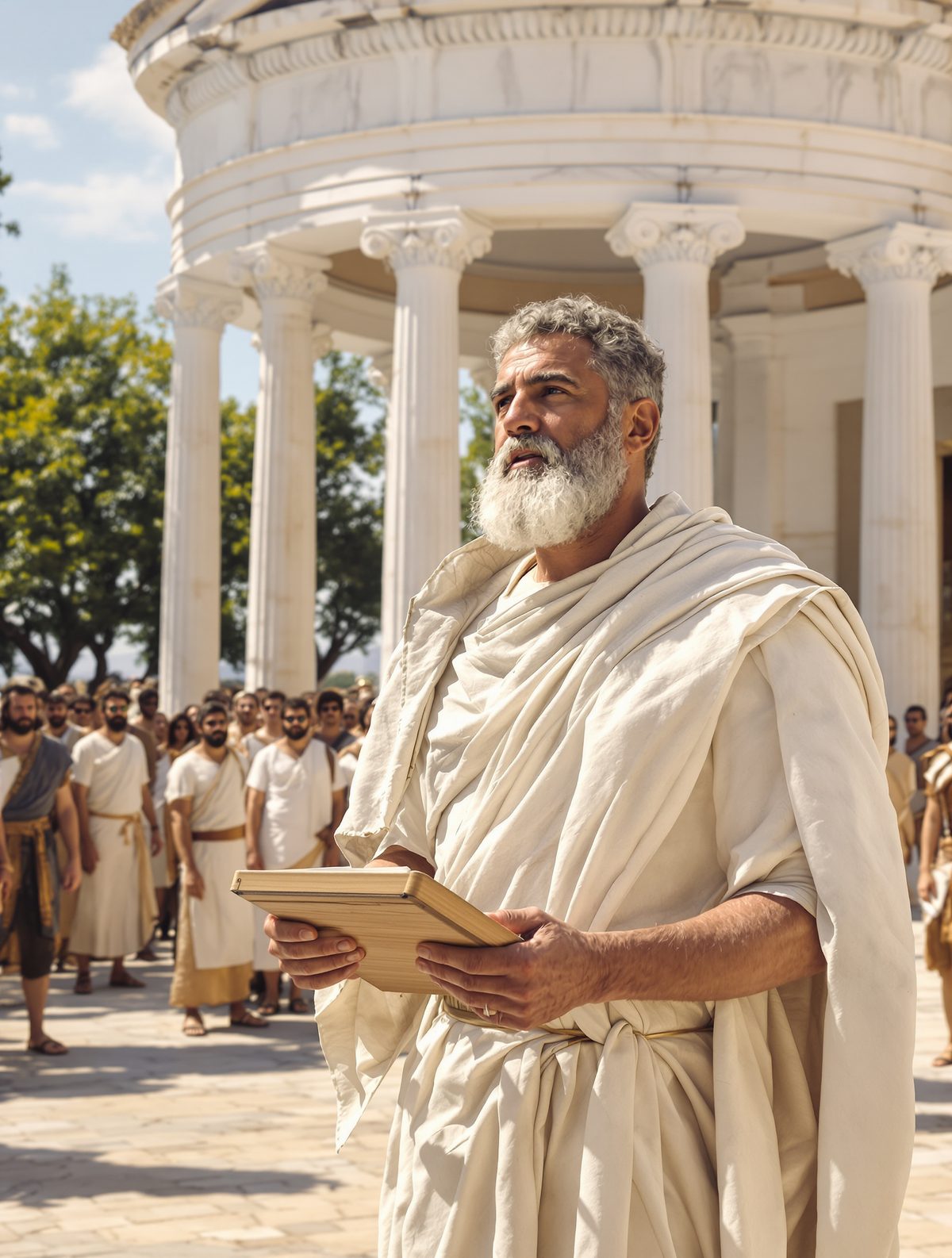
The tension in the stone hall was so thick you could cut it with a seax. King Oswiu of Northumbria sat rigid on his wooden throne, his weathered hands gripping the armrests as two groups of monks faced off like armies before battle. On one side stood the Irish monks with their distinctive tonsures—heads shaved from ear to ear across the front. On the other, Roman clergy with their familiar crown-shaped shaves. Between them stood a young Northumbrian monk named Wilfrid, clutching a scroll covered in astronomical calculations that would either vindicate him as a scholar or condemn him as a heretic.
It was 664 AD, and Wilfrid had just done the unthinkable: he'd proven mathematically that the Celtic Church had been celebrating Easter on the wrong date for decades. The room erupted in angry voices. Some called him a fraud. Others whispered "heretic" under their breath. A few even demanded his immediate exile. But Wilfrid stood his ground, because he knew something that would shake the very foundations of Christianity in Britain—and nearly cost him his life in the process.
When Two Christianities Collided
To understand the magnitude of Wilfrid's bombshell, you need to picture 7th-century Britain as a religious battleground. When Roman legions withdrew in 410 AD, they left behind a fledgling Christian church. But when Anglo-Saxon invaders swept across the land, that Roman Christianity was nearly wiped out, surviving mainly in Wales and Cornwall. Meanwhile, Irish missionaries led by figures like Saint Columba had been spreading their own brand of Christianity throughout Scotland and northern England since the 6th century.
By Wilfrid's time, these two Christian traditions had evolved quite differently. The Irish Church, isolated from Rome for generations, had developed its own customs. Priests could marry. Monasteries followed different rules. And most controversially of all, they calculated Easter using an ancient system that Rome had abandoned nearly a century earlier.
King Oswiu found himself in an impossible position. He'd been raised in the Irish tradition during his exile in Scotland, but his wife Queen Eanflaed followed Roman customs. This meant that some years, the king would be solemnly observing Lent while his queen was already celebrating Easter in the next room. Imagine the awkwardness at royal dinner parties.
The Mathematics of Divine Drama
The Easter controversy wasn't just about picking a random Sunday to celebrate. It was a mind-bendingly complex astronomical puzzle that had confounded scholars for centuries. According to the Council of Nicaea in 325 AD, Easter should fall on the first Sunday after the first full moon following the spring equinox. Simple enough, right?
Wrong. The Celtic Church was using calculation tables called "Latercus" that dated back to the 4th century, while Rome had adopted more accurate tables developed by Dionysius Exiguus in 525 AD. The difference could be substantial—sometimes Celtic Easter fell a full month earlier than the Roman date, and occasionally it even fell on the same day as the Jewish Passover, which early church councils had specifically forbidden.
Wilfrid had spent months hunched over manuscripts in Ripon Abbey, working by candlelight to master these calculations. He'd studied the lunar cycles, tracked the movements of celestial bodies, and compared the competing systems line by line. What he discovered was damning: the Irish system was based on an 84-year cycle that accumulated significant errors over time, while the Roman system used a more accurate 19-year cycle that better reflected actual astronomical observations.
The Young Monk Who Dared to Speak Truth
Wilfrid was an unlikely candidate for such controversy. Born around 634 AD to a noble family in Northumbria, he'd shown early promise as a scholar and had even traveled to Rome—a dangerous journey that took months and could easily prove fatal. There he'd witnessed the sophistication of Roman Christianity firsthand, studying under the latest theological and astronomical authorities.
But what made Wilfrid dangerous wasn't just his knowledge—it was his personality. Contemporary sources describe him as brilliant but arrogant, charismatic but uncompromising. He wasn't content to quietly study his calculations; he wanted to broadcast them to the world, regardless of the consequences.
When King Oswiu announced the Synod of Whitby to settle the Easter question once and for all, Wilfrid saw his chance. The gathering would bring together the most influential religious figures in the kingdom. Abbot Colman would represent the Irish position, while Wilfrid would argue for Rome. The stakes couldn't have been higher—the losing side faced potential exile or worse.
The Showdown at Whitby
The Synod of Whitby convened in the autumn of 664 at the double monastery ruled by the formidable Abbess Hilda. The setting was deliberately neutral—Hilda followed Irish customs but maintained good relations with both sides. Still, you could feel the tension as monks, abbots, and nobles filed into the great hall overlooking the North Sea.
Abbot Colman spoke first, invoking the authority of Saint Columba and the ancient traditions of the Irish Church. His argument was compelling: how could they abandon the practices handed down by saints and martyrs? The Irish system had served them well for generations. Why fix what wasn't broken?
Then Wilfrid rose to speak. Contemporary accounts suggest he was nervous—his hands may have trembled as he unrolled his calculations—but his voice grew stronger as he laid out his case. He didn't just argue theology; he presented hard mathematical proof. The Irish system, he demonstrated, was simply wrong. It failed to accurately track lunar cycles and often violated the church's own rules about Easter timing.
But Wilfrid's masterstroke wasn't mathematical—it was political. He pointed out that the Irish system isolated British Christians from the rest of the world. Rome, Gaul, Africa, Asia—virtually every Christian community used the Roman calculation. Were the Northumbrians really going to stand alone against universal church practice?
The Aftermath That Changed Everything
King Oswiu's decision was swift and decisive. He ruled in favor of Rome, reportedly joking that he didn't want to risk angering Saint Peter, the keeper of heaven's keys. But the aftermath was anything but humorous. Abbot Colman, refusing to accept the decision, gathered his supporters and left for Ireland, never to return. Many Irish monks followed him, abandoning monasteries they'd built and communities they'd served for decades.
Wilfrid's victory came at a steep personal cost. While he'd won the argument, he'd also made powerful enemies who would spend years plotting his downfall. He would eventually become Bishop of York, but his career was marked by repeated conflicts, exiles, and even imprisonment. His uncompromising nature, which had served him so well at Whitby, would repeatedly bring him to the brink of disaster.
The Synod's decision fundamentally transformed British Christianity. It aligned England with continental Europe, paving the way for closer ties with Rome and greater integration into the broader Christian world. The unique Celtic traditions that had flourished for centuries were gradually replaced by Roman practices, architecture, and scholarship.
Why a Medieval Calendar Fight Still Matters
At first glance, the Synod of Whitby might seem like an obscure theological dispute with little relevance to modern life. Who cares when medieval monks celebrated Easter? But look deeper, and you'll find themes that resonate powerfully today.
This was fundamentally a story about the collision between local tradition and global standardization—a tension we see everywhere from cryptocurrency regulation to climate change policy. Wilfrid's mathematical proof reminds us that some questions have objectively correct answers, regardless of how uncomfortable those answers might make us. And the brutal aftermath of the Synod shows how even necessary changes can tear communities apart.
Perhaps most importantly, Wilfrid's story illustrates the courage required to speak unpopular truths. In an age when conformity often seems easier than challenging established wisdom, we might remember a young monk who risked everything to defend what he knew was right. His calculations were vindicated by history, but the price he paid reminds us that being correct and being popular are very different things.
The next time you check a calendar or use GPS satellites to navigate, remember that you're relying on the same type of precise astronomical calculations that a brave monk named Wilfrid defended in a cold stone hall thirteen centuries ago. Some truths are worth fighting for, even when the whole world seems arrayed against you.