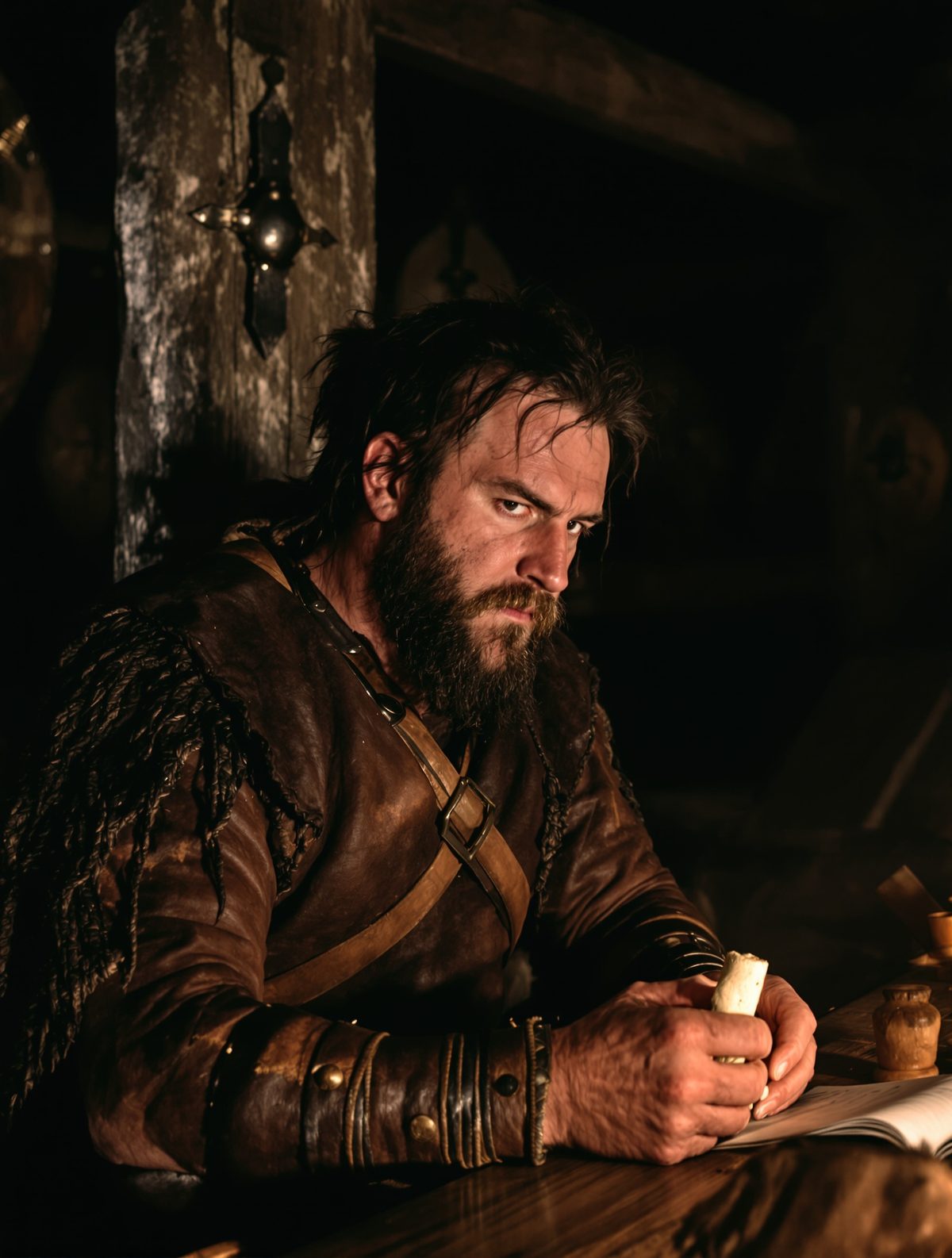
Picture this: It's 11:40 PM on April 14, 1912, and Chief Baker Charles Joughin feels the RMS Titanic shudder beneath his feet like a giant beast taking its last breath. While 2,224 other souls aboard the "unsinkable" ship scramble in panic, Joughin makes a decision that would either kill him or save his life. He heads to his quarters, grabs a bottle of whiskey, and proceeds to drink himself into what most would consider oblivion. Three hours later, he would literally ride the Titanic down into the frigid Atlantic Ocean—and somehow live to tell about it.
This is the extraordinary true story of how liquid courage became liquid salvation, and why Charles Joughin's survival defied every law of nature, probability, and common sense.
The Baker Who Baked Under Pressure
Charles John Joughin wasn't your average crew member aboard the Titanic. At 33 years old, the Liverpool-born baker held the prestigious position of Chief Baker, responsible for feeding the ship's 2,224 passengers and crew. His domain was the ship's bakery on E Deck, where he supervised a team of 13 bakers who worked around the clock to produce fresh bread, pastries, and confections for first-class dining rooms and third-class galleys alike.
On that fateful night, Joughin had been asleep in his cabin when the collision with the iceberg jolted him awake. Unlike many crew members who initially dismissed the impact as minor, Joughin sensed something was terribly wrong. The ship's engines had stopped—an ominous sign that any experienced sailor would recognize. As he made his way through the corridors, the gradually increasing tilt of the deck confirmed his worst fears.
But here's where Joughin's story takes a remarkable turn. While other crew members rushed to their emergency stations, Joughin made a detour that would save his life: he returned to his cabin and retrieved a bottle of whiskey. What happened next would become one of the most debated survival stories in maritime history.
Liquid Courage in the Face of Certain Death
As the Titanic's bow began to dip lower into the Atlantic, Joughin didn't just sip his whiskey—he methodically consumed the entire bottle over the course of the next two hours. This wasn't panic drinking; witnesses later described him as remarkably calm and coherent throughout the ordeal. He even helped load women and children into Lifeboat 10, working efficiently despite his increasing intoxication.
The alcohol had an immediate warming effect on Joughin's body, dilating his blood vessels and creating a sensation of heat that would prove crucial in the hours ahead. While passengers around him shivered in the 28-degree Fahrenheit air, Joughin felt comfortable enough to remove his life jacket and give it to a woman who didn't have one—a decision that seemed like madness but would later prove strategically brilliant.
As the last lifeboats departed around 2:05 AM, Joughin found himself among the 1,500+ souls still aboard the doomed vessel. But instead of joining the crowds rushing toward the stern, he made another counterintuitive choice: he went to his cabin one final time, not for another drink, but to calmly wait for what he believed was inevitable death.
Riding an "Elevator" to Hell
What happened at 2:20 AM on April 15, 1912, defies belief. As the Titanic's stern rose higher into the air and the ship began its final plunge, Joughin stepped onto the stern rail and held on. Then, in what he later described as riding the ship "like an elevator," he remained calm as the massive vessel slipped beneath the waves, taking him down with it.
Here's the incredible part: Joughin never went underwater. As the ship sank beneath him, he simply stepped off into the ocean as if he were stepping off a curb. The 882-foot-long ship had become his personal descent vehicle into the North Atlantic. His blood alcohol content, estimated by modern experts to have been somewhere between 0.15 and 0.20—nearly twice today's legal driving limit—had numbed his panic response and allowed him to think clearly in a situation where others were paralyzed by terror.
But the real test was just beginning. The water temperature was a bone-numbing 28 degrees Fahrenheit—cold enough to kill a sober person within 15-30 minutes through hypothermia and cardiac arrest. Joughin, however, had unknowingly created his own biological antifreeze system.
Two Hours in a Liquid Grave
For the next two hours and twenty minutes, Charles Joughin treaded water in conditions that should have killed him dozens of times over. The alcohol in his system had dilated his blood vessels, keeping warm blood flowing to his extremities when it should have been retreating to protect his vital organs. This prevented the rapid onset of hypothermia that claimed most of the other victims within the first 30 minutes.
Joughin later testified that he never felt cold during his time in the water—a statement that seemed impossible to investigators until modern medical science explained the mechanism. The alcohol had essentially turned his circulatory system into a heating unit, maintaining his core body temperature at the cost of accelerated heat loss—a trade-off that paradoxically worked in his favor given the circumstances.
Swimming among the debris and bodies of fellow passengers and crew members, Joughin remained conscious and alert. He could hear the cries of other survivors growing weaker and then falling silent as hypothermia claimed them one by one. Yet somehow, impossibly, he continued to survive in water that was described by other survivors as "like liquid ice."
Salvation Arrives with the Dawn
At approximately 4:40 AM, just as the alcohol was beginning to wear off and hypothermia was finally starting to set in, Joughin spotted the overturned Collapsible Lifeboat B. The boat was already overcrowded with survivors standing on its hull, including Second Officer Charles Lightoller and wireless operator Harold Bride. There was no room for another person aboard.
But Joughin's luck held. The survivors on the boat allowed him to grab onto the side, keeping just his head above water while they supported his body. When rescue ship RMS Carpathia arrived at dawn, Joughin was pulled from the water after spending nearly four hours in conditions that had killed hundreds of others.
Remarkably, Joughin suffered no frostbite, no hypothermia, and no lasting physical effects from his ordeal. He was walking around the Carpathia within hours, helping other survivors and even assisting the ship's bakers in preparing food for the rescued passengers. His only complaint was swollen feet—a minor inconvenience considering he had just survived the impossible.
The Science Behind the Miracle
Modern medical experts have studied Joughin's case extensively, and while they don't recommend alcohol as a survival strategy, they acknowledge that his unique combination of circumstances created a perfect storm for survival. The alcohol prevented the immediate vasoconstriction that typically leads to rapid hypothermia, while his calm demeanor—also influenced by intoxication—prevented the panic-induced hyperventilation that often causes people to drown in cold water.
Dr. John Hayward, a hypothermia expert at the University of Victoria, has noted that alcohol's effects are highly unpredictable in cold water survival situations. In most cases, alcohol actually increases the risk of death by impairing judgment and accelerating heat loss. Joughin's survival was likely due to a combination of factors: his robust physical condition, the specific amount of alcohol consumed, the timing of consumption, and sheer biological luck.
Perhaps most importantly, Joughin's story reminds us that history's greatest mysteries often lie not in what happened, but in the remarkable individuals who defied every odd to survive and tell the tale. Charles Joughin lived until 1956, working as a baker for the rest of his life and rarely speaking about his extraordinary night in the North Atlantic. He took his secrets with him to the grave, leaving us to marvel at a survival story that seems too incredible to be true—yet absolutely is.
In our modern world of calculated risks and safety protocols, Joughin's story serves as a reminder that sometimes survival comes down to split-second decisions that defy conventional wisdom. His tale isn't a recommendation for alcohol consumption in emergencies, but rather a testament to the mysterious ways that human biology, circumstance, and sheer determination can combine to create miracles in the darkest of hours.