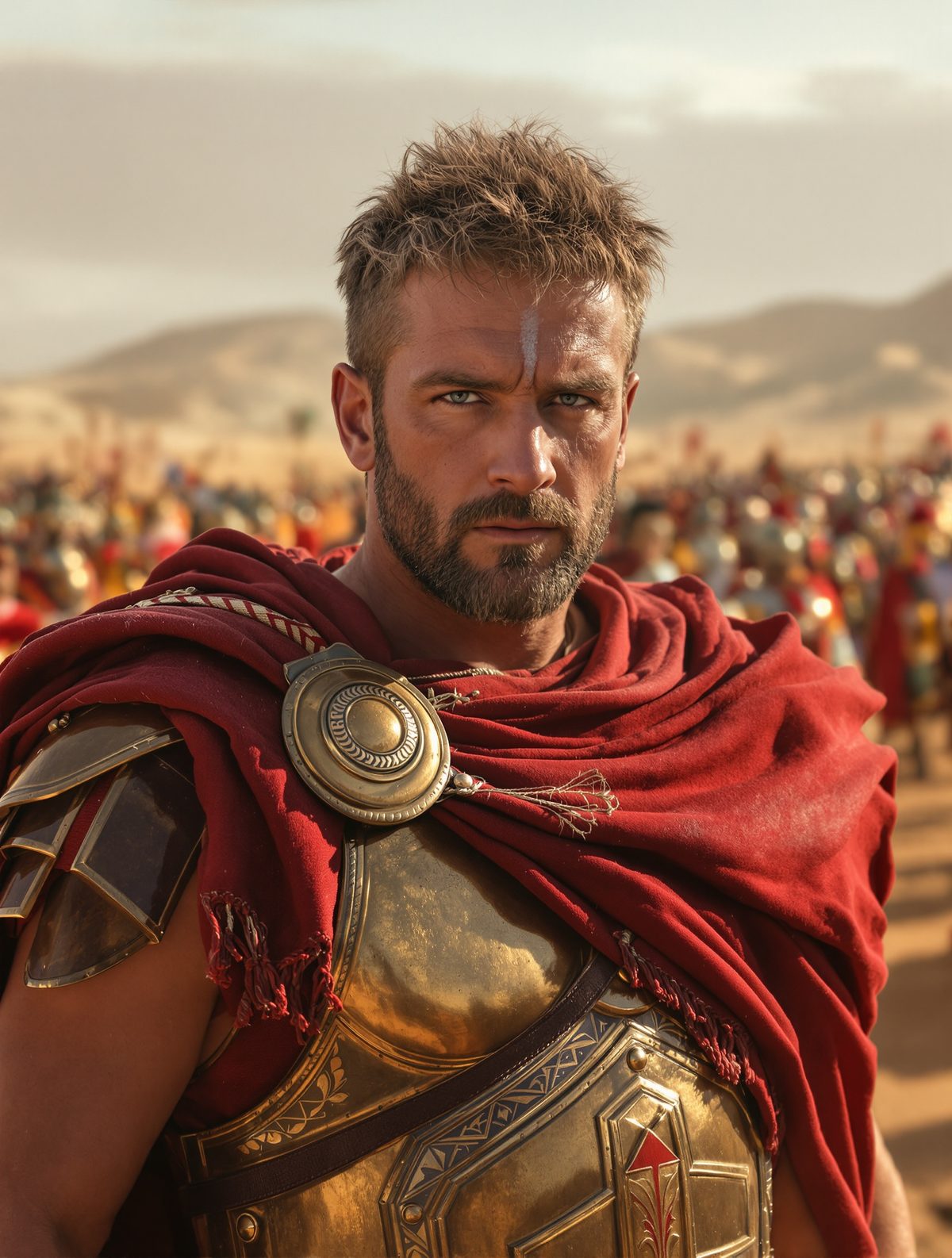
Picture this: You're Augustus Caesar, master of the known world, commander of history's greatest military machine. Your legions have conquered Gaul, crushed Egypt, and brought the Mediterranean to heel. Then a package arrives at your palace. Inside? The severed head of your ambassador, along with a message that essentially translates to "come and take it." The sender? A one-eyed African queen who's about to hand you the most humiliating defeat of your reign.
Welcome to the story of Amanirenas, the Kushite queen who made the Roman Empire blink first.
The Kingdom That Wouldn't Kneel
In 25 BC, while Rome was busy celebrating its dominance over the civilized world, the Kingdom of Kush was thriving far up the Nile in what is now Sudan. This wasn't some primitive backwater—Kush was a sophisticated empire that had once ruled Egypt for nearly a century. Their capital, Meroë, boasted iron foundries, elaborate temples, and pyramid fields that rivaled anything in Giza.
But here's what makes Kush truly remarkable: they were ruled by a series of powerful queens called Kandakes (from which we get the name "Candace"). These weren't ceremonial figureheads—they were warrior-queens who led armies into battle and governed with absolute authority. The Romans, for all their military prowess, had never encountered anything quite like them.
Amanirenas had already proven her mettle in combat, losing her right eye in a previous conflict with Roman forces. Far from retreating to lick her wounds, she wore her battle scar like a crown. Ancient historians describe her as "a very masculine sort of woman, and blind in one eye"—which, in the decidedly non-feminist language of the time, was actually grudging respect for a formidable opponent.
Augustus Makes a Fatal Miscalculation
Fresh from his conquest of Egypt in 30 BC, Augustus was feeling invincible. The young emperor decided that the wealthy kingdom to the south should acknowledge Roman supremacy and pay tribute. It seemed like a reasonable demand—after all, who could stand against the legions that had conquered the world?
Augustus dispatched his ambassador south with typical Roman confidence. The message was simple: submit to Rome, pay tribute, or face the consequences. The ambassador probably expected some diplomatic back-and-forth, maybe a ceremonial gift exchange, and eventual Kushite capitulation.
Instead, he got his head chopped off.
Amanirenas' response was as brutal as it was clear. She had his head severed and sent back to Augustus in a basket, accompanied by what the Roman historian Strabo diplomatically called "insolent replies." But the one-eyed queen wasn't content with just sending a message—she was about to deliver it in person, with an army at her back.
The Queen Strikes North
What happened next shattered Roman assumptions about African military capability. Amanirenas assembled a massive force—ancient sources claim 30,000 warriors—and launched a lightning-fast invasion of Roman Egypt. This wasn't a desperate last stand; it was a calculated military offensive planned and executed with devastating precision.
The Kushite army swept north like a desert storm. They captured Syene (modern-day Aswan), Elephantine Island, and Philae in rapid succession, overrunning Roman garrisons that had never faced anything like this African juggernaut. But Amanirenas wasn't interested in mere conquest—she wanted to send a message that would echo through every Roman forum.
At Syene, her forces discovered something that must have filled the queen with savage satisfaction: bronze statues of Augustus himself. Rather than simply destroying them, Amanirenas ordered the head of one statue to be carefully removed and transported back to Meroë, where it was buried beneath the steps of a temple. Every Kushite who entered would literally walk over the Roman emperor's head.
That bronze head, by the way, was discovered by archaeologists in 1910 and now resides in the British Museum—one of the most spectacular "burn" deliveries in ancient history.
When Rome's Legions Met Their Match
Augustus couldn't let this humiliation stand. He dispatched Gaius Petronius, the Roman prefect of Egypt, with a substantial force to restore imperial honor. Petronius was a capable commander who had cut his teeth in Rome's civil wars, and he initially managed to push the Kushites back, even capturing some of their territory.
But Amanirenas was far from finished. The one-eyed queen regrouped and launched a series of devastating counterattacks that left the Roman forces reeling. What made her military strategy so effective wasn't just the fierce fighting ability of her warriors—it was her intimate knowledge of the terrain and her ability to appear where Romans least expected her.
The Kushite military was a sophisticated machine. They employed war elephants, skilled archers using powerful composite bows, and iron weapons forged in their own foundries. Their cavalry was mobile and deadly, perfectly adapted to the desert warfare that left Roman legionaries struggling in the heat and sand. Most importantly, they were fighting for their homeland against foreign invaders—a motivation that Roman gold couldn't buy.
For three years, this brutal conflict raged up and down the Nile. Roman casualties mounted, and Augustus found himself facing something he'd never encountered before: an African opponent who refused to be intimidated by Roman might.
The Treaty That Rome Tried to Forget
By 22 BC, both sides were exhausted, but it was Rome that blinked first. Augustus, the master of the Mediterranean, sent envoys to negotiate with the one-eyed queen. The resulting treaty was so favorable to Kush that Roman historians barely mentioned its terms.
Here's what Amanirenas extracted from the world's greatest empire: Rome abandoned its demands for tribute, withdrew from Kushite territory, and actually returned some lands they had previously conquered. The treaty established a buffer zone that respected Kushite sovereignty and guaranteed that Roman forces would not venture south of established boundaries.
For Augustus, this was an unprecedented diplomatic concession. The emperor who had brought Egypt to heel, who had defeated Mark Antony and Cleopatra, had been forced to negotiate as an equal with an African queen. Roman propaganda machine went into overdrive to downplay the significance of this "minor frontier adjustment," but the truth was unavoidable: Rome had lost.
Amanirenas had achieved something remarkable—she had fought the Roman Empire to a standstill and secured her kingdom's independence. The treaty held for decades, and Kush remained unconquered until long after Augustus was dead and buried.
Why the One-Eyed Queen Matters Today
Amanirenas challenges everything we think we know about the ancient world. In an era when most historical narratives focus on Mediterranean civilizations, her story reminds us that Africa was home to sophisticated kingdoms that could meet European powers as equals—or betters.
Her legacy also forces us to reconsider the invincibility of imperial power. Augustus Caesar, at the height of his strength, with the world's most professional military at his command, was stopped cold by an African queen who refused to submit. In our own time, when powerful nations still assume that military might guarantees political success, Amanirenas' victory carries a timeless lesson about the limits of force and the power of determined resistance.
Perhaps most importantly, she represents the countless African leaders whose stories have been marginalized or forgotten entirely. For every Cleopatra whose story survived in popular culture, there were dozens of leaders like Amanirenas—brilliant, capable rulers who shaped history but were written out of it by later chroniclers more interested in European glory than African achievement.
The one-eyed queen of Kush didn't just defeat Roman legions; she defeated the assumption that Africa was a continent waiting to be conquered. Her victory stands as testament to a truth that empires throughout history have learned the hard way: underestimate Africa at your peril.