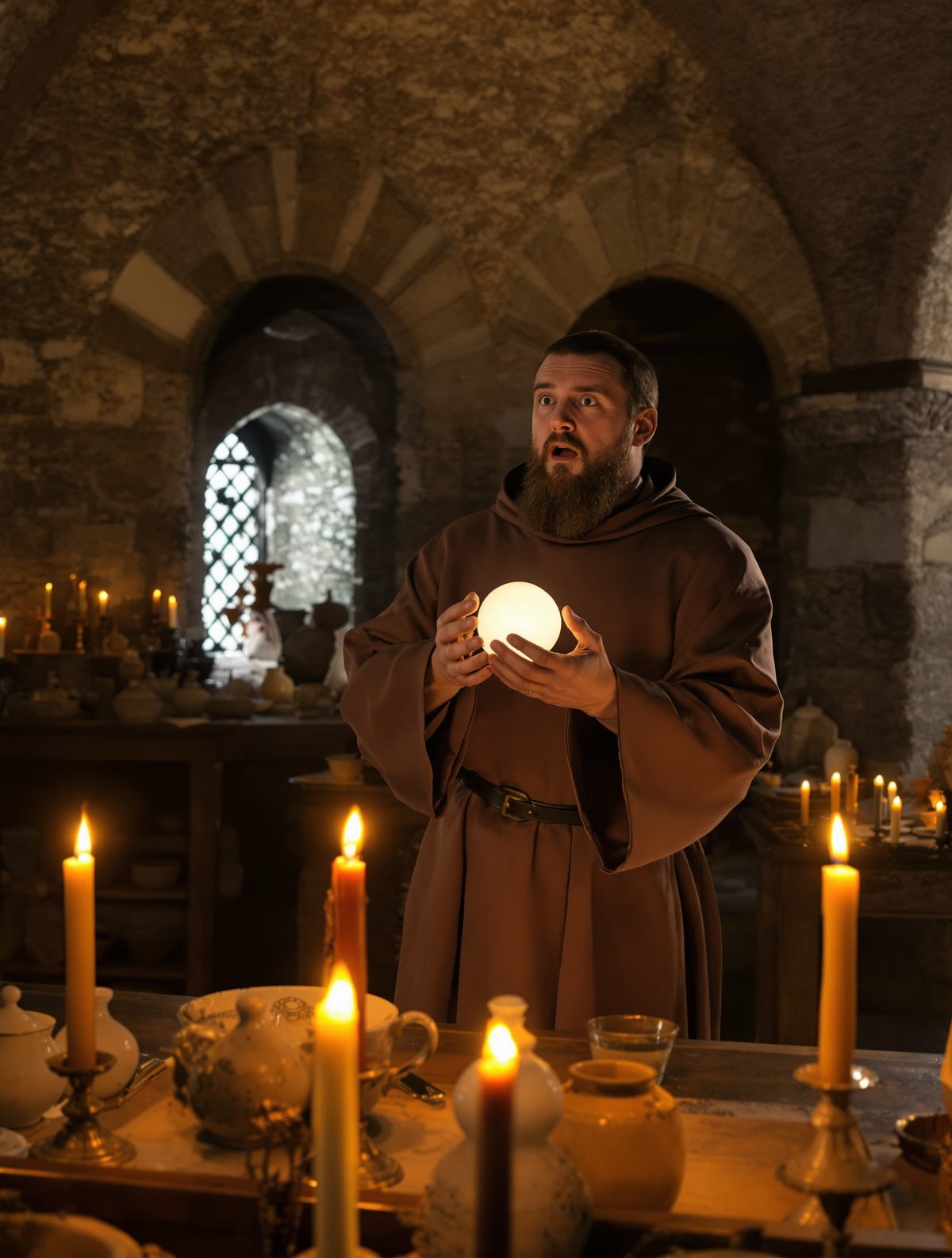
The golden chalice trembled in Prince Khaemwaset's weathered hands as he lifted it toward the flickering torchlight of Pharaoh's great hall. Inside the ornate vessel, a dark liquid swirled—deadly nightshade mixed with wine, enough poison to kill a dozen men. The court of Memphis fell silent, save for the gentle lapping of the Nile outside the palace walls. Nobles who had moments before accused the high priest of fraud now held their breath, watching as he brought certain death to his lips.
It was the winter of 1323 BC, and the most powerful religious figure in Memphis was about to stake his life on a single, impossible claim: that he could speak directly with the gods.
The Prince Who Chose the Temple Over the Throne
Khaemwaset was no ordinary priest. Born Prince Khaemwaset, fourth son of the mighty Pharaoh Ramesses II, he had shocked the royal court decades earlier by abandoning his claim to the throne in favor of serving the god Ptah. While his brothers trained in warfare and statecraft, Khaemwaset immersed himself in the ancient mysteries, eventually rising to become High Priest of Ptah—one of the most prestigious religious positions in all of Egypt.
Memphis, the gleaming capital city where the priest now held sway, was a marvel of the ancient world. Its white limestone walls caught the desert sun like mirrors, while the Great Temple of Ptah dominated the city center with its forest of towering columns and gold-leafed sanctuaries. As high priest, Khaemwaset commanded immense wealth and influence, overseeing thousands of temple workers, vast agricultural estates, and the spiritual lives of nearly 300,000 residents.
But by 1323 BC, whispers had begun to circulate through the marble corridors of power. The aging priest, now in his seventies, claimed he could commune directly with Ptah and the other gods—not through dreams or visions, but in actual conversation. He issued prophecies with startling accuracy, knew secrets he shouldn't have known, and seemed to possess an otherworldly wisdom that unsettled even his most devoted followers.
When Faith Meets Politics in the Shadow of the Pyramids
The challenge came during the Festival of Ptah, Memphis's most sacred celebration. As thousands of pilgrims packed the temple courtyards and the air thick with incense, Khaemwaset delivered a prophecy that sent shockwaves through the assembled crowd. He declared that the gods had revealed to him the location of a lost treasure chamber beneath the Great Pyramid of Khufu—and that Pharaoh should immediately dispatch workers to claim it for the crown.
This was too much for the skeptics. Led by Amenemhab, a wealthy noble whose own family had held priestly positions for generations, a group of court officials openly accused Khaemwaset of elaborate fraud. How convenient, they argued, that the gods always seemed to speak when it served the temple's interests. How suspicious that these "divine revelations" often concerned earthly matters of gold and grain.
The confrontation came to a head in Pharaoh's audience chamber, a vast hall lined with statues of past rulers and illuminated by dozens of oil lamps. Amenemhab stood before the throne and delivered his challenge: if Khaemwaset truly enjoyed divine protection, let him prove it before the entire court. Let him drink poison and see if his gods would save him.
The chamber erupted in shocked murmurs. Even in an age when public executions were common entertainment, the proposal was breathtakingly audacious. But before Pharaoh could intervene, the elderly priest rose from his position of honor and accepted.
A Deadly Gamble in the Hall of Kings
What followed was perhaps the most dramatic religious test in ancient history. Word spread through Memphis like wildfire, and by the appointed evening, the great hall overflowed with spectators. Nobles, priests, merchants, and commoners pressed against the walls, while scribes prepared to record what many believed would be the high priest's final moments.
The poison itself was a masterpiece of lethality. Royal physicians had prepared a mixture of Atropa belladonna—deadly nightshade—combined with crushed seeds from the castor bean plant. The concoction contained enough toxins to kill within minutes, causing excruciating convulsions, paralysis, and cardiac arrest. There would be no antidote, no possibility of trickery.
Khaemwaset entered the hall wearing his full ceremonial regalia: a leopard skin draped over pristine white linen, golden bands around his arms and neck, and the sacred sidelock that marked his royal heritage. Despite his advanced age, witnesses later recorded that he moved with surprising grace and showed no signs of fear.
The moment of truth arrived as scribes marked the exact time—the third hour after sunset. Khaemwaset lifted the chalice, spoke a brief prayer to Ptah, and drained the deadly mixture in three long swallows. Then he set the empty vessel on the floor and waited.
The Miracle That Shook an Empire
For ten agonizing minutes, nothing happened. The priest stood motionless in the center of the hall while hundreds of eyes watched for the first signs of poisoning. Physicians counted his pulse and observed his breathing. Scribes noted the time in precise detail. Amenemhab and his supporters waited for vindication.
But as minutes stretched into an hour, then two, the impossible became undeniable. Khaemwaset showed no symptoms of poisoning whatsoever. His color remained normal, his speech clear, his movements steady. When court physicians examined him, they found his vital signs completely stable.
The psychological impact was immediate and devastating. Several nobles fell to their knees in worship. Others fled the hall in terror. Amenemhab himself reportedly collapsed and had to be carried out by servants. In a single evening, Khaemwaset had transformed from a suspected charlatan into a living god in the eyes of many witnesses.
But the most shocking twist was yet to come. After standing calmly for nearly three hours, the high priest simply bowed to Pharaoh and walked out of the hall. He returned to his temple duties the next morning as if nothing had happened, never again referring to the incident or claiming credit for the miracle.
The Mystery That Endures
Historical records from multiple sources confirm the basic facts of Khaemwaset's poison test, but they offer no explanation for his survival. Modern toxicologists have proposed several theories: perhaps the priest had developed immunity through gradual exposure, or maybe he possessed knowledge of ancient antidotes unknown to the court physicians.
Some historians suggest the entire event was an elaborate piece of theater, with Khaemwaset somehow switching the poison for harmless liquid. But this theory struggles to explain how such deception could have succeeded under the intense scrutiny of hostile witnesses, trained physicians, and the Pharaoh himself.
What we do know is that the poison test transformed Khaemwaset's reputation permanently. His prophecy about the pyramid treasure proved accurate—workers did indeed discover a hidden chamber filled with gold and precious stones. His influence at court reached unprecedented heights, and pilgrims traveled from across the Mediterranean world to seek his blessing.
Perhaps most remarkably, Khaemwaset lived for another fifteen years after drinking the deadly nightshade, dying peacefully in 1308 BC at the extraordinary age of eighty-seven. His tomb, discovered in 1980, contained an inscription that may hold a clue to the mystery: "He who serves truth need fear no test."
In our age of scientific skepticism, it's tempting to dismiss Khaemwaset's story as ancient propaganda or religious mythology. But the survival of detailed records from multiple sources, including accounts by his enemies, suggests something genuinely extraordinary occurred in that torchlit hall. Whether through divine intervention, ancient knowledge, or sheer force of will, a seventy-year-old priest faced impossible odds and emerged victorious—proving that history's greatest mysteries often lie not in distant galaxies or quantum equations, but in the remarkable courage of those who dared to stake everything on their deepest beliefs.