Picture this: you're standing in the most magnificent palace hall in 8th century China, watching the greatest painter of the age put the finishing touches on a mural so breathtakingly beautiful that it seems to pulse with life. The emperor himself gasps in wonder as painted waterfalls appear to cascade down the wall, and birds seem ready to take flight from their perches on impossible cliffs. Then the artist turns to you, points at a cave entrance deep within his painted landscape, and says there are wonders beyond imagination inside. Before you can blink, he walks toward his own creation—and vanishes into the wall itself, leaving only the echo of his footsteps and a mystery that would captivate China for over a thousand years.
This isn't the opening scene of a fantasy novel. According to Tang Dynasty records, this is exactly what happened when Wu Daozi, imperial China's most celebrated painter, completed his final masterpiece for Emperor Xuanzong in 742 AD.
The Painter Who Made Gods Jealous
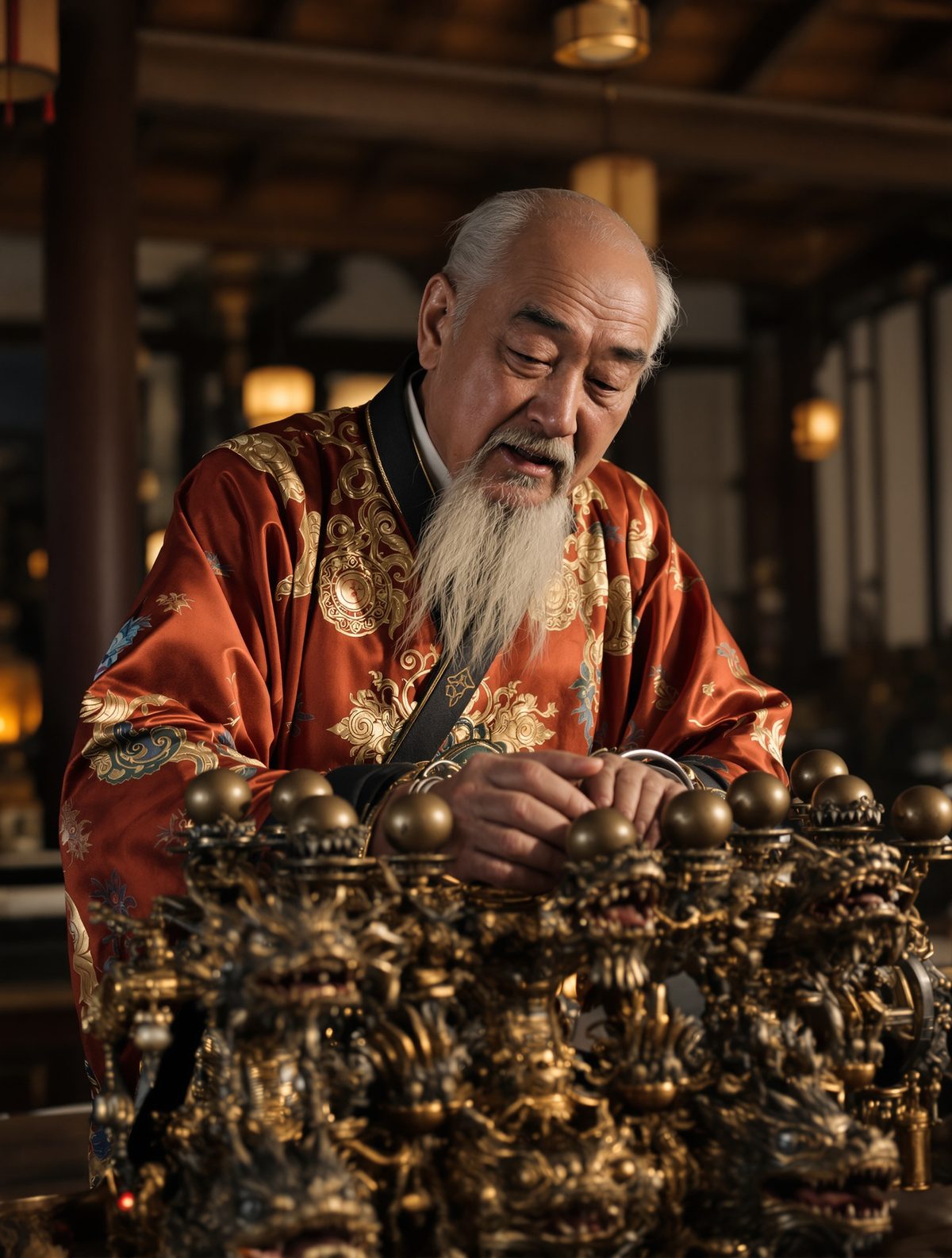
Wu Daozi wasn't just any court artist—he was a legend walking among mortals, a man whose brushstrokes were said to breathe life into stone and silk. Born around 680 AD in Yangzhai (modern-day Henan Province), Wu had risen from humble beginnings to become the Tang Dynasty's most prized artistic treasure. The emperor didn't just commission paintings from Wu Daozi; he collected them like sacred relics.
Contemporary accounts describe Wu's technique as supernatural. Unlike other painters who labored for months over detailed works, Wu Daozi painted with a speed and fluidity that mesmerized onlookers. Court records mention that he could complete an entire temple mural in a single day, working in what witnesses described as an almost trance-like state. His figures seemed to move when viewed from different angles, and his landscapes possessed a three-dimensional quality that made viewers feel they could step right into them.
The Tang poet Du Fu, writing decades later, claimed that Wu Daozi's painted horses would leave their walls at night to drink from palace fountains, returning before dawn to resume their motionless poses. While poetic exaggeration was common, the consistency of such accounts suggests Wu's work achieved something genuinely extraordinary—a visual realism that transcended anything previously seen in Chinese art.
An Emperor's Impossible Commission
In 742 AD, Emperor Xuanzong—himself a patron of unprecedented artistic flowering during the Tang Golden Age—approached Wu Daozi with his most ambitious commission yet. The emperor wanted a mural for his private meditation chamber, but not just any mural. He wanted Wu to paint the landscape of dreams itself, a vision of the mythical Shu Mountains that would serve as a gateway to contemplation and enlightenment.
The commission came with unusual specifications that hint at the emperor's deeper intentions. Historical records from the Lidai Minghua Ji (Records of Famous Painters Through the Ages) indicate that Xuanzong requested a landscape that would "contain all the wonders of the immortal realm" and serve as a "window to the world beyond the world." This wasn't mere decoration—it was meant to be a spiritual portal.
Wu Daozi accepted the commission with characteristic confidence, but what happened next revealed the true extent of his artistic ambition. Rather than begin painting immediately, he spent three months in meditation and preparation, studying Taoist texts and consulting with court astronomers about the alignment of celestial forces. When he finally began painting, he worked in complete secrecy, allowing no one—not even the emperor—to observe his progress.
The Mural That Defied Reality
When Wu Daozi finally unveiled his creation in the autumn of 742 AD, the court's reaction was unprecedented. Historical accounts describe grown men weeping at the sight of the painted landscape, while others fell to their knees in reverence. The mural covered an entire wall of the emperor's chamber—roughly 30 feet wide and 12 feet tall—and depicted a mountain landscape of such impossible beauty that viewers reported feeling physically transported.
What made the mural extraordinary wasn't just its technical mastery, but its apparent violation of natural laws. Court records meticulously describe details that seemed to change based on viewing angle and time of day. Painted clouds appeared to drift across the surface, waterfalls seemed to flow with actual motion, and deep within the composition, a cave entrance beckoned with mysterious shadows that appeared to have genuine depth.
The emperor himself spent hours studying the work, reportedly discovering new details each time he looked. Palace guards later claimed they could hear the sound of distant water and wind when standing close to the mural, though this might have been the power of suggestion combined with the incredibly realistic acoustic properties Wu had somehow captured in his painted waterfalls and rustling trees.
The Vanishing Act That Shook an Empire
The disappearance itself occurred during the formal presentation to the full imperial court. After accepting the emperor's praise and the gasps of amazement from assembled nobles, Wu Daozi approached his creation one final time. According to the court chronicler's detailed account, preserved in multiple historical sources, the artist pointed to the cave entrance deep within his painted landscape.
"Your Majesty," Wu said, his voice carrying an otherworldly certainty, "the wonders inside this cave surpass anything in our mortal realm. Allow me to show you the path to enlightenment I have discovered."
What happened next was witnessed by over fifty people, including the emperor himself. Wu Daozi walked directly toward the wall, his movement purposeful and unhurried. Instead of stopping or striking the surface, he appeared to enter the painting itself, his figure seeming to merge with the two-dimensional landscape. Witnesses described seeing his form become part of the composition for a brief moment before disappearing entirely into the painted cave.
The wall was immediately examined by court officials, architects, and even Taoist priests summoned from nearby temples. They found solid stone covered with paint—no hidden passages, no trick mechanisms, no rational explanation for what they had witnessed. Wu Daozi had simply vanished into his own creation, leaving behind only the mural and a mystery that would haunt the Tang Dynasty for generations.
The Search for Answers in an Age of Wonders
Emperor Xuanzong's reaction to Wu Daozi's disappearance reveals the profound impact of the event on Tang Dynasty culture. Rather than dismissing it as an elaborate trick, the emperor ordered the mural sealed and declared it a sacred relic. He commissioned investigations that lasted for years, bringing together the era's greatest minds—philosophers, scientists, artists, and spiritual leaders—to explain what they had witnessed.
The official court explanation, recorded in imperial archives, concluded that Wu Daozi had achieved the ultimate artistic transcendence described in Taoist philosophy—the ability to merge completely with one's creation and enter the realm of immortals. This wasn't seen as fantasy but as the logical conclusion of a lifetime spent perfecting the art of bringing painted worlds to life.
More intriguingly, several copycat attempts were recorded over the following decades. Other painters tried to recreate Wu's technique, with some reportedly disappearing in similar circumstances, though none were witnessed by the imperial court. These accounts, while less well-documented, suggest that Wu Daozi's achievement might have been part of a broader artistic movement exploring the boundaries between reality and representation.
The Mystery That Still Captivates
Today, Wu Daozi's disappearance represents more than just an ancient mystery—it embodies humanity's eternal fascination with the power of art to transcend physical limitations. In our digital age, when virtual reality and augmented reality are reshaping how we experience created worlds, Wu's legendary vanishing feels less like impossible fantasy and more like prophetic vision.
The story resonates because it touches on fundamental questions about the nature of reality and creativity that remain relevant today. When we lose ourselves completely in a book, film, or video game, we're experiencing a diluted version of what Wu Daozi allegedly achieved—the complete merger of creator and creation, observer and observed.
Whether Wu Daozi actually walked into his own painting or simply staged the ultimate performance art piece, his story reminds us that the most powerful art doesn't just depict other worlds—it creates doorways to them. In an age when digital artists are creating increasingly immersive virtual environments, perhaps Wu Daozi wasn't vanishing into fantasy, but stepping forward into humanity's artistic future, showing us that the boundary between the real and the imagined has always been far thinner than we dare to believe.