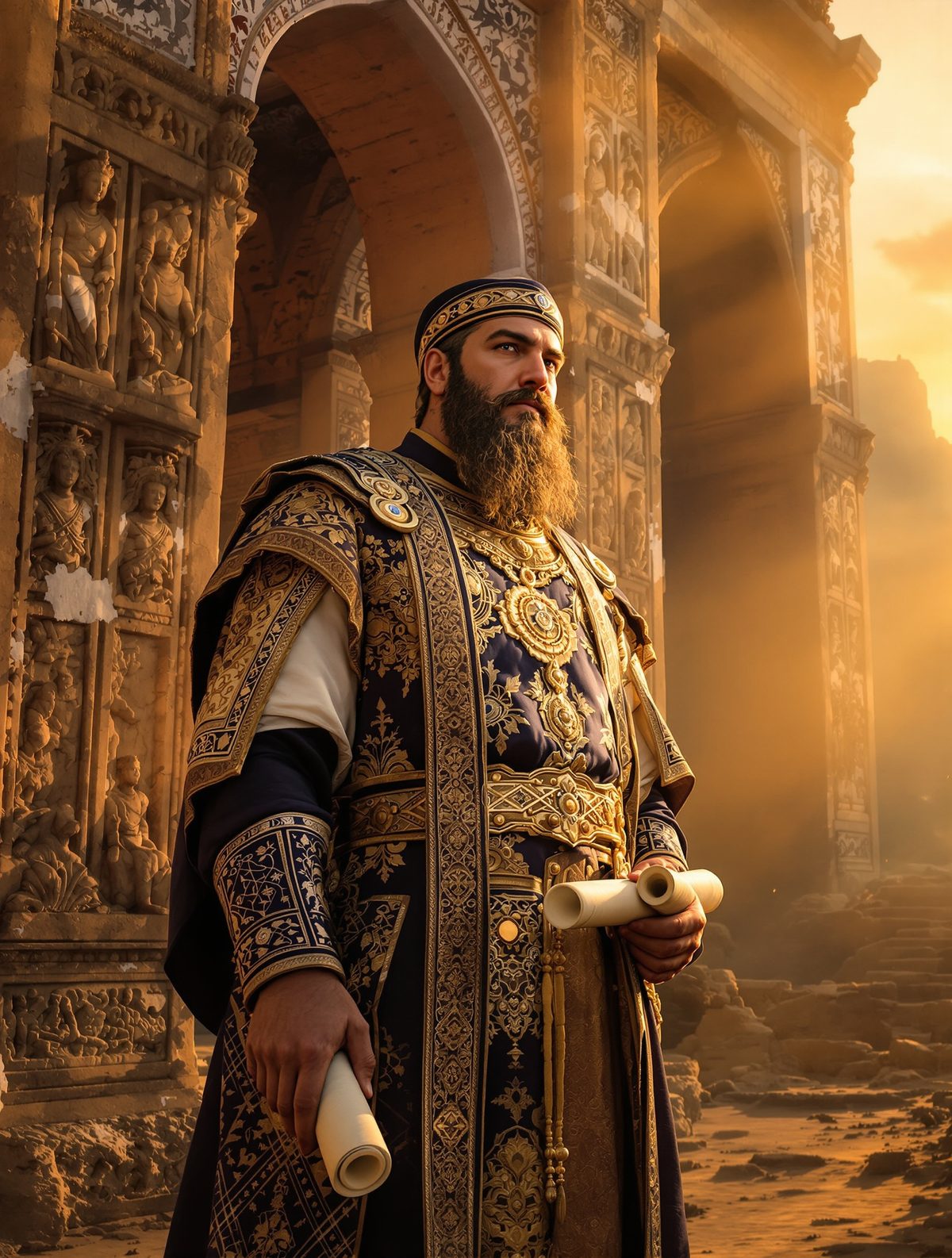
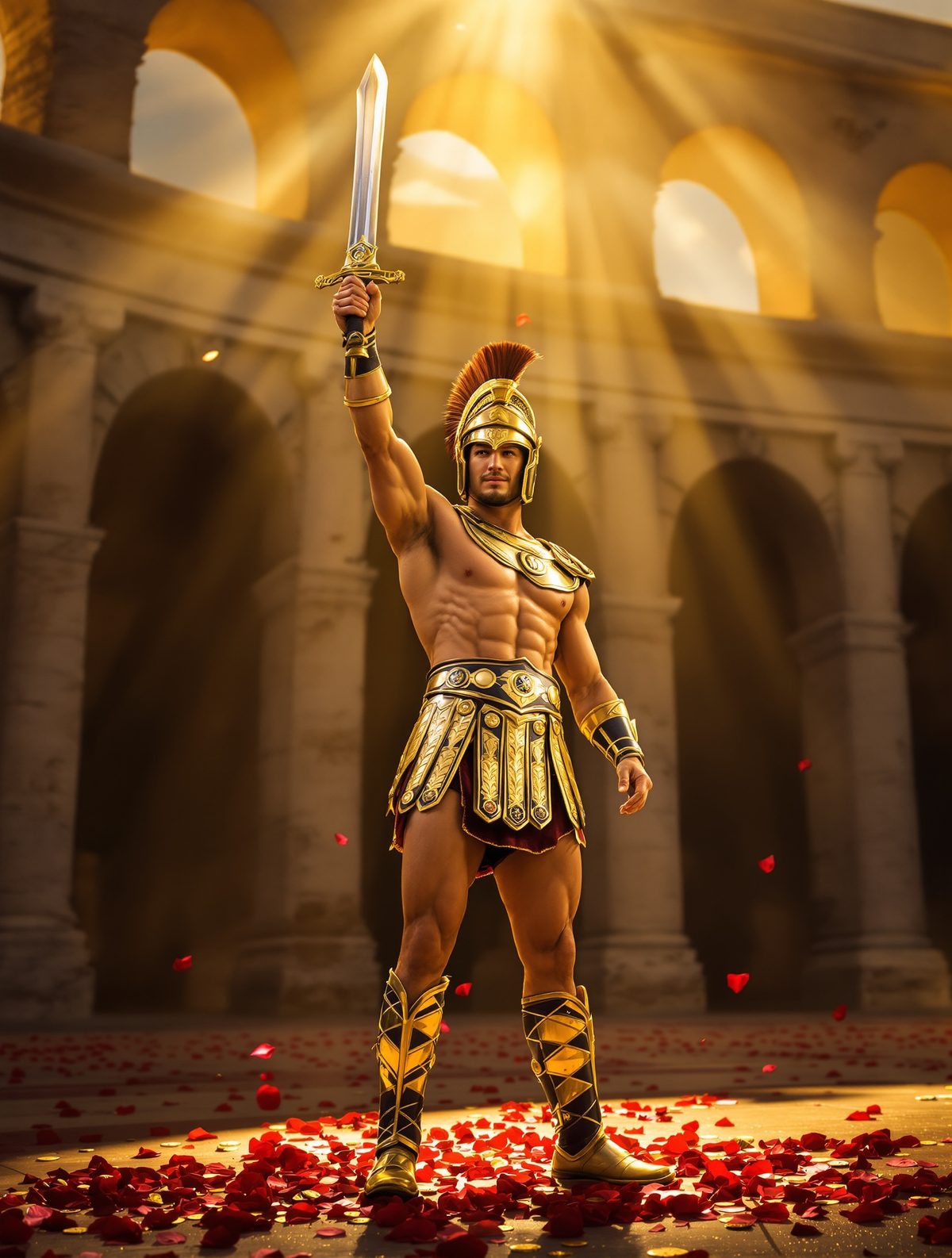
Picture this: 50,000 of Rome's finest legionaries marching in perfect formation across the scorching Syrian desert, their bronze armor gleaming like mirrors under the merciless sun. At their head rides Marcus Licinius Crassus, one of Rome's wealthiest and most ambitious generals, dreaming of glory that would rival his partners in the First Triumvirate—Julius Caesar and Pompey the Great. It's May 53 BC, and Crassus is about to lead his men into what would become Rome's most catastrophic military disaster, a defeat so complete and humiliating that it would echo through the corridors of power for centuries.
What happened at Carrhae wasn't just a battle—it was a masterclass in how superior tactics, terrain knowledge, and innovative warfare could completely obliterate the world's most feared military machine. The Parthians didn't just defeat Rome; they revolutionized warfare itself.
The Richest Man in Rome Gambles Everything
Marcus Crassus wasn't your typical Roman general. Known as Dives ("the Rich One"), he had accumulated wealth that would make modern billionaires jealous—estimates suggest he owned over 7,000 talents of silver, equivalent to roughly $200 billion today. But money couldn't buy the one thing he craved most: military glory to match his political partners.
While Caesar was conquering Gaul and Pompey basked in his Eastern victories, Crassus had made his reputation crushing Spartacus's slave rebellion—hardly the stuff of legendary heroism. Now, as governor of Syria, he saw his chance. The Parthian Empire, stretching from the Euphrates to India, seemed ripe for conquest. After all, hadn't Romans always triumphed through discipline, superior equipment, and unbreakable formations?
Crassus assembled a force that should have been unstoppable: seven legions totaling about 35,000 heavy infantry, 4,000 light infantry, and 4,000 Gallic and Germanic cavalry—roughly 50,000 men in total. These weren't raw recruits; many were battle-hardened veterans who had served in Gaul under Caesar. Their destination was the heart of Parthian territory, and their goal was nothing less than to bring Rome's eagles to the banks of the Indus River.
But Crassus made his first critical error before the campaign even began. Ignoring advice to follow the established route along the Euphrates River, he chose to march directly across the waterless wastes of northern Mesopotamia. His guide, an Arab chieftain named Ariamnes, assured him this path would bring him quickly to the enemy. What Crassus didn't know was that Ariamnes was secretly in Parthian pay.
The Desert Trap Springs Shut
On that fateful day near the town of Carrhae (modern-day Harran in Turkey), Crassus's army had been marching for hours when scouts reported dust clouds on the horizon. The general expected to face the traditional Parthian army he'd studied—a mix of infantry and cavalry that Roman tactics had handled before. Instead, what emerged from the shimmering heat was something entirely different: roughly 10,000 horsemen, but no foot soldiers in sight.
Leading this force was Surena, a 30-year-old Parthian general whose name would become synonymous with tactical brilliance. Here's a detail that rarely makes it into history books: Surena was so wealthy that he could field an army of 10,000 horsemen from his personal retinue alone, and when he traveled, he required 1,000 camels just to transport his baggage and 200 more for his concubines. Yet on this day, he had brought something far more valuable than luxury—he had brought revolution.
The Parthian force consisted of two distinct elements that would work in deadly harmony. The majority—about 9,000 men—were horse archers, lightly armored riders on swift mounts who could shoot accurately at full gallop. The remaining 1,000 were cataphracts: heavily armored shock cavalry whose horses and riders were encased in steel scales, looking like metallic centaurs rising from myth.
As the armies faced each other across the dusty plain, Crassus initially felt confident. Roman legions had faced cavalry before. His men locked shields, lowered spears, and prepared to receive a charge that never came.
Rain of Death: The Horse Archer Revolution
Instead of charging, the Parthian horse archers began to circle the Roman formation like a pack of wolves around a wounded buffalo. At distances that Roman javelins couldn't reach, they began to loose arrows in continuous volleys. These weren't ordinary arrows—Parthian bows were composite masterpieces that could drive an arrowhead through Roman mail at 150 yards.
The Romans responded as they had been trained, forming the famous testudo or tortoise formation, where shields locked together to create a mobile fortress. Under normal circumstances, this would have worked—most ancient armies carried limited ammunition, and the Romans could simply wait out the barrage. But Surena had prepared for this exact scenario with an innovation that changed warfare forever: a supply chain of camels carrying nothing but arrows.
As Roman soldiers crouched beneath their shields in the blazing desert sun, wearing 60 pounds of bronze and iron armor, the arrows never stopped coming. Hour after hour, the metallic rain continued. Men began collapsing from heat exhaustion. Others, driven mad by thirst and the constant stress, broke formation only to be cut down instantly.
Crassus ordered his son Publius to take 1,300 Gallic cavalry, 500 archers, and 8 cohorts of legionaries—roughly 8,000 men total—to drive off the horse archers. It was exactly what Surena had been waiting for. As Publius's force pursued the seemingly retreating Parthians, they were led further and further from the main army. Then, in a perfectly coordinated maneuver, the cataphracts appeared.
The Hammer Falls: Cataphract Catastrophe
The sight of Parthian cataphracts charging at full gallop was something few Romans had ever witnessed and lived to describe. These weren't the light cavalry Rome was accustomed to fighting. Each horse and rider was covered in overlapping steel scales, wielding 12-foot lances called kontos that could skewer a man like a fish. When they hit Publius's isolated force, the result was carnage.
The young Crassus and most of his men were annihilated within minutes. In a psychological masterstroke that reveals the Parthians' sophisticated understanding of warfare, Surena had Publius's head mounted on a spear and paraded it in front of the main Roman army. The sight of his son's severed head reportedly broke something fundamental in the elder Crassus—sources describe him as becoming almost catatonic with grief.
But the Parthians weren't finished. As the demoralized Romans tried to maintain formation, the horse archers resumed their deadly dance, now joined by the cataphracts who would charge in, break Roman lines with their lances, then retreat before the legionaries could respond. It was combined-arms warfare at its most sophisticated—and Rome had no answer for it.
By nightfall, the field was littered with Roman dead. Of the 50,000 men who had marched so confidently into Parthian territory, nearly 20,000 lay dead, 10,000 were captured (many to be settled as colonists in distant Bactria), and only about 20,000 managed to escape back to Syria. It was a casualty rate that would make modern generals weep.
Golden Revenge: The Death of Crassus
The end of Marcus Crassus himself has become the stuff of legend, though separating fact from ancient propaganda is challenging. What we know is that during negotiations for a Roman withdrawal—negotiations that were likely a Parthian trap from the beginning—Crassus was killed. Whether he died in a scuffle that broke out during the parley or was deliberately assassinated remains unclear.
But it's what allegedly happened next that captured the ancient world's imagination and became a powerful symbol of poetic justice. According to several sources, including the historian Cassius Dio, the Parthians poured molten gold down Crassus's throat, with Surena reportedly declaring, "Here, satisfy yourself with the metal for which in life you were so greedy."
Whether this actually happened or was invented by later writers to emphasize the moral lesson about greed and hubris, the image became iconic. Here's a fascinating detail: Crassus's head was later used as a prop in a performance of Euripides' The Bacchae at the Parthian court, with the actor playing Agave holding up the Roman general's actual severed head instead of the usual theatrical mask.
Legacy of a Desert Disaster
The Battle of Carrhae sent shockwaves through the Mediterranean world that extended far beyond the immediate military disaster. For the first time in living memory, Roman legions—the military machine that had conquered the known world—had been not just defeated but utterly destroyed by what Romans considered "barbarian" tactics.
The strategic implications were enormous. Rome's eastward expansion ground to a halt, and the Parthian Empire established itself as a legitimate rival superpower. For the next 300 years, the two empires would face each other across fortified frontiers, neither able to definitively conquer the other. The defeat also accelerated the collapse of the First Triumvirate, contributing to the civil wars that would ultimately destroy the Roman Republic.
But perhaps most importantly, Carrhae revolutionized military thinking across the ancient world. The battle proved that mobility, superior logistics, and innovative tactics could triumph over traditional strengths like heavy armor and disciplined formations. It was a lesson that would influence military strategy for centuries—and one that modern armies, from the Mongols to modern mechanized forces, would apply again and again.
Today, as we watch conflicts where high-tech, mobile forces outmaneuver traditional armies, we're seeing the same principles that Surena employed in the Syrian desert over 2,000 years ago. Sometimes the greatest victories come not from fighting the enemy on their terms, but from changing the very nature of the game itself. Rome learned this lesson the hard way, written in the blood of 20,000 legionaries beneath the pitiless desert sun.