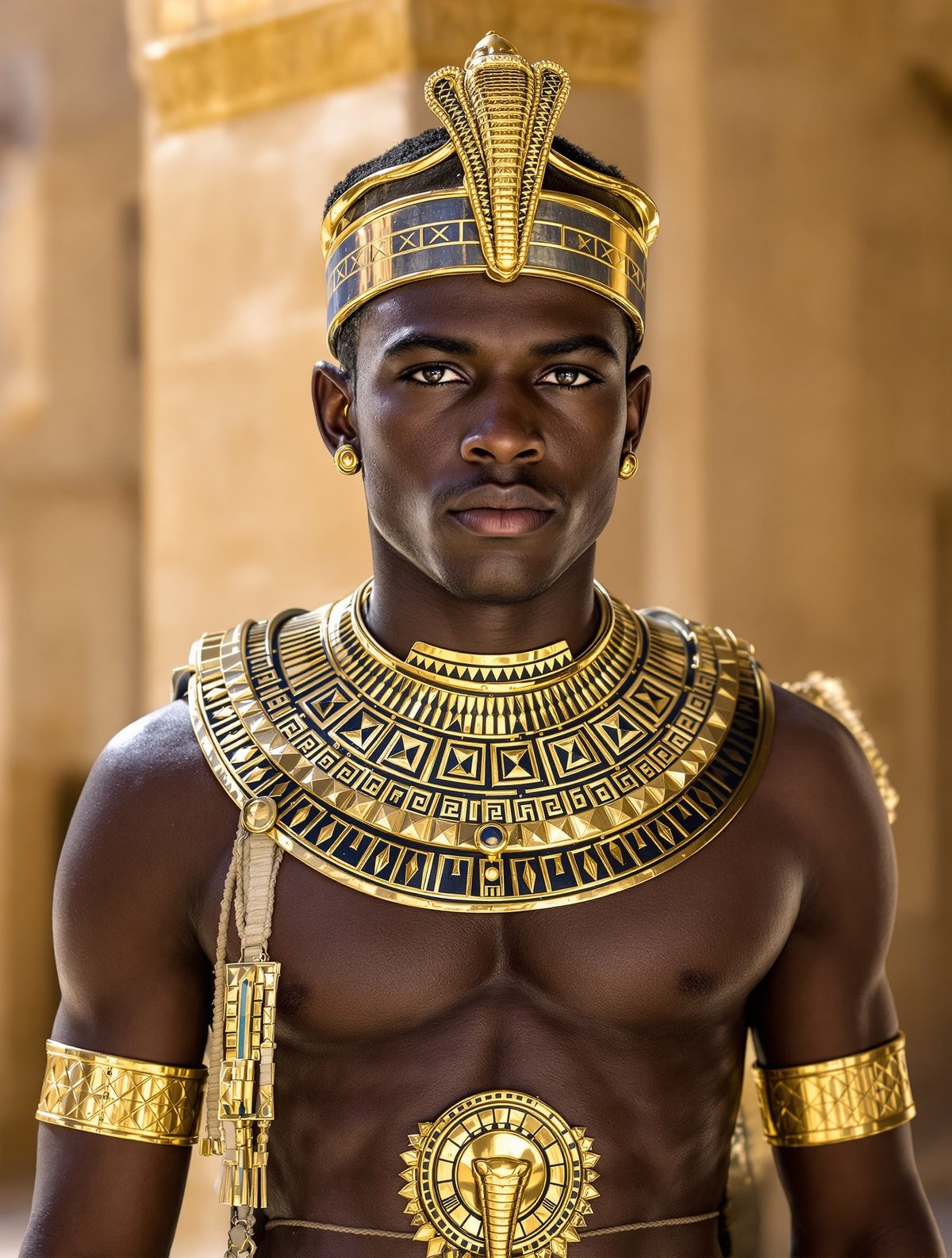
Picture this: a brilliant mind, perhaps the greatest intellect of the ancient world, stumbling through the darkness with his eyes fixed on the glittering canvas above. Thales of Miletus, the man who would become known as the father of Western philosophy and astronomy, was so captivated by the dance of celestial bodies that he failed to notice the gaping well directly in his path. One moment he was contemplating the infinite mysteries of the cosmos—the next, he was flailing helplessly in murky water while a servant girl's laughter echoed through the night air.
Her words would ring through history: "How can you know the heavens when you can't see what's at your feet?" With that single quip, delivered sometime around 585 BC, the world's first recorded joke about absent-minded intellectuals was born. But the real story behind this legendary tumble reveals far more than just ancient comedy—it illuminates the birth of scientific thinking itself.
The Man Who Dared to Look Up
Thales wasn't just any stargazer wandering the streets of ancient Miletus. Born around 624 BC in this prosperous Greek city on the coast of modern-day Turkey, he was a polymath whose curiosity knew no bounds. While his contemporaries explained natural phenomena through the whims of gods and goddesses, Thales dared to suggest something revolutionary: that the universe operated according to predictable, natural laws.
This was intellectual heresy of the highest order. In a world where earthquakes were attributed to Poseidon's anger and eclipses to divine displeasure, Thales proposed that water was the fundamental substance of all things. He theorized that the Earth floated on water like a ship, and that tremors occurred when this celestial ocean grew turbulent. While his specific theories were wrong, his method was groundbreaking—he was using reason and observation rather than mythology to understand the world.
But it was his astronomical observations that truly set him apart. Night after night, Thales would venture out to study the stars, meticulously tracking their movements and patterns. He learned from Babylonian astronomers, who had been recording celestial data for centuries, and combined their knowledge with his own systematic observations. The result was nothing short of miraculous for the ancient world.
The Eclipse That Stopped a War
On May 28, 585 BC, Thales achieved what might be considered the greatest prediction in human history. As the armies of the Lydians and Medes clashed in bitter warfare, the sun began to disappear. Darkness crept across the battlefield as a total solar eclipse unfolded exactly as Thales had foretold. The terrified soldiers threw down their weapons, convinced that the gods themselves were intervening to end their conflict.
The historian Herodotus later wrote about this extraordinary event, noting that the eclipse occurred "when the battle was equally balanced." The sight was so terrifying that both armies immediately ceased fighting and negotiated peace. For perhaps the first time in recorded history, scientific prediction had literally stopped a war.
What makes this achievement even more remarkable is the sophisticated understanding of celestial mechanics it required. Thales had to track the complex dance between Earth, moon, and sun with incredible precision, using only naked-eye observations and mathematical calculations. He understood that eclipses weren't random acts of divine intervention but predictable events following natural laws—a concept that wouldn't become widespread for centuries.
Yet this same man who could predict cosmic events with stunning accuracy couldn't see a well right in front of him. The irony wasn't lost on his contemporaries, and the story quickly became legendary throughout the Greek world.
A Servant's Wit and the Birth of Academic Humor
The identity of the servant girl who mocked Thales remains one of history's great mysteries, but her sharp wit secured her a place in the annals of human comedy. According to Plato's account in the Theaetetus, she was a "clever and witty Thracian servant girl" who couldn't contain her amusement at seeing the great philosopher floundering in the well.
Her observation—that Thales was "eager to know the things in the sky" but failed to see "what was behind him and at his very feet"—became the template for centuries of jokes about intellectuals. The image of the brilliant but impractical scholar, so absorbed in lofty thoughts that they can't navigate basic reality, was born in that moment of laughter echoing from a well in ancient Miletus.
But there's a deeper significance to this exchange that's often overlooked. The servant girl's comment represented a clash between two fundamentally different ways of seeing the world. She valued practical wisdom—the kind that keeps you from falling into wells. Thales represented a new type of thinking that prioritized understanding universal principles, even at the cost of immediate practical concerns.
This tension between theoretical knowledge and practical wisdom would become one of the defining debates of Western philosophy. Aristotle later distinguished between sophia (theoretical wisdom) and phronesis (practical wisdom), a distinction that can be traced directly back to that night in Miletus when brilliance met basic clumsiness.
The Practical Genius Behind the Absent-Minded Professor
Here's where the story takes an unexpected turn. Despite his reputation for impracticality, Thales was actually a shrewd businessman who proved that theoretical knowledge could translate into real-world success. According to Aristotle, critics often mocked philosophy as useless, claiming that if philosophers were so smart, why weren't they rich?
Thales decided to answer this challenge in spectacular fashion. Using his understanding of weather patterns and agricultural cycles, he predicted that the coming year would bring an exceptional olive harvest. During the off-season, when prices were low, he quietly cornered the market on olive presses throughout Miletus and the nearby island of Chios. When harvest time arrived and his prediction proved correct, desperate farmers had no choice but to rent his equipment at premium rates.
The profits were enormous. Overnight, Thales had demonstrated that philosophical thinking could generate serious wealth—he simply chose not to focus on money-making because he found the pursuit of knowledge more interesting. As Aristotle noted, "he made it clear that it is easy for philosophers to be rich if they want to, but this is not what they care about."
This olive oil scheme reveals the true complexity of Thales' character. He wasn't just an absent-minded dreamer stumbling through life with his head in the clouds. He was a practical genius who understood both celestial mechanics and market mechanics—he simply found stars more fascinating than profit margins.
The Revolutionary Who Changed Everything
To truly understand why Thales' midnight tumble matters, we need to grasp just how revolutionary his entire approach to knowledge was. In the 6th century BC, the dominant method of understanding the world was through myth and tradition. Want to know why earthquakes happen? Poseidon is angry. Curious about the weather? Zeus is having a mood swing. Every natural phenomenon had a supernatural explanation rooted in the unpredictable emotions of the gods.
Thales shattered this paradigm. He proposed that natural events had natural causes that could be understood through observation and reason. This wasn't just a different theory—it was an entirely different way of thinking about reality itself. Instead of appeasing gods, humans could study patterns and make predictions. Instead of accepting mystery, they could seek understanding.
His astronomical work exemplified this new approach. While others saw eclipses as divine omens, Thales recognized them as predictable events in a cosmic clockwork. He identified the constellation Ursa Minor as a more reliable navigational guide than the previously used Ursa Major. He determined that the year consisted of 365 days and divided it into seasons. These might seem like simple observations now, but they represented a fundamental shift from supernatural to natural explanations.
The well incident perfectly captured the tension inherent in this new way of thinking. To unlock the secrets of the universe, someone had to be willing to ignore immediate, practical concerns and focus on larger patterns and principles. Sometimes that meant missing what was right in front of you—quite literally.
Why a 2,600-Year-Old Pratfall Still Matters
That servant girl's laughter continues to echo through the corridors of academia today. Every time someone jokes about ivory tower intellectuals or absent-minded professors, they're channeling the same sentiment that bubbled up from that well in ancient Miletus. The stereotype of the brilliant but impractical scholar—from Einstein forgetting to wear socks to the classic image of the professor who can solve complex equations but can't operate a coffee machine—all trace back to Thales' midnight mishap.
But perhaps we've misunderstood the lesson of that famous fall. The servant girl saw Thales' tumble as evidence that his cosmic pursuits were worthless—after all, what good is knowledge of the heavens if you can't avoid a simple hole in the ground? History suggests she missed the point entirely.
Thales' willingness to risk looking foolish, to prioritize understanding over immediate safety, to value cosmic knowledge over pedestrian concerns, launched the entire Western intellectual tradition. His students included Anaximander, who created the first world map, and Anaximenes, who proposed that air was the fundamental element. Together, they founded what became known as the Milesian School—the first institution dedicated to natural philosophy.
The ripple effects of that decision to look up rather than down transformed human civilization. The same intellectual courage that led Thales into that well eventually produced democracy in Athens, the scientific revolution, the Enlightenment, and the modern world. Sometimes, you have to be willing to fall into a few wells to reach the stars.
So the next time you hear someone mock intellectuals for being out of touch with reality, remember Thales. Yes, he fell into a well. But he also stopped a war with the power of prediction, founded Western philosophy, and launched the scientific method. Not a bad trade-off for a little midnight embarrassment and a servant girl's laughter that echoed through eternity.