1418. The sky flickered with shards of twilight as frantic footsteps disrupted the quiet marshes.
A Mother's Desperation
In the heart of the Aztec Empire, power was a precarious possession, often won and lost in the ruthless theatre of ambition. Tezozomoc of Azcapotzalco, the most powerful chieftain in the Valley of Mexico, was emblematic of this relentless struggle. His reach was vast, his influence unparalleled, and his wrath was something to fear. All who challenged him paid a steep price, as Ixtlilxochitl, the ruler of Texcoco, tragically learned. With Texcoco conquered, Tezozomoc's attention turned to eradicating any threats to his dominion, which meant targeting Ixtlilxochitl's progeny — young Nezahualcoyotl.
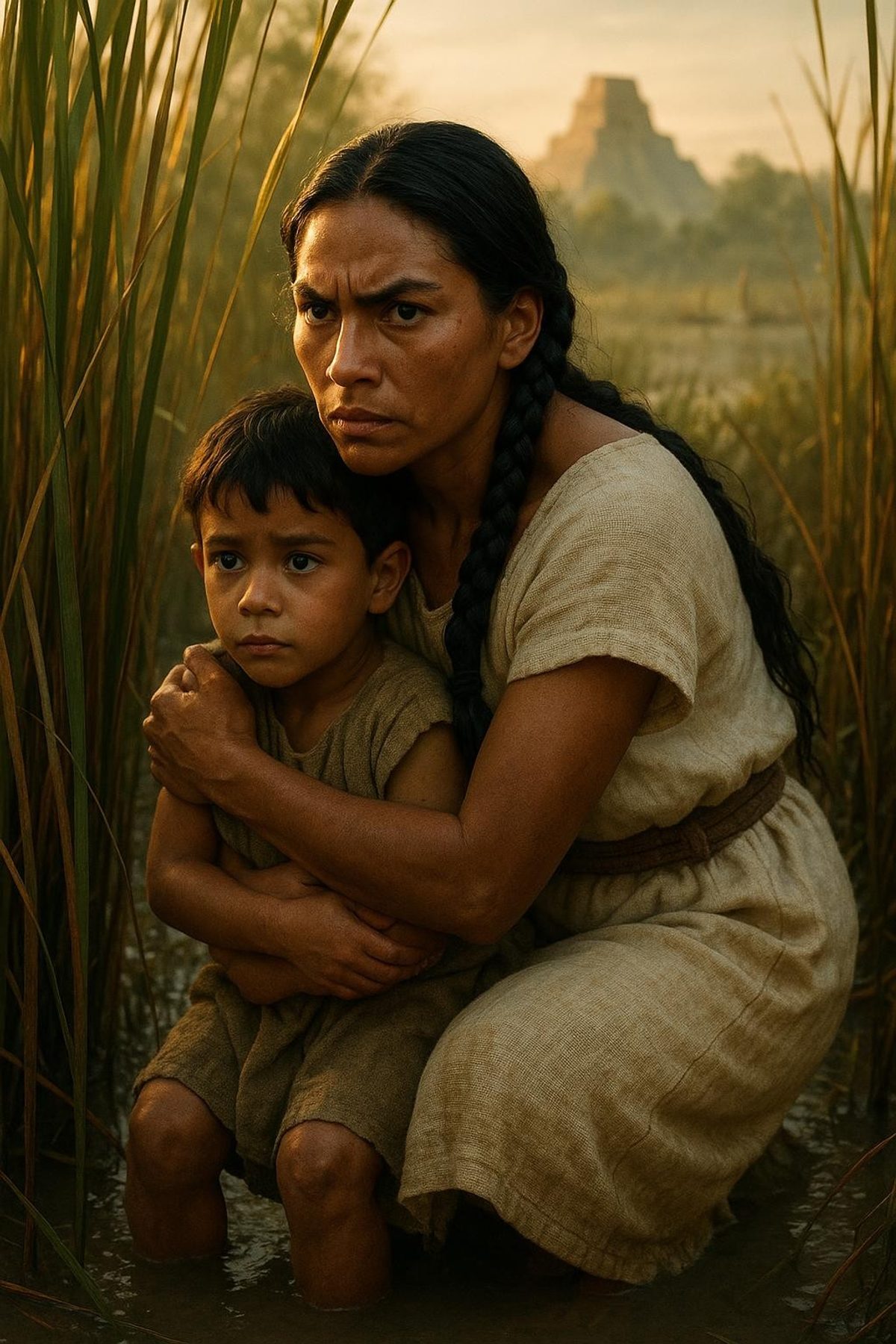
In the dead of night, Nezahualcoyotl’s mother, reeling from the brutal execution of her husband, faced an unimaginable horror. With Tezozomoc’s executioners on her heels, her only imperative was to save her son. The marshes of Lake Texcoco became her refuge — a tangled sanctuary of reeds and murky waters. Here, amongst the dark reeds and the silence of the marshes, she clutched her son close, heart pounding with the urgency of a mother’s resolve to protect her child from certain death.
The marshes were not just a haven; they were a crucible in which Nezahualcoyotl’s destiny was forged. His mother hid him amidst the reeds, the water his blanket, the stars his only compass in an uncertain world. She taught him the songs of their people, stories laced with the past and hints of a future she desperately hoped he’d live to see. She passed to him not only survival but a vision of resistance and renewal. It is in these bleak moments, where shadows hung long over the valley, that the future poet-king’s survival instincts sharpened, and the seeds of ingenious governance were sown.
The Exile and the Return
Despite the despair in those dark days, Nezahualcoyotl found strength in survival. As he grew, hidden from the wrath of Tezozomoc, he learned the lessons of resilience. His exile became his education; his deprivation, a teacher. Time passed, and with each duck and dodge, he eluded the forces that sought his life. His mother, ever vigilant, ensured not only his survival but nurtured an unquenchable spirit in him. Together, they navigated the treacherous waters of political exile, moving from shelter to tenuous shelter.
Tezozomoc's reign, however, was not eternal. With time, the turbulence of his expansive rule eroded the loyalty that his conquests demanded. The very alliances upon which his power rested were shaky edifices. Different factions began to see the boy, thought safe in hiding, as a symbol of hope and resistance. Nezahualcoyotl’s story grew, whispered in markets and sung along trader routes, a legend of survival against imperial might.
Eventually, as Tezozomoc's power flickered and faded, the landscape of the valley shifted. In this transformed political terrain, Nezahualcoyotl's chance for reclamation emerged. It was a slow and careful journey back to Texcoco, a mixture of strategic diplomacy and rekindled alliances. He was no longer the hunted child. Now, he was a young man, returning to the seat of his ancestors to reclaim what was taken. His mother’s strength had become his own, her whispers of the greatness that once was driving his ambitions.
Rebuilder of a Kingdom
Nezahualcoyotl's return marked more than just a reclamation of power; it signaled the dawn of a new era. As king, he espoused a philosophy that blended the profound and the pragmatic, deeply influenced by his harrowing journey. The marshes of his sanctuary formed the foundation for a visionary leader, one who understood both the depth of human despair and the heights of human potential. His rule would be remembered not merely for the sword but for the pen.
Under Nezahualcoyotl’s leadership, Texcoco flourished. The city became an epicenter of culture and intellect, forests of learning sprouted around it, and arts mingled with politics at a scale unseen before. He designed aqueducts and palace gardens, transformed laws, and fostered a court of poets and scholars — an enlightened absolutism that was deeply involved in the philosophical and artistic discourse of his time. Perhaps most remarkably, Nezahualcoyotl himself was a poet, cementing his legacy not only through governance but also through the profound words he left behind.
His poetry, like his leadership, was imbued with the knowledge that life was fragile yet exquisite. Lines lingered with the breath of marsh whispers, the spirit of valleys, and the echoes of his mother’s courage. What she had preserved in him burgeoned into a legacy that stretched far and wide across Mesoamerican landscapes.
This tale of endurance and brilliance is a poignant reminder that history's most vibrant chapters often begin in shadow. Just as Nezahualcoyotl rose from the reeds of Lake Texcoco, so too can genius rise from the adversity of obscurity. In a world etched with aggression and ambition, the echoes of a mother's love and a son's resilience call across the ages, urging us to see strength where others see weakness, and potential where many overlook possibility.