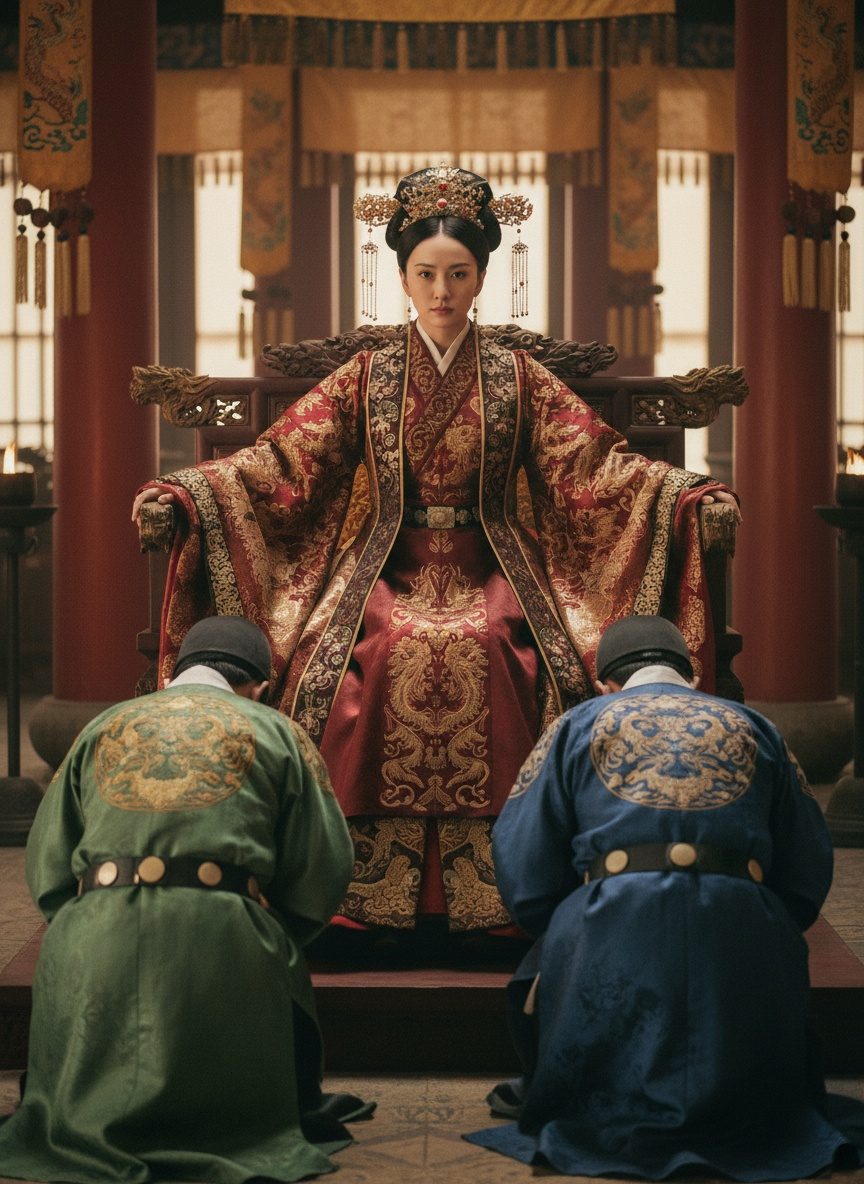
The echo of the courtyard's morning sounds was broken by the faintest click of a lock turning. Wu Zetian's heart pounded in her chest as she stepped past the threshold, her slippers barely making a sound on the polished stone. It was the first time she had entered this hall not merely as a presence in the background but as the speaker of the realm's future.
The Concubine Who Learned to Rule
Wu Zetian entered the imperial palace as a teenage concubine, a mere footnote in the life of the Emperor Taizong. Her beginnings were humble, with no official title or power to wield. She was expected to fulfill her duty as a concubine, remain in the background, and leave the political games to the men of the court. Yet, young Wu had a different vision for her future.
Wu was observant and astute, qualities that soon set her apart. While many others wasted away their days in the lethargic comfort of palace life, Wu Zetian was drawn towards the rituals and rhythms of power like a seamstress to a particularly intricate weave. She took meticulous mental notes, not just of the Emperor's decrees, but also of the minutiae of court life—who hesitated at certain decrees, who repeated the Emperor's words back with a stammer, and who simply acquiesced.
A Game of Thrones
The path from the modest quarters of a concubine to the highest seat in the land, occupied solely by men since time immemorial, was fraught with peril and intrigue. But Wu Zetian was a masterful player in this high-stakes game of thrones.
Her opportunity arose when Emperor Taizong passed, and his ninth son, Emperor Gaozong, ascended to the throne. Wu, who had once caught the eye of Gaozong and begun a discreet romantic relationship with him even before she was officially in his favor, re-entered the palace as a senior concubine. Her wit and intelligence soon made her a trusted confidant of the emperor, much to the disdain of the existing Empress and court officials.
This was Wu's chance to emerge from the shadows completely. Like a chess grandmaster, she anticipated every move, every counter-move, and she used every slight, every whisper and rumor to her advantage. Her rise was not without casualties; rivals were removed with ruthless efficiency, their demises echoing through the whispers of the palace halls.
The Power Behind the Curtain
Deep into the sixth century, Emperor Gaozong's health began to decline, and with it, his ability to govern. Wu Zetian stepped away from her typical role and expanded her influence over state affairs. She governed from behind the throne, a shadow empress with a solid grasp on the reins of power. Her every decision was calculated, every directive carefully thought out, aimed at cementing her indispensable role in the administration of the empire.
Despite opposition from ministers and family who balked at such unprecedented female power, Wu's determination and political acumen persuaded or coerced allies into submission. She initiated reforms, promoted those who supported her, and eliminated opposition, all while appearing to be the ever-dutiful consort.
Yet she was no mere figurehead. Wu Zetian was, by this time, the de facto ruler, managing state affairs and steering the destiny of the Tang Dynasty. Her governance was marked by efficiency and effectiveness, as she employed a merit-based system to curb the influence of aristocratic kinship on bureaucracy.
The Imperial Ascent
When Emperor Gaozong died in 683 AD, the court expected Wu Zetian to step aside for her son. But by then, power was no longer alluring; it was necessary. She did not simply hold on to power by becoming regent for Gaozong's successor—she eclipsed the throne's authority to make it her own. She gracefully orchestrated becoming the regent before systematically removing each son from power, embodying both the rule and the ruler.
In 690 AD, Wu formally declared herself Emperor of China, the only woman in four thousand years to have accomplished this feat. The title "Emperor" rather than "Empress" withstood convention and was a proclamation of her sovereign rule over the Middle Kingdom. Under her reign, the Tang Dynasty continued to flourish, further consolidating the Central Asian territories and expanding trade routes.
The Legacy Echoing Through Time
Wu Zetian’s story is one of resilience, ambition, and an indomitable will to rise above the confining roles that her time and society prescribed for women. In rewriting the rules of conduct for women, she created an indelible impact on Chinese history. Her government made significant advancements in agriculture, supported Buddhism, and embraced written documentation—contributing profoundly to what would be heralded as a golden era for the Tang Dynasty.
In examining Wu Zetian’s life, we are confronted with questions of power, gender, and the ways in which narratives are shaped by victors and those who record history. While she was vilified in the records written by her successors, seen as ruthless and unscrupulous, modern scholars have re-evaluated her achievements and the socio-political context of her reign. Her ascent from the shadows to the throne showcases the possibilities of human endeavor when combined with intellectual tenacity and strategic insight.
Wu Zetian reminds us that history is frequently written from perspectives that highlight the remarkable feats of those who dare to go against the current. Her legacy endures as a focal point of discussion, questioning traditional gender roles and the nature of governance. She may have lived a millennium ago, but Wu Zetian’s voice, indeed, echoes still. And through her story, we are reminded of the potent possibilities of perseverance and ambition in shaping the world around us.