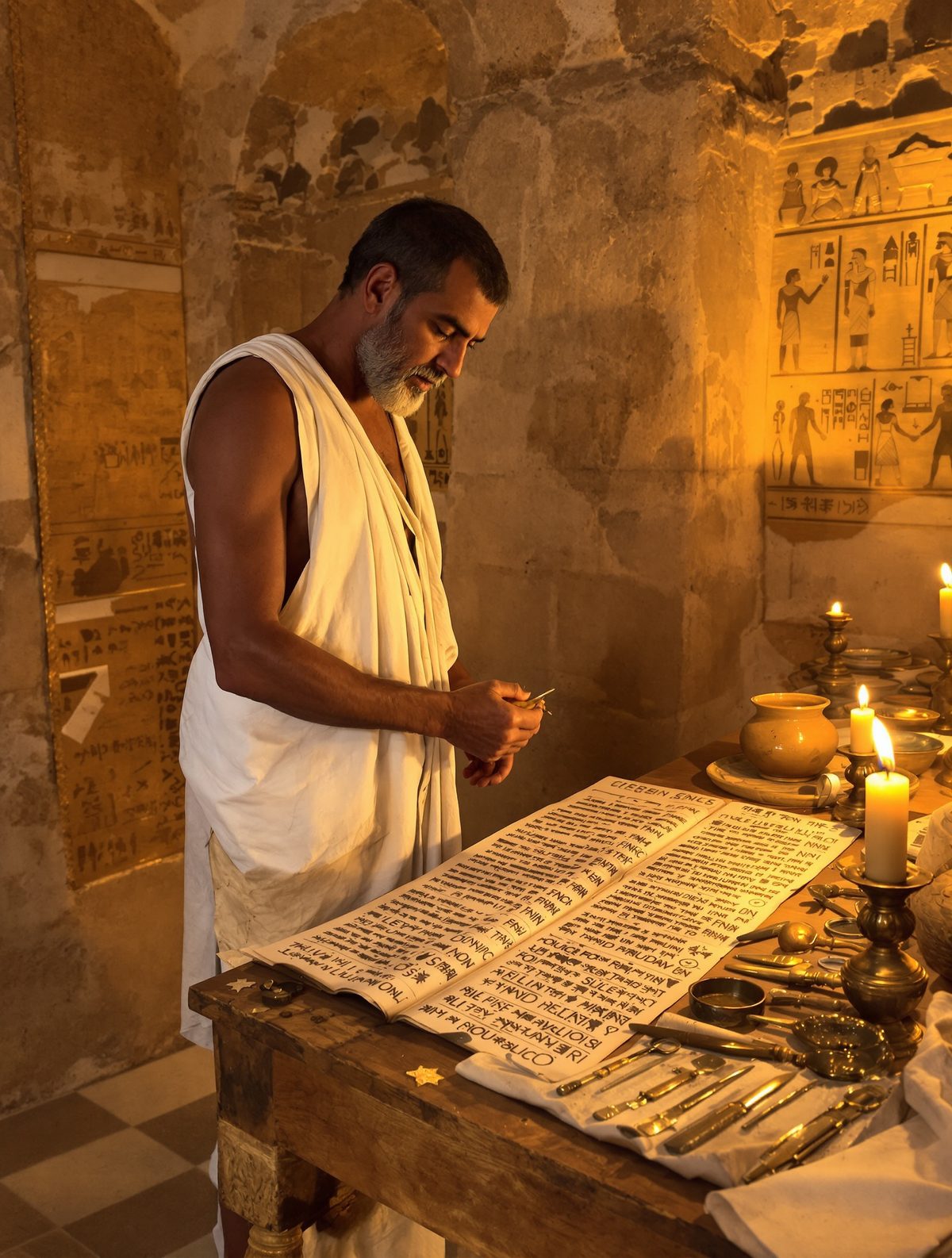
In 1927, American archaeologist Charles Breasted was carefully documenting Queen Hatshepsut's magnificent mortuary temple at Deir el-Bahari when he made a discovery that would rewrite our understanding of ancient Egyptian court life. Behind a stone door that hadn't been opened for over three millennia, he found something that should never have existed: the carefully carved image of a commoner kneeling in eternal worship, hidden in one of Egypt's most sacred spaces. The man was Senenmut—Queen Hatshepsut's chief architect, closest advisor, and perhaps something much more intimate.
What Breastead had uncovered wasn't just ancient graffiti. It was evidence of one of history's most audacious acts of self-preservation, a desperate bid for immortality that violated every rule of ancient Egyptian society. For 3,500 years, Senenmut had been hiding in plain sight, secretly carved into the very temple he had designed for his queen.
The Commoner Who Built for a God-Queen
Senenmut's story begins around 1479 BC, when a young woman named Hatshepsut was thrust into one of history's most impossible positions. Her husband, Thutmose II, had died after a brief reign, leaving behind only a male heir—Thutmose III—who was still a child. In any other civilization, Hatshepsut might have ruled as regent until the boy came of age. But this was Egypt, where pharaohs were living gods, and Hatshepsut had bigger plans.
Within seven years, she had done the unthinkable: declared herself pharaoh, donned the false beard of divine kingship, and begun one of the most prosperous reigns in Egyptian history. But to pull off this unprecedented power grab, she needed allies. She needed someone brilliant, loyal, and ambitious enough to help her reshape the very concept of Egyptian rulership. She found that person in Senenmut.
Unlike the blue-blooded nobles who typically surrounded pharaohs, Senenmut came from humble origins in the small town of Iuny. His parents, Ramose and Hatnofer, were commoners—his father likely a minor official, his mother perhaps a servant. In the rigid hierarchy of ancient Egypt, Senenmut should have lived and died in obscurity. Instead, he would become one of the most powerful men in the kingdom.
The Forbidden Rise to Power
How exactly Senenmut caught Hatshepsut's attention remains one of history's tantalizing mysteries. Some scholars believe he first served as a tutor to her daughter, Neferure, demonstrating an education that was remarkable for someone of his background. Others suggest he was an architect whose innovative designs caught the queen's eye. What we know for certain is that his rise was meteoric and unprecedented.
By 1473 BC, Senenmut held an astonishing array of titles: Chief Architect of Amun, Steward of the King's Daughter, and Overseer of All Works of the King. Royal inscriptions describe him as "the one who gives advice in the entire land," and "he who is in the confidence of the Lord of the Two Lands." These weren't just ceremonial positions—Senenmut wielded real power in Hatshepsut's administration.
But it was his role as her chief architect that would define his legacy. Hatshepsut was determined to out-build every pharaoh who came before her, and Senenmut was the genius who made her vision reality. He designed her magnificent mortuary temple at Deir el-Bahari, a revolutionary structure that seemed to grow organically from the limestone cliffs of the Valley of the Kings. The temple's terraced design, with its elegant ramps and colonnades, was unlike anything Egypt had ever seen.
Hidden in Plain Sight: The Secret Portraits
It was in this temple—his masterpiece—that Senenmut committed his most daring act. Sometime around 1470 BC, as work on the temple neared completion, he arranged for his own image to be carved into the sacred walls. Not once, but multiple times, in locations where they would be hidden from public view but preserved for eternity.
The most famous of these hidden portraits shows Senenmut kneeling in traditional worship posture behind one of the temple's great doors. When the doors were closed, as they were meant to be most of the time, his image disappeared completely. But when opened for sacred ceremonies, there he was—forever present in the most holy rituals of his beloved queen.
The audacity of this act cannot be overstated. In ancient Egypt, the right to be depicted in royal tombs and temples was jealously guarded. Only the pharaoh, immediate family members, and occasionally favored gods were permitted such honor. For a commoner—no matter how powerful—to insert himself into these sacred spaces was not just presumptuous; it was sacrilegious.
Yet Senenmut didn't stop with one hidden portrait. Archaeologists have discovered his image in at least two other locations within the temple complex, always carefully concealed, always showing him in poses of worship and devotion. Most remarkably, in one image he appears to be kneeling directly behind the queen herself, positioned as if he were her eternal shadow and protector.
Love, Ambition, or Survival?
Why did Senenmut risk everything for these hidden portraits? The answer depends on which theory you believe, and scholars have been debating it for nearly a century.
The romantic interpretation suggests that Senenmut and Hatshepsut were lovers, and that his hidden portraits were acts of devotion from a man who could never publicly claim his true relationship with the queen. Some evidence supports this theory: Senenmut never married (highly unusual for a man of his status), he had unprecedented access to the royal family, and he was clearly trusted with state secrets that few others knew.
The political interpretation is more cynical but perhaps more realistic. Senenmut may have realized that his power was entirely dependent on Hatshepsut's continued reign, and that when she died, her successor—likely the displaced Thutmose III—would have little love for her supporters. The hidden portraits were his insurance policy, a way to ensure his ka (soul) would be sustained in the afterlife even if his official monuments were destroyed.
As it turned out, this latter concern was prescient. Around 1458 BC, Senenmut vanished from the historical record. We don't know if he died naturally, fell from favor, or was eliminated by political rivals. What we do know is that many of his official statues and inscriptions were later damaged or destroyed, probably during Thutmose III's campaign to erase Hatshepsut's reign from history.
The Discovery That Changed Everything
For over three millennia, Senenmut's gamble paid off. While his public monuments crumbled and his name was chiseled from official records, his secret portraits remained hidden and protected. The doors that concealed them were sealed, the passages forgotten, the very existence of the images lost to history.
Then came Charles Breastead and the modern archaeological expeditions of the early 20th century. Using new techniques and systematic exploration, archaeologists began uncovering parts of Hatshepsut's temple that had been sealed since ancient times. The discovery of Senenmut's portraits sent shockwaves through the scholarly community.
Here was proof that the rigid hierarchies of ancient Egypt could be subverted, that a commoner could literally write himself into history through cleverness and audacity. The portraits also provided new insights into the relationship between Hatshepsut and her inner circle, suggesting a level of intimacy and trust that official records never revealed.
Modern analysis of the carvings has revealed additional details that ancient eyes would never have noticed. The quality of the work is exceptional—these weren't crude scratchings but carefully planned and executed reliefs that matched the artistic standards of the rest of the temple. This suggests that Senenmut didn't sneak around at night with a chisel, but rather incorporated his portraits into the official construction process, probably with the help of trusted artisans.
Eternal Ambition in Stone
Senenmut's hidden portraits raise uncomfortable questions that resonate far beyond ancient Egypt. What drives someone to risk everything for a chance at immortality? How far should ambition push against social boundaries? And what happens when love—whether romantic or platonic—collides with the rigid structures of power?
In our own age of social media and personal branding, Senenmut's story feels surprisingly contemporary. He was, in essence, inserting himself into history's feed, ensuring that future generations would discover his presence in places where he technically didn't belong. His hidden portraits were ancient Egypt's equivalent of a strategic photo bomb—audacious, risky, and ultimately successful.
Today, visitors to Deir el-Bahari can still see Senenmut's masterpiece rising from the desert cliffs, its clean lines and revolutionary design as striking now as they were 3,500 years ago. But they cannot see his hidden portraits—those remain accessible only to archaeologists and scholars, still protected behind the stone doors where he placed them.
Perhaps that's fitting. Senenmut's greatest achievement wasn't just designing one of Egypt's most beautiful temples or rising from humble origins to extraordinary power. It was understanding that sometimes the most profound acts of love, ambition, and hope happen in the shadows, hidden from the judgment of the present but preserved for the discovery of the future. In the end, the commoner who dared to make himself eternal got exactly what he wanted: a place in history that no pharaoh, no matter how powerful, could ever erase.