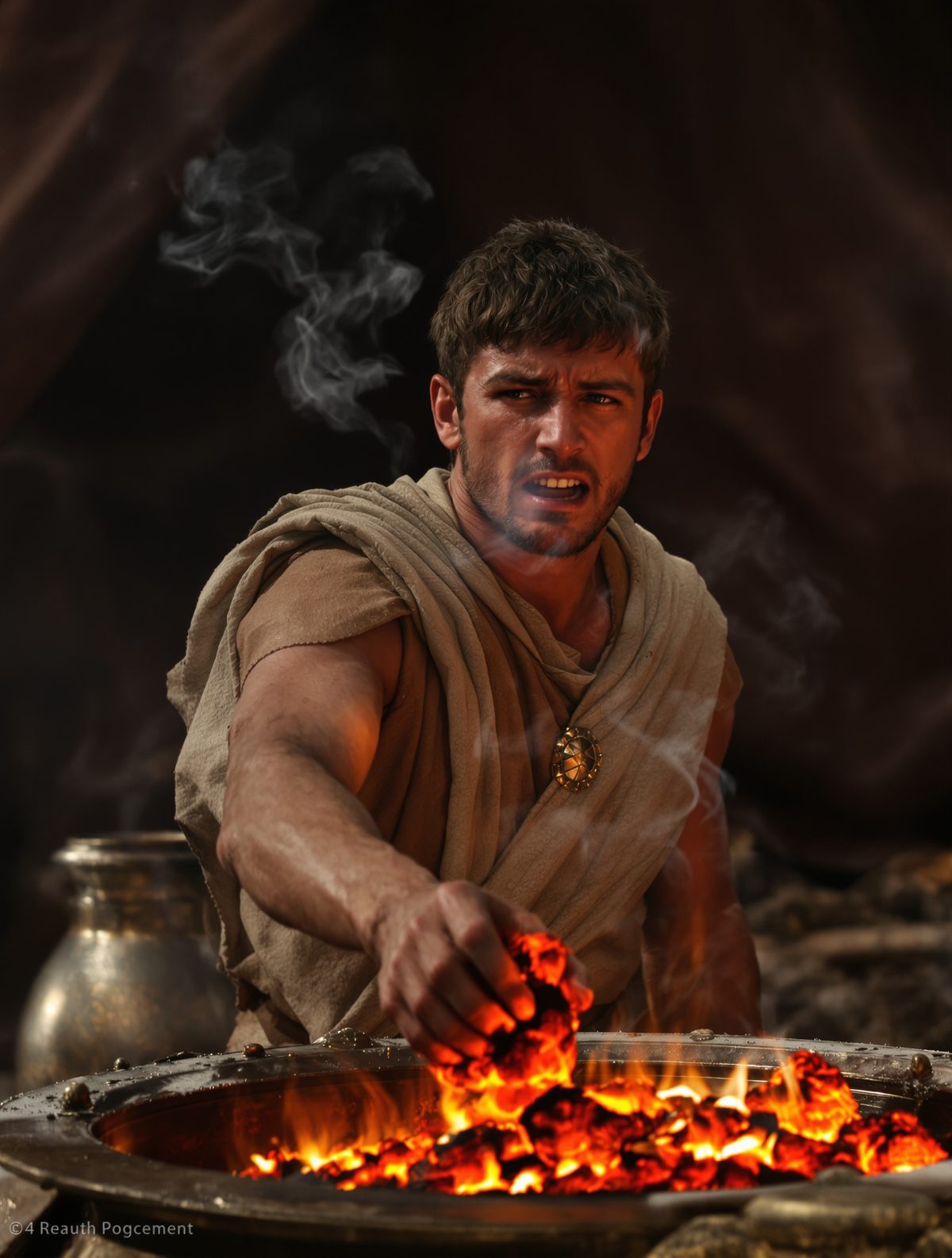
The wine cup trembled slightly in Prexaspes' weathered hand as he raised it to his lips, unaware that this simple gesture would seal his son's fate. Across the torch-lit banquet hall of Persepolis, King Cambyses II watched with the calculating gaze of a predator, his own goblet forgotten as madness danced behind his eyes. What happened next would become one of history's most chilling examples of absolute power corrupting absolutely—and of a father's tragic choice between family and loyalty to a mad king.
In 522 BC, the Persian Empire stretched from the Hindu Kush to the Mediterranean, the largest realm the world had ever seen. At its heart sat Cambyses II, son of the great Cyrus, but a man whose brilliant military mind was slowly being consumed by paranoia, cruelty, and an insatiable need to test the limits of his subjects' devotion.
The Archer Who Never Missed
Prexaspes was no ordinary courtier. As the empire's finest archer and one of Cambyses' most trusted advisors, he had served the royal family for decades. His arrows had found their mark in countless battles, helping to expand Persian dominion across three continents. More than just a military asset, Prexaspes served as a royal confidant—one of the precious few who could speak honestly to the increasingly volatile king.
The Persian court was a place where truth was a dangerous commodity. Surrounded by sycophants and terrified nobles who told him only what they thought he wanted to hear, Cambyses had grown to treasure Prexaspes' candor. It was this very honesty that had elevated the archer from common soldier to intimate advisor, but it would also become the spark that ignited one of history's most horrific demonstrations of royal caprice.
On that fateful evening, as wine flowed freely through the pillared halls of the palace, Cambyses watched his trusted archer drink with the other nobles. Perhaps it was the wine speaking, or perhaps it was the paranoia that had been growing like a cancer in the king's mind, but something about Prexaspes' slightly unsteady movements caught the royal attention.
A King's Accusation
"You drink too much, old friend," Cambyses announced, his voice cutting through the conversations around them. The hall fell silent as courtiers turned to witness what they sensed would be another of their king's unpredictable outbursts. "Your hand shakes with wine. How can I trust an archer whose arrows might fly wide because he cannot resist the grape?"
According to the ancient historian Herodotus, whose account remains our primary source for this tale, Prexaspes was genuinely surprised by the accusation. The archer had always been moderate in his drinking—a necessity for a man whose livelihood depended on steady hands and sharp eyes. "My lord," he replied carefully, aware that the wrong word could mean death, "I am as steady as I have ever been. Wine has never clouded my aim."
What followed reveals the twisted psychology of absolute power. A reasonable king might have accepted the explanation or perhaps arranged a test of marksmanship the following morning. But Cambyses was no longer reasonable. The same man who had conquered Egypt and extended Persian power to its greatest extent was increasingly given to fits of rage and bizarre demonstrations of authority.
The king's eyes glittered with dangerous interest. "Steady, you say? Then prove it."
The Unthinkable Command
What Cambyses proposed next shocked even his jaded courtiers, men who had witnessed executions, tortures, and the casual cruelty that had become commonplace in the royal presence. "Bring your son here," the king commanded. "If your hand is as steady as you claim, you will shoot him through the heart. If you succeed, I will know your aim is true. If you fail..." The threat hung in the air, unspoken but understood.
Prexaspes' son was summoned—a young man in the prime of his life, likely serving as a page or minor official in the royal household. Imagine the boy's confusion as he was positioned against the far wall of the banquet hall, servants hastily clearing space for what must have seemed like an elaborate jest. The flickering torchlight cast dancing shadows across the assembled nobles, their faces frozen in fascinated horror.
For Prexaspes, the choice was impossible yet inevitable. To refuse meant certain death for both himself and his son—Cambyses would not tolerate defiance. To comply meant betting his child's life on his own skill, hoping against hope that the wine had not affected his legendary precision. In the Persian Empire, where the king's word was divine law, there was no middle ground.
The archer's hands, steady from decades of practice, strung his bow with mechanical precision. His son stood against the wall, perhaps understanding now that this was no royal game but a genuine test that would end in death—his own or his father's, or quite possibly both.
The Arrow That Found Its Mark
The silence in the hall was absolute as Prexaspes drew back his bowstring. Every eye watched the father who had been forced to target his own child's heart. The torches guttered in their sconces. Wine cups sat forgotten. Even the servants had stopped their endless bustling to witness this moment of supreme cruelty.
The arrow flew true.
Herodotus records that the shot was perfect—the arrow piercing the young man's heart with surgical precision. The boy crumpled to the marble floor as his life ebbed away, while his father stood frozen, bow still in hand, having just proven his sobriety in the most horrific way imaginable.
Cambyses was delighted. "You see?" he announced to the stunned assembly, his voice bright with satisfaction. "His hand is steady! The wine has not affected our master archer!" The king's applause echoed through the silent hall, a sound more chilling than any scream.
But the story doesn't end with this moment of successful marksmanship. According to Persian tradition, Cambyses ordered the boy's chest cut open to examine the wound. The arrow had indeed pierced the heart exactly—a testament to both Prexaspes' skill and the precision of his obedience to royal command.
The Reckoning of a Mad King
History records that Prexaspes outwardly accepted the king's praise, even expressing satisfaction at the accuracy of his shot. But this moment marked a turning point. The archer had passed Cambyses' test, but at a cost that would ultimately contribute to the king's downfall.
Within months, Cambyses II was dead, killed during his rushed return to Persia to deal with a rebellion. Some sources suggest poison, others point to an infected wound, but many historians believe that men like Prexaspes—loyal servants pushed beyond all reasonable limits—may have finally turned against their increasingly erratic ruler.
The incident reveals the fundamental instability of absolute power unchecked by law or moral restraint. Cambyses had inherited the greatest empire in human history, but his inability to distinguish between loyalty and fear, between strength and cruelty, ultimately undermined the very foundations of his rule.
Echoes Through Time
The tale of Prexaspes and his son resonates across centuries because it captures something essential about power, loyalty, and the prices we pay for both. In our modern world of democratic institutions and human rights, it's easy to dismiss such stories as relics of a barbaric past. Yet the underlying dynamics—the pressure to prove loyalty through increasingly extreme acts, the corruption that comes with unchecked authority—remain disturbingly relevant.
This wasn't just about one mad king and one tragic father. It was about a system that placed no limits on royal power, that confused fear with respect and cruelty with strength. The Persian Empire, for all its administrative brilliance and cultural achievements, contained within itself the seeds of tyranny that would eventually contribute to its decline.
Perhaps most chilling is how the story reveals the slow erosion of moral boundaries. Prexaspes didn't wake up one morning deciding to kill his son—he was led there step by step, through years of increasing royal demands, until the unthinkable became not just possible but seemingly necessary. It's a reminder that civilization's most precious achievement isn't technology or wealth, but the hard-won limits we place on power itself.
In the end, the archer's perfect aim became a symbol not of loyalty rewarded, but of humanity lost to the madness of absolute power—a lesson written in blood that echoes through every age.