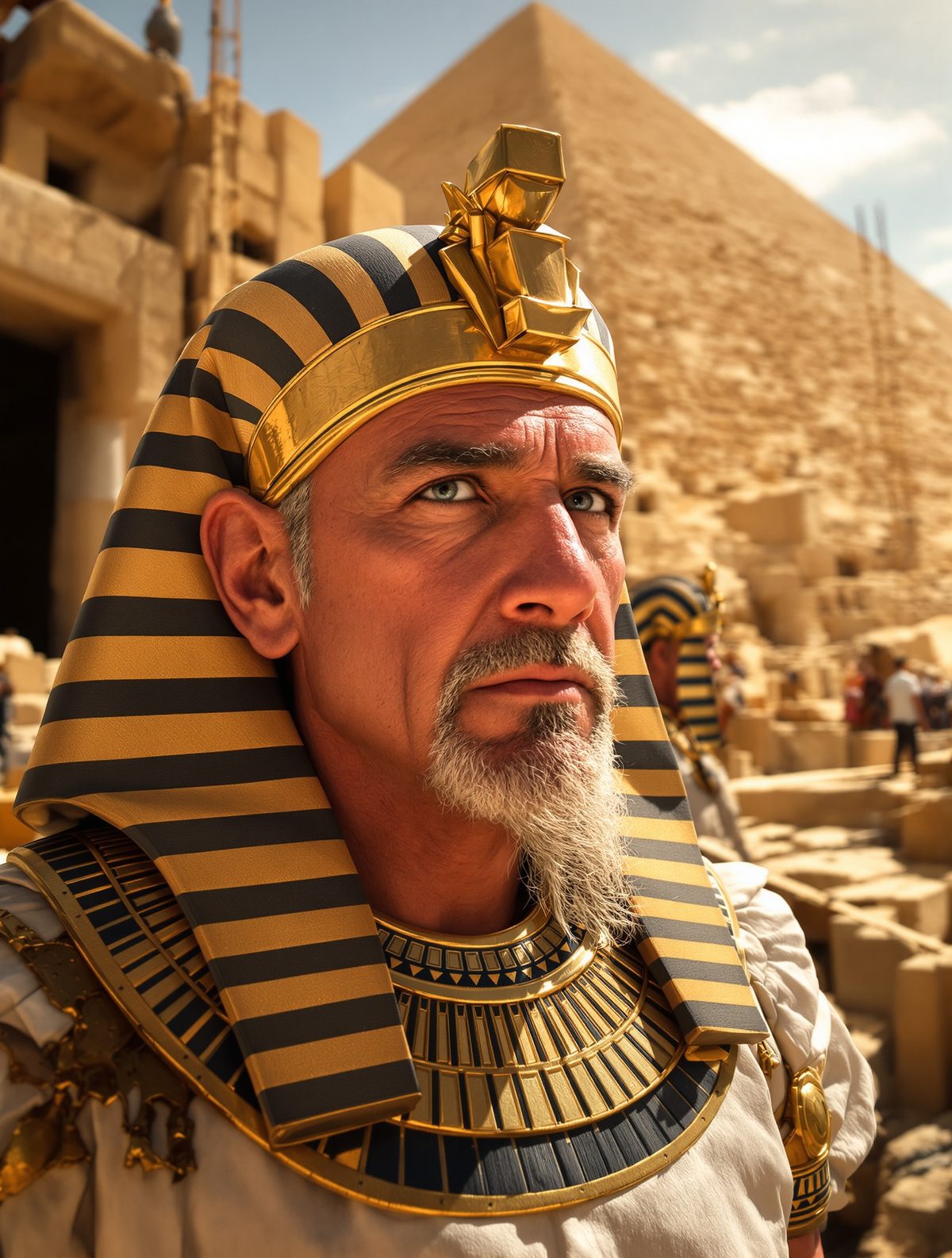
Picture this: you're standing in the shadow of the Great Pyramid of Giza, circa 2500 BC. The limestone blocks tower above you, each one weighing as much as fifteen elephants. Workers swarm the construction site like ants, their bronze tools glinting in the desert sun. And there, directing a crew of laborers with the authority of a general, stands a man who reaches barely to their waists.
His name was Seneb, and at three feet tall, he commanded respect in a civilization that worshipped physical perfection. In an era when pharaohs were considered living gods and physical deformity often meant social exile or death, this remarkable man rose to become Chief of All Royal Dwarfs—a position that made him one of the wealthiest and most powerful non-royals in all of Egypt.
This is the story they never taught you in school: how a dwarf became a giant in the land of the pharaohs.
The Kingdom of Perfect Bodies
Ancient Egypt was obsessed with physical perfection. Their art depicted humans with idealized proportions: broad shoulders tapering to narrow waists, perfectly symmetrical faces, and bodies that seemed carved by the gods themselves. The pharaoh was considered the physical embodiment of divine perfection on earth, and his court was expected to reflect that same ideal.
So when Seneb was born during the Fourth Dynasty, around 2520 BC, his prospects should have been grim. Dwarfism in ancient Egypt wasn't just a physical condition—it was a social death sentence for most. Archaeological evidence shows that many individuals with dwarfism were buried in unmarked graves, their bodies contorted into positions suggesting they lived as outcasts.
But Seneb was different. Born during the reign of Pharaoh Khufu (the builder of the Great Pyramid), he entered a world where the impossible was becoming routine. If men could move two-million-ton limestone blocks and align pyramids with celestial precision, perhaps a three-foot-tall man could rise to greatness too.
What made Seneb's rise even more extraordinary was the Egyptian belief system itself. The god Ptah, creator deity and patron of craftsmen, was sometimes depicted as a dwarf. The god Bes, protector of households and children, was also portrayed with dwarfism. These divine associations may have provided Seneb with a crucial cultural foothold that others like him lacked.
Rising Through the Ranks of Stone and Gold
Seneb's career began in the workshops and construction sites surrounding the Giza complex. Here's what most people don't realize: building the pyramids wasn't just about hauling stones. It required an army of specialists—accountants to track supplies, scribes to record progress, overseers to manage teams, and administrators to coordinate the massive logistics operation.
Seneb possessed something that transcended physical stature: an brilliant mind for organization and an uncanny ability to earn loyalty. Contemporary inscriptions describe him as "beloved of his lord" and "he who does what his king praises every day." These weren't empty titles—they represented real political currency in pharaonic Egypt.
By 2490 BC, Seneb had achieved something unprecedented: he was appointed Chief of All Royal Dwarfs. This wasn't merely a ceremonial position. In Egyptian court hierarchy, dwarfs served crucial roles as personal attendants to royalty, entertainers, and even religious functionaries. As their chief, Seneb commanded significant resources and wielded genuine political influence.
But here's the truly shocking part: Seneb didn't stop there. Court records show he also held the titles of "Overseer of the Textile House" and "Priest of the Funerary Cults of Khufu and Djedefre." These positions came with substantial land grants and revenue streams. By modern estimates, Seneb controlled estates worth millions of dollars in today's currency.
Love in the Time of Pharaohs
Perhaps nothing illustrates Seneb's remarkable social position better than his marriage. In a society where arranged marriages reinforced class boundaries and bloodline purity, Seneb married Senetites, a woman of normal stature who held the prestigious title of "Priestess of Hathor."
This wasn't just a marriage—it was a declaration of social equality that would have been unthinkable for someone of Seneb's physical condition in nearly any other ancient civilization. Senetites came from a respectable family with her own property and religious duties. Their union was celebrated with all the ceremony due to nobility.
The couple's tomb, discovered in 1926 near the Giza pyramids, provides intimate glimpses into their relationship. The famous limestone statue shows them seated together with their two children positioned strategically where Seneb's legs would normally be depicted—an artistic solution that speaks to both the sculptor's ingenuity and the family's desire to be remembered as a unified whole.
What makes this even more remarkable is that both of their children—Ankhenmire and Senebtisis—were of normal height. In an era before genetic counseling, this must have seemed like divine favor. Both children inherited not only their father's wealth but also his social standing, going on to hold important positions in Egyptian society.
The Dwarf's Dynasty
Seneb's influence extended far beyond his own lifetime. His son Ankhenmire became a respected scribe and administrator, while his daughter Senebtisis married into another prominent family, further expanding the dynasty's reach. Archaeological evidence suggests that Seneb's descendants remained prominent in Egyptian society for at least three generations—extraordinary longevity for any family line in the ancient world.
The wealth Seneb accumulated was staggering by ancient standards. His tomb contained gold jewelry, precious stones, fine linens, and ceremonial weapons. Hieroglyphic inscriptions detail his ownership of multiple estates, herds of cattle, and teams of servants. By some estimates, he controlled more personal wealth than many regional governors.
But perhaps Seneb's greatest legacy was invisible: he fundamentally changed Egyptian attitudes toward physical difference. After his success, court records show increased numbers of dwarfs in prestigious positions. Some even adopted titles clearly modeled on Seneb's own, suggesting he had created a new pathway to social mobility.
His tomb inscription includes a phrase that would have seemed impossible for someone like him just a generation earlier: "An honored one before the great god, Seneb." In death, as in life, he was literally honored before divinity—a status reserved for Egypt's most exalted citizens.
The Man Behind the Monument
What kind of person was Seneb? The historical record provides tantalizing glimpses. Contemporary accounts describe him as "sharp of speech" and "beloved by all who worked under him." These weren't typical pharaonic platitudes—they appear in multiple independent sources, suggesting genuine respect from peers.
One particularly revealing inscription describes Seneb mediating a dispute between work crews during pyramid construction. His solution—redistributing workloads based on individual capabilities rather than traditional hierarchies—sounds remarkably modern. It also reveals a man who understood that true leadership meant seeing people's potential rather than their limitations.
Seneb also appears to have had a sense of humor about his situation. His tomb contains several artistic references that seem to playfully acknowledge his stature while simultaneously asserting his dignity. One relief shows him seated at the same eye level as normal-height officials—achieved by depicting him on a raised platform that's integrated so naturally into the scene that the viewer barely notices the accommodation.
A Legacy Written in Stone and Spirit
Seneb died around 2465 BC, after a career spanning nearly six decades. His mummified remains, examined by modern archaeologists, show evidence of the spinal conditions associated with his form of dwarfism, but also reveal a man who lived to an impressive age for his era—likely around 70 years old.
But here's why Seneb's story matters today, more than four millennia later: he proved that human worth isn't measured in inches or conventional expectations. In our modern world of accessibility laws and inclusion initiatives, Seneb stands as perhaps history's earliest example of how societies benefit when they judge people by their contributions rather than their appearance.
His story also challenges our assumptions about ancient civilizations. We often imagine the past as uniformly brutal toward anyone who was different. Seneb's life proves that even 4,500 years ago, extraordinary individuals could sometimes transcend the limitations their societies tried to impose.
Today, as we grapple with questions of equality and representation, Seneb's legacy offers both inspiration and instruction. He didn't just break barriers—he rebuilt them higher and stronger for everyone who came after. In a kingdom of giants, he proved that greatness comes in every size.
The next time you see the pyramids of Giza—whether in person or in photographs—remember that among the countless workers who built those monuments was a three-foot-tall man who stood tallest of all.