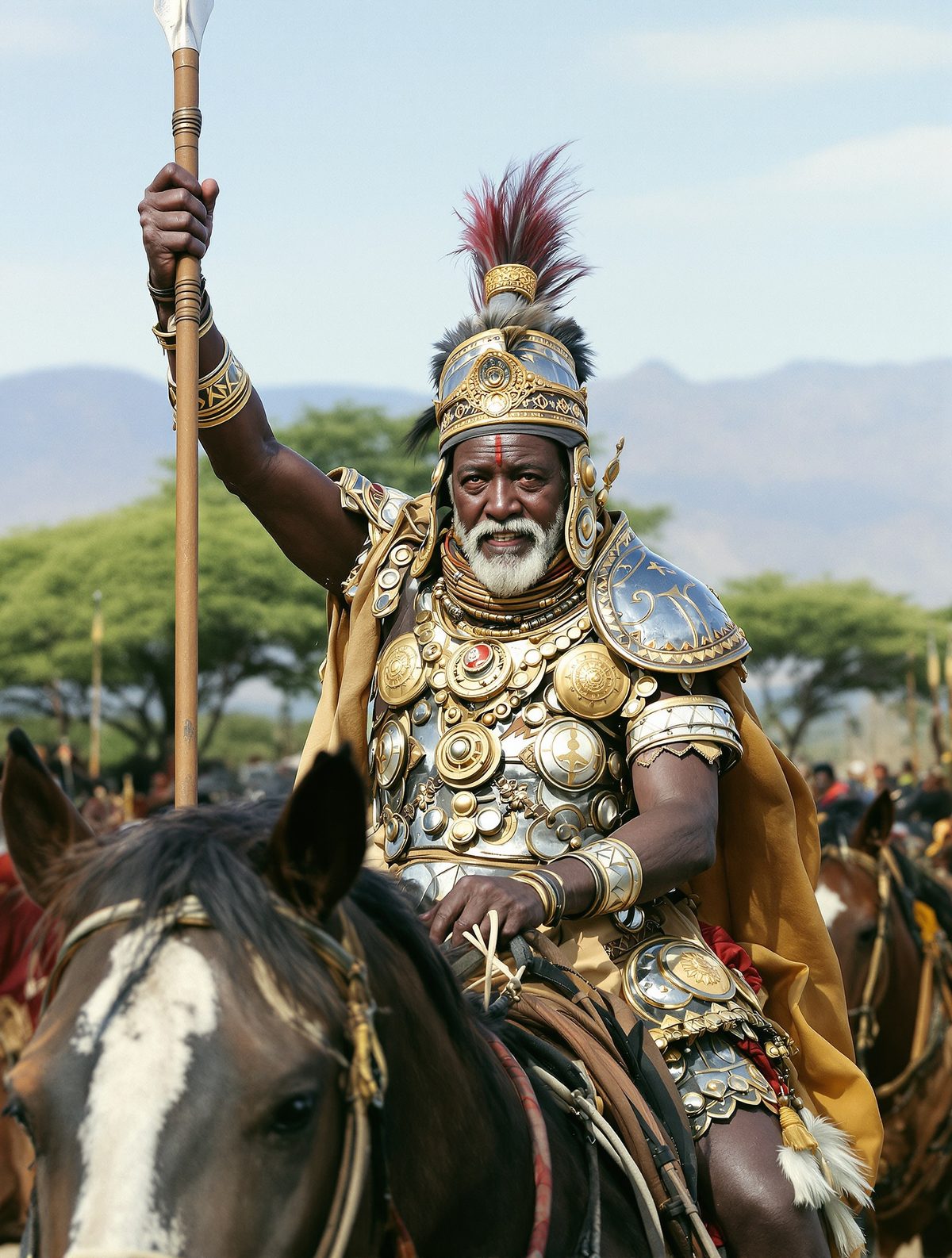
The morning mist clung to the Euphrates River as a wicker basket bobbed silently downstream, its precious cargo hidden beneath a blanket of bitumen and reeds. Inside lay a baby boy, abandoned to the mercy of the current and the gods. No one watching that basket drift past the mud-brick walls of ancient Mesopotamian cities could have imagined they were witnessing the beginning of history's first empire. That baby would grow up to become Sargon of Akkad—the man who would unite a fractured land and create a template for conquest that would echo through Alexander, Caesar, and Napoleon.
But this isn't just another rags-to-riches story. This is the tale of how a foundling became the world's first emperor, and how his rise from the riverbank would reshape civilization itself.
The Mystery of the Floating Baby
Around 2334 BCE, somewhere along the fertile banks of the Euphrates, a story began that would be retold for millennia. According to the legend inscribed on cuneiform tablets, Sargon's mother was a high priestess—a woman bound by sacred vows who could not openly acknowledge her child. His father? Unknown, though some texts hint at divine parentage, a common claim for extraordinary rulers.
The baby's mother crafted a basket from reeds, sealed it with bitumen to make it waterproof, and set her son adrift on the river. It's a story that feels familiar because variations of it appear across cultures—Moses in the Nile, Romulus and Remus by the Tiber. But Sargon's tale is likely the original, the first recorded instance of this archetypal narrative of the abandoned hero destined for greatness.
What makes this story particularly fascinating is how it reflects the geography of ancient Mesopotamia. The Euphrates wasn't just a river—it was a highway, connecting city-states and carrying both trade goods and, apparently, future emperors. The basket would have drifted past Babylon, Nippur, and Uruk, each city an independent kingdom with its own god, its own king, and its own fierce independence.
From River Foundling to Royal Gardener
The basket's journey ended when Akki, a royal gardener, spotted it among the reeds. Some translations describe him as a "drawer of water," suggesting he was irrigating the palace gardens when he made his life-changing discovery. Akki raised the boy as his own, naming him Sargon—though this was likely a throne name meaning "legitimate king," adopted later to legitimize his rule.
Growing up in the gardens of Kish, one of Mesopotamia's most powerful city-states, young Sargon would have witnessed the intrigue and politics of royal court life while learning the practical skills of agriculture and irrigation—knowledge that would prove invaluable when governing an empire dependent on river systems. The gardens themselves were marvels of engineering, requiring complex irrigation networks that demonstrated humanity's growing mastery over nature.
But here's where the story takes an intriguing turn: Sargon didn't remain a gardener. Somehow, this foundling caught the attention of Ur-Zababa, king of Kish, and rose to become his cup-bearer—a position of enormous trust and influence. Cup-bearers tasted the king's food and drink to detect poison, meaning they were literally trusted with royal lives. This wasn't just serving wine; this was high-level court politics.
The Accidental Revolutionary
Legend says that Ur-Zababa began having disturbing dreams about his cup-bearer's future greatness and decided to eliminate the threat. He sent Sargon on a suicide mission to Uruk, another powerful city-state, carrying a clay tablet with secret instructions for the ruler there to kill the messenger. It was an ancient version of a death warrant, and Sargon was unknowingly carrying his own execution order.
But something went wrong—or right, depending on your perspective. Instead of being killed, Sargon somehow turned the situation to his advantage. The exact details are lost to history, but the outcome was clear: by around 2334 BCE, Sargon had not only survived but had established his own power base in the city of Akkad, a location so thoroughly destroyed by later conquerors that archaeologists still haven't definitively identified where it stood.
What happened next changed the world. Rather than being content with ruling a single city-state like every other Mesopotamian king before him, Sargon had bigger plans. Much bigger plans.
Building the World's First Empire
Sargon's military innovations were as revolutionary as his political ambitions. While other armies relied heavily on infantry with spears and crude bronze weapons, Sargon developed the world's first professional standing army. His forces were equipped with composite bows that could fire arrows with deadly accuracy at longer ranges than ever before. More importantly, he created mobile archer units that could outmaneuver the heavy infantry formations that had dominated warfare for centuries.
The numbers are staggering for the time: ancient texts claim Sargon commanded an army of 54,000 men—larger than many modern cities. To put this in perspective, most city-state armies numbered in the hundreds, maybe low thousands. Sargon was bringing industrial-scale warfare to a craft-shop world.
His conquests reads like a ancient world tour: Uruk, Ur, Lagash, Umma—every major Sumerian city fell to his forces. But Sargon didn't stop at Mesopotamia. His armies pushed west into Syria and Lebanon, reaching the Mediterranean Sea, and east into the Zagros Mountains. For the first time in human history, a single ruler controlled trade routes stretching from the Persian Gulf to the Mediterranean—an empire spanning over 1,000 miles.
One inscription boasts that Sargon "defeated Uruk and tore down its wall" and that "in battle over [the god] Enlil he was victorious, and he struck down his enemies." These weren't just military victories; they were theological statements. By conquering cities, Sargon was claiming that his gods were more powerful than theirs.
The Art of Keeping an Empire
Conquering an empire is one thing; keeping it together is another entirely. Sargon proved as innovative in administration as he was in warfare. Rather than simply extracting tribute and moving on, he established a system of governance that would influence empires for millennia to come.
He placed Akkadian governors in conquered cities, but cleverly allowed local traditions and religions to continue. This wasn't tolerance for tolerance's sake—it was shrewd politics. By respecting local customs while installing his own administrators, Sargon created a model of imperial governance that balanced central control with local autonomy.
The economic implications were revolutionary. For the first time, goods could move safely across vast distances under a single authority. Mesopotamian grain could feed Lebanese cedar workers, while precious stones from Iran could adorn Sumerian temples. Sargon essentially created history's first free trade zone, and the economic boom that followed helped fund his military and administrative expenses.
His empire lasted 180 years and included some of history's most remarkable rulers, including his grandson Naram-Sin, who declared himself a god—taking Sargon's imperial ambitions to their logical extreme. The Akkadian language became the diplomatic tongue of the ancient world, the English of its day, remaining in use for over 1,500 years.
The Template for Every Empire Since
When we think of great empires—Rome, Britain, the Mongols—we're really looking at variations on the theme that Sargon first composed 4,300 years ago. The idea that a single ruler could unite diverse peoples under one authority, that military might could be combined with administrative efficiency, that conquest could create prosperity rather than just destruction—all of these concepts trace back to that baby in the reed basket.
Even the story of Sargon's origins became a template. Rulers from Cyrus the Great to Napoleon crafted origin stories emphasizing their humble beginnings and destiny for greatness. The narrative of the abandoned child who rises to rule tapped into something fundamental about human psychology—our love for underdogs and our belief in the possibility of transcending circumstances.
But perhaps Sargon's most lasting legacy was proving that empires were possible at all. Before him, human political organization had never expanded beyond city-states and loose confederations. He demonstrated that vast territories could be governed, that diverse peoples could coexist under unified rule, and that the benefits of such organization could outweigh the costs.
Today, as we grapple with globalization, international governance, and the tension between local identity and universal values, we're still wrestling with questions that Sargon first confronted over four millennia ago. How do you balance unity with diversity? How do you maintain control over vast distances? How do you create institutions that outlast their founders? The baby who floated down the Euphrates may not have had all the answers, but he was the first to seriously ask the questions that still shape our world.