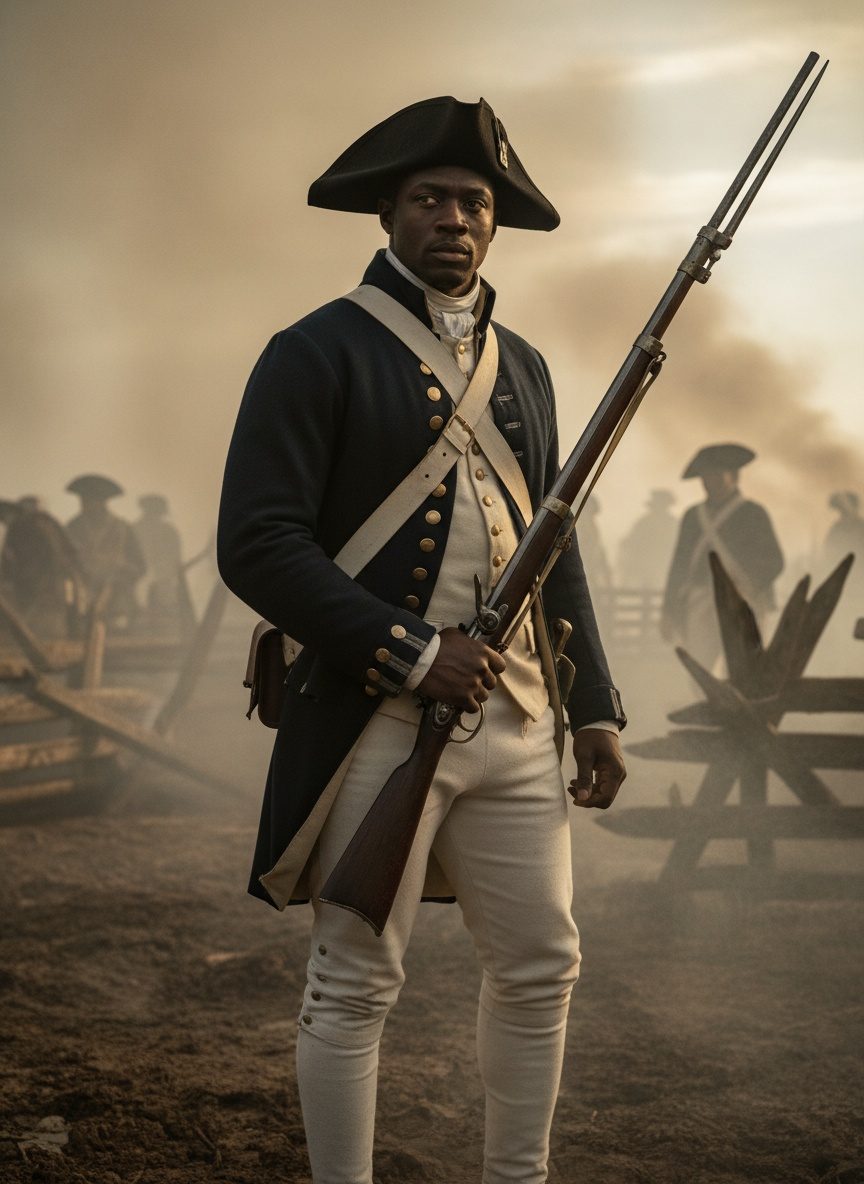
June 17, 1775. Smoke lingered in the morning air over the Charlestown Peninsula.
The Unlikely Path to Freedom
Salem Poor's journey began in the stark confines of the 18th-century American slave system. Born into slavery in the unforgiving landscapes of Massachusetts, Poor's early life was defined by the backbreaking labor and oppressive oversight that marked the existence of so many enslaved individuals. Yet, somewhere amidst the adversity, Poor summoned the resolve to carve a different path. In 1769, demonstrating an unwavering commitment to his own autonomy, Poor managed to purchase his freedom from John Poor for the price of 27 pounds — a significant sum at the time. Though he was now free, liberty for the masses was still a distant dream.
After gaining his freedom, Poor built a life in Boston, a city bustling with revolutionary fervor and palpable tension. It wasn't a world free from racism or prejudice, but Poor's determination saw him through. Instead of falling victim to the societal obstacles that surrounded him, he harnessed his newfound liberty, steadily establishing himself and his family in this vibrant, albeit divided, landscape. His story, however, would intersect dramatically with the birth of a new nation, drawing him onto the stage of an emerging struggle that sought to redefine the very concept of freedom.
The Call to Arms
With the outbreak of the American Revolution, Salem Poor found himself drawn into the escalating conflict. The battle for independence was more than a struggle for liberty from British chains; for Poor and countless other African Americans, it was an opportunity to assert a sense of belonging in a nation still grappling with its values. Swelling with the promise of change, Poor enlisted in the ranks of the Continental Army. He joined the militia and took up arms alongside fellow revolutionaries, forging common cause with a diverse assembly of soldiers determined to carry the torch of rebellion.
June 1775 presented a turning point. As the embers of discontent glowed brighter, calls to arms echoed across New England. Within this fermenting atmosphere, Poor's commitment reached its zenith on the morning of June 17, at the Battle of Bunker Hill. Though misnamed, with most of the combat occurring at nearby Breed's Hill, the altercation was a pivotal moment in the Revolutionary War. There, Poor would leave an indelible mark, showcasing extraordinary valor and tenacity.
Bunker Hill: Courage Under Fire
The Battle of Bunker Hill was a crucible that would test even the bravest souls. As dawn broke, the Continental forces readied their defenses, facing relentless British Regulars trained to crush rebellion. It was amidst this chaotic vista that Poor's actions became legendary. Accounts from that day suggest that it was here he distinguished himself most remarkably, displaying a level of bravery that stood out amidst the din of war.
Reports indicate that Poor participated in some of the fiercest fighting on the hillside. His valor in the face of danger was so pronounced that it caught the attention of numerous officers. In an era where the deeds of many were swiftly lost to history's shadows, Poor's conduct shone brightly enough to elicit a unique recognition. After the battle, fourteen officers submitted a formal petition commending his conduct, describing Poor as behaving like an experienced officer, and calling for his distinguished service to be publicly acknowledged by the newly formed United States government. For a Black man in 18th-century America, the commendation was nothing short of revolutionary.
A Soldier's Legacy, a Nation's Amnesia
Despite the officers' commendation, Salem Poor's remarkable wartime accomplishments have largely faded from popular consciousness. Histories of war often overlook the contributions of those who did not rise to command, but Poor's case is particularly egregious. The narrative of the American Revolution often omits such figures, robbing them of their rightful place in the quilt of an evolving nation.
Yet, the officers who served with Poor didn't forget. The fact that they crafted and signed that petition speaks volumes. In a society where prejudice was institutionalized and systemic, these men, recognizing courage and skill without regard to color, embodied the principles of equality and justice the war professed to uphold. Such endorsements were uncommon at the time, reflecting Poor's exceptional character and the respect he inspired among his peers.
The Echoes of a Forgotten Hero
Why does Salem Poor's story matter today? It is a stark reminder that the principles enshrined in the Revolutionary War were not evenly distributed. While the Declaration of Independence proclaimed that "all men are created equal," Poor fought bravely for a freedom that was denied to people of his race for generations to come. Despite serving a purpose greater than himself, he returned to a society that would still hold him at arm's length.
Salem Poor’s life is a testament to the complexities and contradictions at the heart of America's founding. His courage and the recognition he received challenge us to reflect on those unsung heroes who helped construct the bedrock of contemporary society. As we reassess our narratives, it becomes ever more important to resurrect and honor tales like Poor's, lest we forget the many strands of bravery that supported the fragile early republic. In remembering Salem Poor, we confront the uncomfortable truth that the fight for freedom and equality remains unfinished, and we renew the call to carry it forward for all.