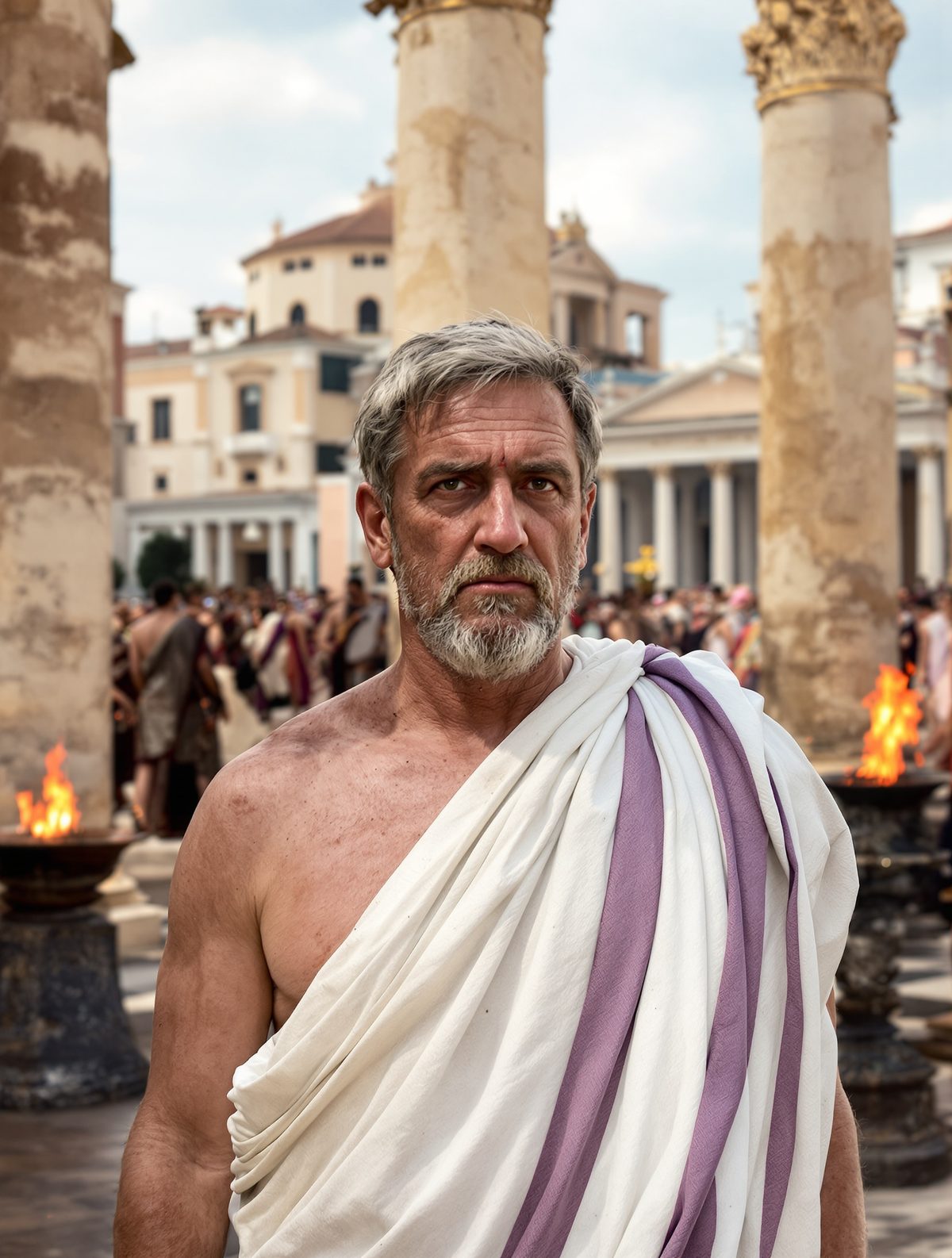
Picture this: You've just returned from the most extraordinary journey of your life, having sailed beyond the edges of the known world. You've witnessed seas that turn solid as jelly, lands where the sun refuses to set for months, and encountered fierce warriors who paint their bodies blue. You've measured the Earth itself and discovered new constellations. But when you tell your story, everyone calls you a liar.
This was the fate of Pytheas of Massalia, a Greek explorer whose incredible voyage in 325 BC took him farther north than any Mediterranean civilization had ever traveled. For two centuries, his countrymen dismissed him as the ancient world's greatest fabricator. Today, we know he was one of history's most accurate explorers—a man whose observations were so far ahead of his time that they seemed impossible.
The Merchant-Explorer from Massalia
Pytheas wasn't your typical Greek hero. Born in Massalia (modern-day Marseille), he was a mathematician, astronomer, and geographer living in what was essentially a Greek trading colony on the edge of barbarian Gaul. While Athens and Sparta fought their endless wars, Massalia prospered by trading with whoever would buy their goods—Greeks, Gauls, or otherwise.
Around 330 BC, something motivated Pytheas to attempt the impossible: sail beyond the Pillars of Hercules (Gibraltar) and explore the mysterious northern seas that no Greek had ever documented. Perhaps it was scientific curiosity, or maybe Massalia's merchants wanted to find the source of the precious tin and amber that trickled down through barbarian trade routes. Whatever the reason, Pytheas convinced someone to fund an expedition that would make Columbus's voyage look like a weekend cruise.
The timing was perfect. Alexander the Great's conquests had distracted the Carthaginians, who normally blockaded the Gibraltar strait like ancient customs agents. With their navy stretched thin across the Mediterranean, Pytheas slipped past their patrols and sailed into the Atlantic—a sea so mysterious that many Greeks believed it was an impassable river that encircled the entire world.
Into the Mare Tenebrosum
Imagine the courage required to sail north into what Romans called the Mare Tenebrosum—the Sea of Darkness. No GPS, no radio, no reliable maps. Just a single ship, probably a sturdy merchant vessel about 50 feet long, carrying perhaps 20-30 men into waters that might not even exist.
Pytheas first sailed along the Spanish and French coasts, taking careful measurements and notes. Unlike casual travelers, he was conducting serious scientific research. At every stop, he calculated latitude using a gnomon (a primitive sundial) and recorded the length of the longest day—measurements so accurate that modern scholars can trace his exact route.
When he reached the English Channel, Pytheas became the first Mediterranean explorer to document Britain. But his description of the island and its inhabitants was so exotic that it sounded like fantasy to stay-at-home Greeks. He wrote of a triangular island called "Pretanike" (Britain), inhabited by numerous tribes of warriors who painted themselves with woad, a blue dye extracted from plants.
The Britons, he reported, were surprisingly sophisticated. They grew grain, kept cattle, and lived in houses made of wood and reeds. More intriguingly, they were skilled metalworkers who produced the tin that Mediterranean civilizations desperately needed for making bronze. Pytheas had discovered the source of one of the ancient world's most valuable trade goods—and nobody back home believed him.
The Land Where the Sun Never Sets
But Pytheas wasn't finished. After circumnavigating Britain—a journey of roughly 4,000 miles that took him around Scotland's treacherous northern coast—he pushed even further into the unknown. Six days north of Britain, he reached a land he called "Thule," where he witnessed something that sounded utterly impossible to Mediterranean ears: the midnight sun.
"In Thule," he wrote, "the nights are very short, in some parts two, in others three hours long, so that the sun rises again a short time after it has set." He described summer nights so bright that people could work as if it were daytime, and reported that during winter, the sun barely appeared at all.
Modern scholars debate whether Pytheas reached Iceland, Norway, or somewhere else in the Arctic Circle. What's certain is that he accurately described the phenomenon of polar summer—something no Greek had ever witnessed or even imagined. To people living around the Mediterranean, where day and night remain roughly equal year-round, Pytheas might as well have claimed to visit the land of the gods.
Even more bizarre were his reports of the sea itself behaving strangely. North of Thule, he encountered waters that were neither liquid nor solid, but something in between—a substance he compared to jellyfish that could neither be walked upon nor sailed through. "The sea," he wrote, "resembles a sea lung, and upon it neither earth nor water nor air can exist separately, but a mixture of all these, of such a consistency as a sea lung."
The Liar of Massalia
When Pytheas returned home around 320 BC, his reception was less than heroic. The geographer Strabo called him "the greatest liar of all time." Polybius dismissed his accounts as pure fiction. For nearly 200 years, respected scholars ridiculed Pytheas as a charlatan who had invented fantastical stories to gain fame.
Their skepticism was understandable. Pytheas claimed to have traveled roughly 8,000 miles through unknown seas and returned with tales that contradicted everything Greeks knew about the world. Seas that turned to jelly? Lands where night became day? Barbarians who lived in houses made of grain and wood? It sounded like the ravings of someone who had spent too much time drinking fermented mare's milk with northern savages.
The tragedy is that almost everything Pytheas reported was accurate. His "sea lung" was probably pack ice or slush ice—a phenomenon completely unknown in the Mediterranean. His midnight sun was a precise description of Arctic summer conditions. His measurements of latitude and the length of days were so exact that modern scientists use them to reconstruct his route.
Even his stranger claims have proven true. When he described Britons threshing grain indoors because of frequent rain, Mediterranean Greeks found this absurd—until modern archaeology confirmed that Iron Age Britons did indeed process grain inside covered buildings due to Britain's wet climate.
Vindication and Legacy
Pytheas's reputation began to recover during the Roman expansion into northern Europe. As Roman legions marched through Gaul and invaded Britain, they confirmed many of his observations. Julius Caesar's accounts of British culture and geography often echoed descriptions that Pytheas had written 250 years earlier.
But it wasn't until much later that scholars fully appreciated Pytheas's achievements. He had calculated Earth's circumference within a few percentage points of the correct figure—centuries before Eratosthenes received credit for the same calculation. He had identified the relationship between the moon and tides, something that wouldn't be explained scientifically until Newton. He had even determined magnetic north and noted the difference between magnetic and true north.
Perhaps most remarkably, Pytheas accomplished all this using primitive instruments and dead reckoning. He sailed through some of the world's most dangerous waters—the Bay of Biscay, the English Channel, the North Sea—in a single ship with no backup plan. If his vessel had foundered in a North Atlantic storm, the ancient world would never have learned what lay beyond the Pillars of Hercules.
The Price of Being Too Far Ahead
Pytheas's story reminds us that being right isn't always enough—especially when you're too right, too early. His observations were so far beyond his contemporaries' experience that they seemed impossible. It's a phenomenon we see throughout history: Galileo ridiculed for claiming Earth orbits the sun, Semmelweis mocked for suggesting doctors wash their hands, Wegener dismissed for proposing continental drift.
In our age of instant global communication, it's hard to imagine how isolated ancient civilizations really were. The Mediterranean world of 325 BC was as cut off from Arctic phenomena as we are from life on Mars. When Pytheas returned with accurate reports of polar conditions, he was describing an alien world to people who had no frame of reference for understanding it.
Today, as we explore new frontiers—from the deep ocean to distant planets—Pytheas stands as a reminder that the most important discoveries often come from those brave enough to sail beyond the edge of the known world, even if it means being called a liar for their trouble. Sometimes the greatest courage isn't facing the unknown—it's returning home to face the disbelief of those who were too afraid to follow.