He was buried beneath five tons of intricately carved stone. The weight of history itself seemed lighter by comparison, for K'inich Janaab' Pakal, the greatest king of Palenque, had ruled for 68 years—a feat almost unimaginable in the tumultuous world of the Classic Maya civilization.
In 683 AD, Pakal, beloved and revered, became one with the heart of the earth, sealed forever in a pyramid that stood sentinel over the city he transformed. Palenque, with its elegant structures and sophisticated artistry rising from the dense rainforest, was his legacy. Yet, his story did not end with his entombment; rather, that is where the enigma began. Deep inside the Temple of the Inscriptions, Pakal left a message, a cryptic narrative inscribed on his sarcophagus lid—an artifact so rich in symbolism that it would mystify scholars for over thirteen centuries.
The discovery of the tomb itself was an event laden with drama and import, shrouded beneath centuries of jungle growth. Before it was found, the pyramid had been a monumental fixture in Palenque for over a millennium, but its secrets remained locked away, hidden by sheer stone and stairs that no foot had trod upon since the day Pakal was laid to rest. It wasn't until 1952 that the archaeologist Alberto Ruz Lhuillier diligently removed stone by stone to reveal a passage so narrow and steep it seemed a descent to the underworld itself. Each step took him closer to a story frozen in time.
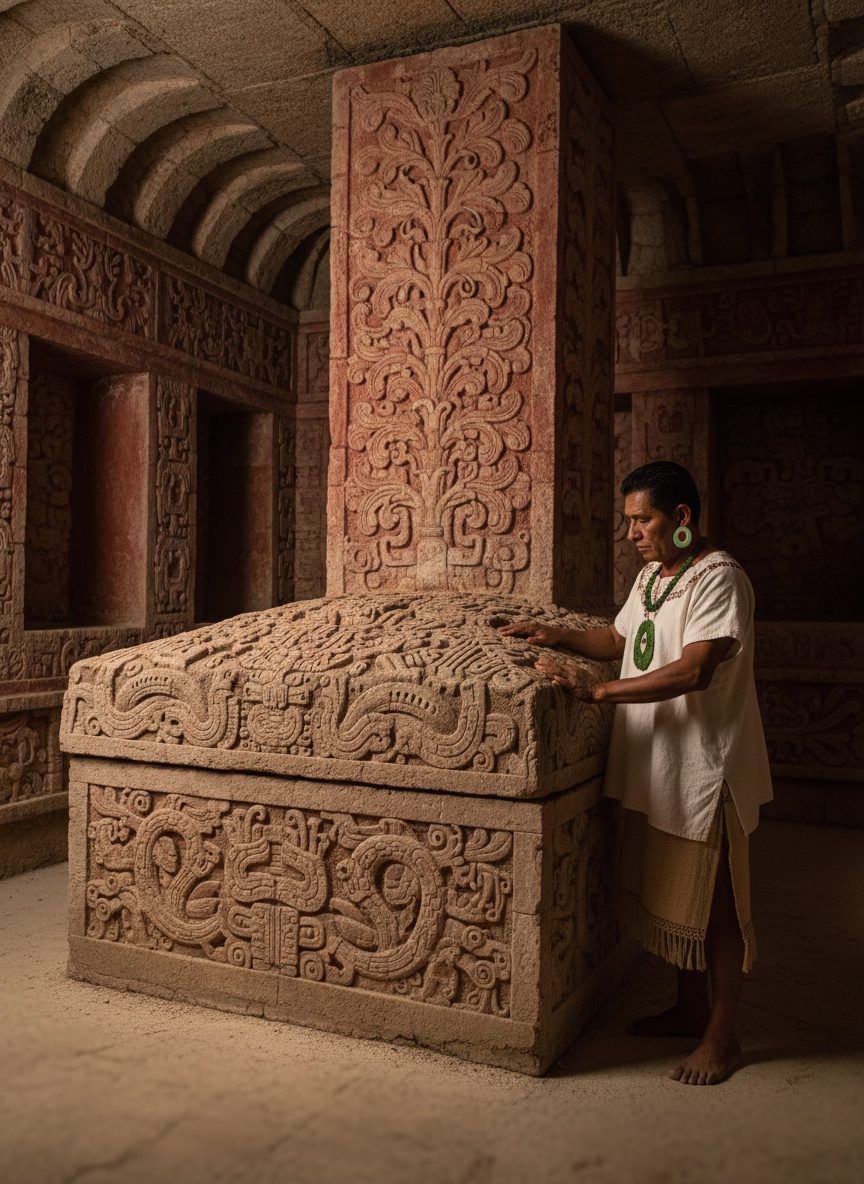
There lay Pakal, his body adorned in jade—the stone that symbolized life, power, and the eternal. But it was the sarcophagus lid that captured the world's imagination. A masterwork of Mayan artistry, it depicted not just the visage of a king but a narrative painted in stone that would stir debate among scholars for generations. Was it a depiction of Pakal's journey into the afterlife, or something more celestial? Images of what appeared to be a tree of life, unfurling with cosmic significance, dominated. Pakal seemed poised between the earthly and the divine, perhaps ascending into the heavens, or was it descending into the underworld?
The art of the Maya was never just decoration; it was a language, meticulously encoded. Pakal's sarcophagus lid was a sentence—a beautifully constructed, complex statement. For the ancient Maya, time was cyclical, a wheel with every revolution marked by myth and history entwined. Thus, to etch Pakal's vision into stone was to ensure it endured as long as the cycles of time itself stretched forward.
Debate surged about the images that crowned the sarcophagus. The motifs and figures—Kukulcán, the Feathered Serpent, entwined within great celestial trees—could be read in many ways, none of them simple. Some saw interstellar journeys, likening the imagery to Pakal seated in a spaceship, reading it as a narrative of an ancient astronaut—a theory both eerie and fascinating to those drawn to the mysteries of the past. To others, it was undoubtedly a spiritual voyage, richly adorned with mythic symbolism that spoke of rebirth and the soul's passage through realms that no earthbound map could chart.
The clues, indeed, were staggering; the imagery—complex and vibrant—was unlike anything the world was prepared to interpret fully at the time. Yet, those eternal questions of existence, the nature of the soul and the cosmos, remained as pressing then as now. The discovery rewrote what was understood about the Maya, revealing them not merely as forgotten people but as profound philosophers, astronomers, and artisans, whose sights were set as firmly on the heavens as the earth.
And then, there was Pakal's face, a mask of jade hidden beneath the pierce of time. With eyes forever open, he seemed to gaze beyond, perhaps seeing past the veils of mortality. To discover him in this form was to uncover a heartbeat from the past, echoing yet palpable, providing a glimpse into the life of an epoch and a civilization that dared to dream loquaciously in stone.
As we continue to sift through the relics of the past, deciphers of the ancient Maya are faced with the profound reality that the stories written in glyph and relief taught much more than mundane histories. They were keystones to a broader, almost universal spectrum which bound humanity to the very stars. Pakal’s tomb, his eternal rest amidst the jungle's whispering green, serves as a potent reminder of the echoes uttered in silence. The deciphering of his secrets is an unending odyssey through the realms of an ancient mind that dared to reach beyond the mortal coil.
Indeed, as we contemplate why Pakal spoke to us dressed as a cosmic traveler, the answer unfurls like the hug of a serpent coiling the branches of time—a humbling realization that to seek understanding is what makes us perpetually human. In sealed chambers beneath stone and sky, the legacy of the Maya continues to sing its intricate song to those who dare to listen.