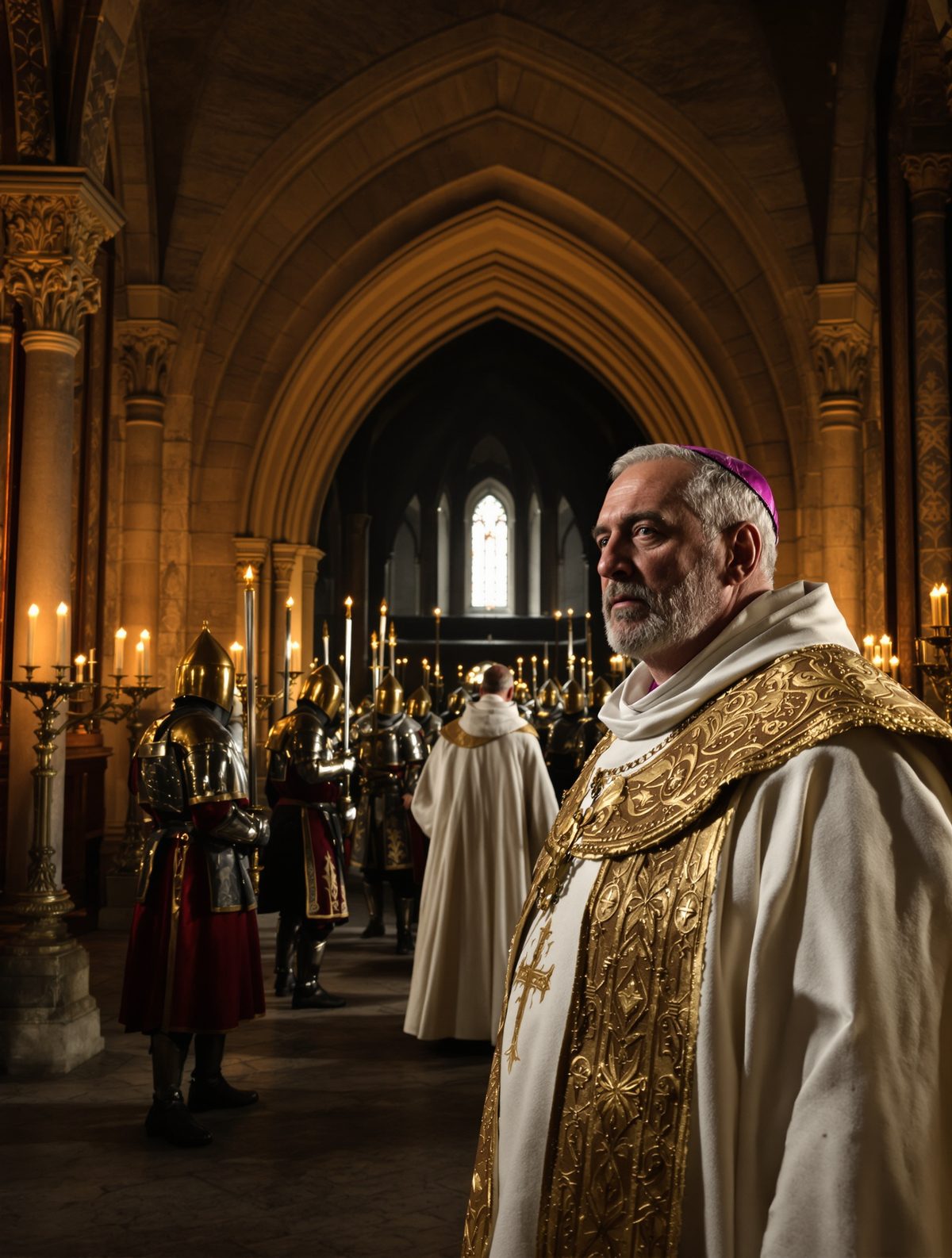
The morning mist clung to the hills near Stiklestad on July 29, 1030, as King Olaf Haraldsson gazed across the battlefield at an impossible sight. Arrayed against him stood not foreign invaders or rival Viking warlords, but his own people—14,000 Norwegian farmers, craftsmen, and warriors who had once knelt before his throne. The irony was as sharp as the axes glinting in the pale Scandinavian dawn: the Christian king who had united Norway through fire and sword would die fighting the very subjects he had sworn to protect.
What followed would become one of history's most tragic reversals of fortune, transforming a despised tyrant into Norway's patron saint and revealing the violent collision between old gods and new faith that defined medieval Europe.
The Hammer of the Heathens
Olaf Haraldsson hadn't started as a saint—he began as something far more familiar to Viking Age Scandinavia: a ruthless warrior with ambitions as vast as the North Sea. Born around 995 into Norway's royal bloodline, young Olaf cut his teeth raiding across Europe, from England to the Baltic, earning silver and reputation in equal measure. But unlike his predecessors who were content with plunder, Olaf harbored a grander vision.
In 1015, at barely twenty years old, he returned to Norway with a burning mission: to forge the fractured petty kingdoms into a unified Christian realm. The pagan chieftains who had carved up Norway like a feast table would bow to one king—and one God. What followed was a decade-long campaign of conquest that combined military genius with religious fervor.
Olaf's methods were as effective as they were brutal. He didn't simply defeat rival kings; he systematically dismantled the entire pagan power structure. Sacred groves were burned, temple idols smashed with iron hammers, and ancient ritual sites converted into Christian churches. Those who resisted faced a choice that wasn't really a choice at all: baptism or death.
The stories of his conversion tactics became legendary—and terrifying. When the powerful chieftain Raud the Strong refused to abandon the old gods, Olaf reportedly forced a snake down his throat using a horn. Another account tells of him binding pagan priests to wild horses and dragging them across rocky ground. These weren't the gentle persuasions of missionary work; this was Christianity imposed at sword-point.
The Iron Fist of Faith
By 1020, Olaf had achieved what many thought impossible: Norway was unified under his crown and officially Christian. Churches rose where temples once stood, and the cross replaced Thor's hammer on royal banners. But unification came at a price that would eventually prove fatal to his reign.
Olaf's vision of a Christian kingdom required more than just changing gods—it demanded a complete social revolution. The king imposed new laws that struck at the heart of traditional Norwegian life. The ancient practice of þing assemblies, where free farmers had voiced their concerns for centuries, was curtailed in favor of royal decree. Traditional Norse law codes were replaced with Christian statutes that seemed foreign and oppressive to people whose ancestors had lived by different rules for a thousand years.
Even more damaging was Olaf's taxation system, which drained silver from communities already struggling with poor harvests. The king needed constant revenue to maintain his royal bodyguard, build churches, and support a growing Christian bureaucracy. To the common farmer watching his grain stores diminish while royal tax collectors demanded ever more tribute, Christianity began to look less like salvation and more like exploitation.
The breaking point came with Olaf's alliance with his brother-in-law, Yaroslav the Wise of Kiev. This foreign entanglement drew Norway into distant conflicts that meant nothing to Norwegian farmers but everything to royal politics. When Olaf began recruiting Norwegian warriors for campaigns in distant Rus territories, many began to question whether their king served Norway or his own ambitions.
When Kings Become Strangers
By 1028, whispers of rebellion had grown into an open conspiracy that reached the highest levels of Norwegian society. The catalyst came from an unexpected source: Cnut the Great, the Danish king who already ruled England and Denmark, set his sights on completing his North Sea empire by adding Norway to his crown.
But Cnut was too clever to simply invade. Instead, he offered disaffected Norwegian nobles something irresistible: a chance to overthrow Olaf without appearing to betray their homeland. Cnut promised to respect Norwegian customs, reduce taxation, and allow traditional assemblies to resume their ancient functions. To a population groaning under Olaf's rigid Christian rule, it sounded like liberation.
The rebellion erupted with shocking speed and scope. It wasn't just the noble families who turned against Olaf—entire communities rose in revolt. Farmers who had been forced to abandon ancestral burial practices, merchants crushed by royal taxes, and warriors tired of foreign wars all found common cause. Most devastating of all, many of Norway's newly converted Christians joined the rebellion, proving that religious conversion hadn't necessarily meant political loyalty.
Faced with an impossible situation, Olaf made the hardest decision of his life. In 1028, rather than fight a civil war against his own people, he chose exile. Taking his most loyal followers, he fled across the mountains to Sweden, then on to the court of his brother-in-law in Kiev. For two years, the king who had conquered Norway lived as a royal guest in foreign halls, plotting his return while his kingdom prospered under Danish rule.
The Return of the Rightful King
Exile taught Olaf bitter lessons about power and loyalty, but it didn't cure his fundamental belief that he was Norway's rightful ruler. When news reached Kiev in early 1030 that Cnut had died and his empire was fracturing, Olaf saw divine providence opening a path home. Gathering just 3,600 loyal followers—a mixture of Norwegian exiles, Swedish volunteers, and Rus warriors—he began the long journey back to reclaim his throne.
The expedition that set out from Kiev in spring 1030 was pitifully small compared to the forces Olaf had once commanded. But the king believed that Norwegian hearts would remember their true loyalty once they saw their rightful monarch again. He was catastrophically wrong.
As Olaf's small army crossed from Sweden into Norway, they found not celebration but preparation for war. The very communities that had once submitted to his rule now organized militias against him. Local assemblies that had been suppressed during his reign now coordinated resistance with an efficiency that would have impressed the king under different circumstances.
The Norwegian rebels had learned from Olaf's own tactics. They used the kingdom's unified Christian infrastructure—the very churches and administrative systems he had built—to organize opposition against him. Priests who had been appointed during his reign now preached against the returning king, calling him a tyrant who threatened the peace that Danish rule had brought.
The Battle That Made a Saint
On July 29, 1030, the two armies met at Stiklestad, a farming settlement in central Norway that would become one of the most famous battlefields in Scandinavian history. The numbers told the story of Olaf's fall from grace: his 3,600 followers faced approximately 14,000 Norwegian rebels—a ratio that made victory virtually impossible.
But Olaf had not returned to Norway to retreat again. As dawn broke over the battlefield, witnesses reported a solar eclipse that cast an eerie twilight over the morning. Both sides interpreted the celestial omen as divine judgment, though they disagreed on which side God favored.
The battle was brutal even by Viking standards. Olaf's professional warriors initially carved through the rebel lines with the skill that had once conquered kingdoms. But sheer numbers eventually told. The king himself fought in the front ranks, his golden banner visible above the carnage as he struck down man after man with his battle-axe.
According to the Heimskringla saga, three Norwegian rebels finally cornered the king: Torstein Knarresmed struck him in the knee, Tore Hund thrust a spear through his stomach, and Kalf Arnesson delivered the killing blow. Olaf Haraldsson, who had conquered Norway in the name of Christ, died fighting his own Christian subjects on Norwegian soil.
The Martyr King's Impossible Victory
Death, however, proved to be Olaf's greatest political victory. Within months of Stiklestad, reports began circulating that the fallen king's body showed signs of sanctity—his hair and nails continued to grow in the grave, and his corpse remained uncorrupted. More importantly, miraculous healings were attributed to his intercession.
The transformation from tyrant to saint reflected a dramatic shift in Norwegian sentiment. Cnut's death had left Norway under the rule of his son Sweyn, whose Danish administrators proved far more oppressive than Olaf had ever been. Suddenly, the harsh Christian king began to look like a golden age compared to foreign occupation. By 1035, Olaf's own son Magnus had returned from exile to claim the throne as "Magnus the Good," riding a wave of nostalgia for his martyred father.
The Catholic Church, recognizing both popular sentiment and political opportunity, declared Olaf a saint in 1164. Saint Olaf became not just Norway's patron but a symbol of Christian kingship throughout Northern Europe. His feast day, July 29th, commemorates not his conquests but his martyrdom—the ultimate sacrifice of a king who died for his beliefs.
The irony is perfect and terrible: Olaf achieved in death what had eluded him in life—the complete loyalty of his people. The Norwegians who had driven him into exile now claimed him as their eternal king, and the Christian faith he had imposed by force became genuinely Norwegian only after his blood watered the soil at Stiklestad.
Olaf's story reminds us that the gap between ruler and ruled, between vision and reality, can prove fatal even to kings. In our own age of political polarization, his tale offers a sobering lesson: power without legitimacy is ultimately powerless, and the most dangerous enemies are often those who should be your greatest allies. Sometimes, the price of being proven right is never living to see it.